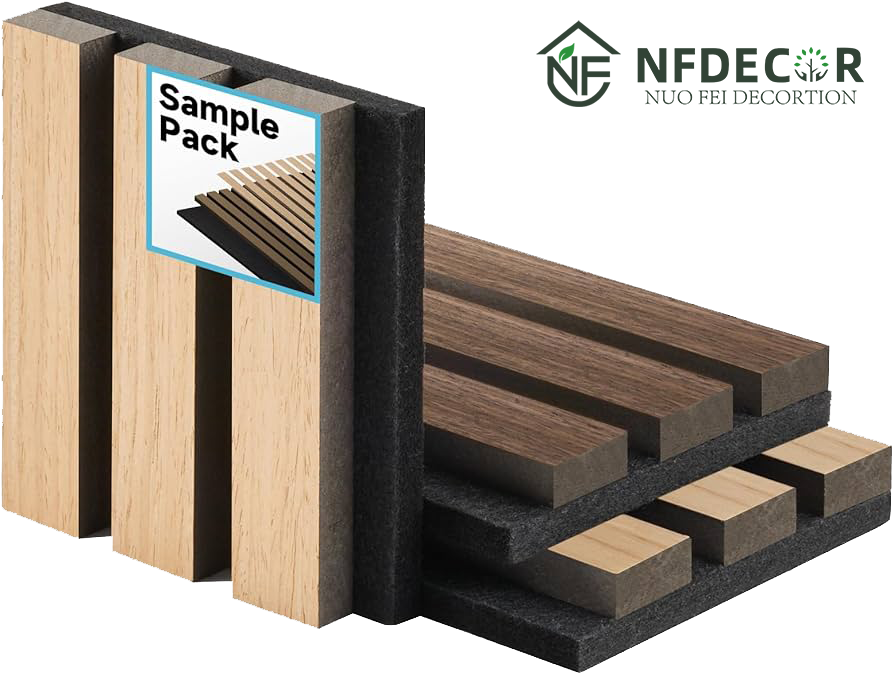
NRC vs STC confusion appears often in the inquiries I receive from architects and interior designers. A project needs better speech privacy, so the specification asks for a high-NRC decorative panel. That mismatch can leave the room looking finished while the original noise problem remains. I start instead by identifying where the unwanted sound travels.
NRC applies when a project needs to reduce reflections, reverberation, and noise buildup within a room. STC applies when a project needs to limit airborne sound transmission between spaces. I do not treat them as competing scores: NRC describes sound absorption, while STC generally rates the performance of a complete tested partition assembly.1
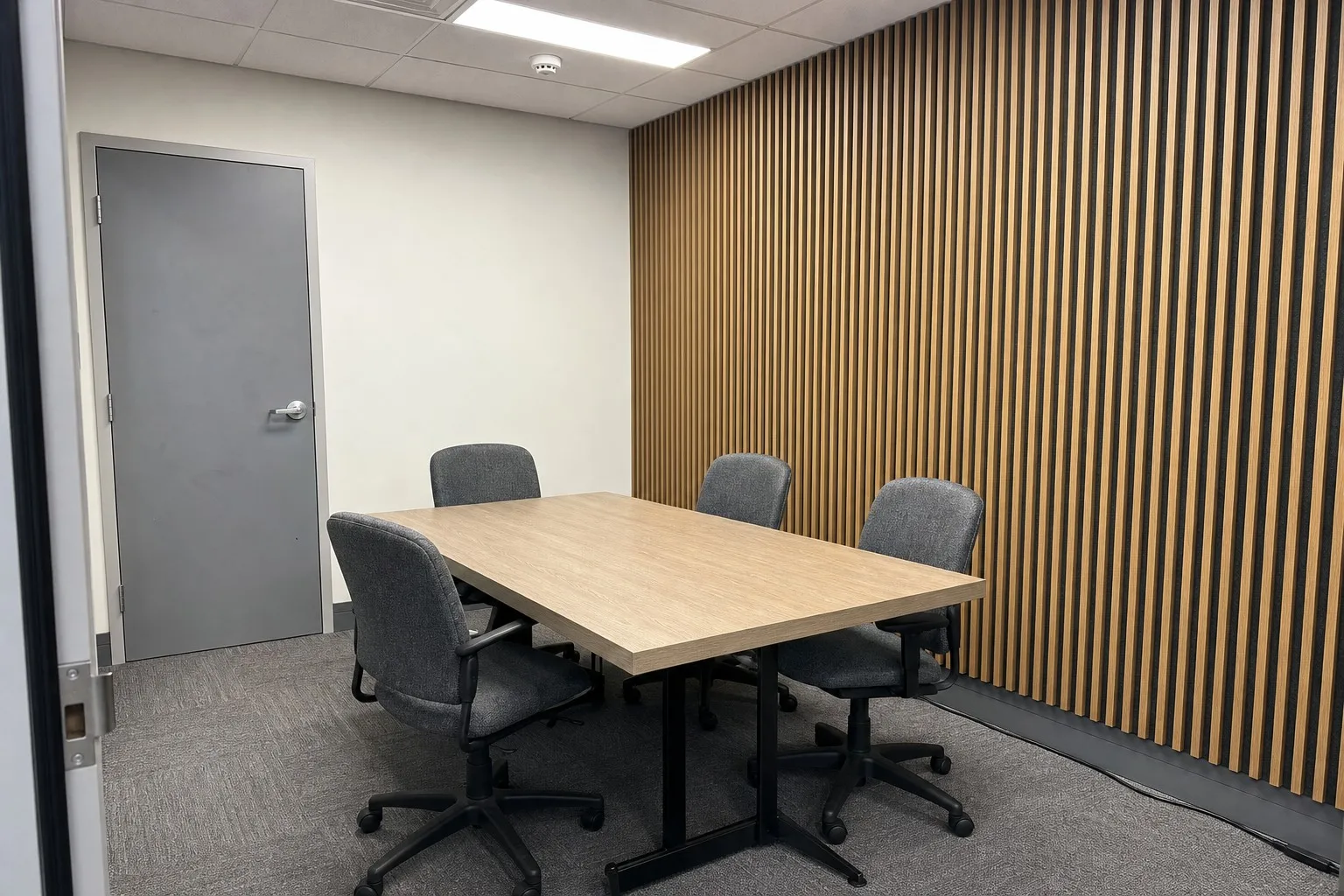
I have learned that the fastest route to a useful specification is not asking which number is higher. I ask three practical questions: Where is the sound generated, where is it heard, and does it remain inside one room or pass between spaces? The answers determine the evidence that buyers should request.
How Should I Decide Between NRC vs STC?
I often see project teams begin with a rating before defining the sound-control task. That approach creates procurement risk because suppliers may answer the number requested rather than the problem intended. I reverse the sequence and establish whether the concern involves internal reflections or transmission through a boundary.
I use NRC for sound absorption inside a room and STC-related assembly evidence for airborne sound isolation between rooms. If speech sounds harsh within a meeting room, I investigate absorption. If speech remains intelligible in the next office, I investigate the complete partition, including doors, glazing, junctions, penetrations, and installation quality.2
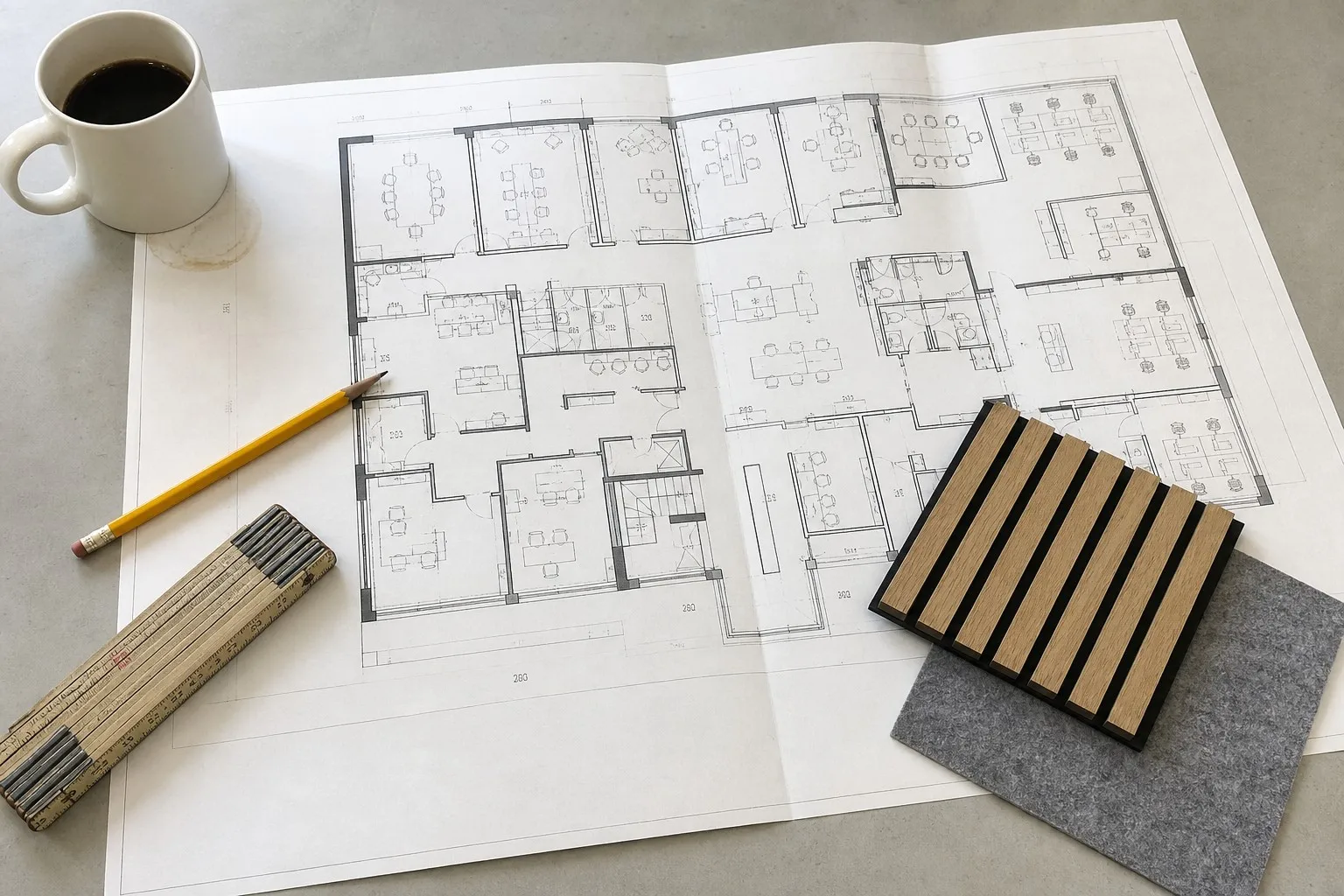
I Start With the Location of the Sound Problem
I ask the project team to describe the sound path in plain language before sending a technical specification. Three questions usually reveal the correct direction:
- Where is the unwanted sound generated?
- Where is the unwanted sound heard?
- Does the source and listener occupy the same enclosed space?
If the source and listener are in the same room, reflected sound may be contributing to poor intelligibility, excessive reverberation, or an uncomfortable noise buildup. A sound-absorbing wall or ceiling finish may then form part of the treatment. I would examine NRC data, test conditions, product coverage, room volume, and the distribution of absorptive surfaces.
If the sound is generated in one room and heard in another, the project has a transmission problem. I would shift the discussion toward the entire separating construction. That review can include wall boards, studs, insulation, resilient channels, doors, glazing, ceilings, raised floors, ductwork, outlets, perimeter seals, and junction details.
I Use a Simple Procurement Matrix
| Project complaint | Likely control task | Evidence I would request | Common specification risk |
|---|---|---|---|
| Meeting room sounds echoey | Reduce in-room reflections | NRC test report or relevant absorption data | Selecting too little absorptive area |
| Restaurant becomes excessively loud | Control reverberant buildup | Absorption data, coverage plan, room-acoustic review | Choosing finishes only by appearance |
| Speech passes into the next office | Limit airborne transmission | Tested wall or partition STC information | Expecting decorative panels to isolate sound |
| Noise leaks around a meeting-room door | Control flanking or leakage paths | Door assembly rating, seals, installation details | Upgrading the wall while ignoring the door |
| Open office lacks speech comfort | Manage reflections and spatial acoustics | Absorption data plus layout assessment | Treating NRC as a speech-privacy guarantee |
| Hotel guest hears the adjacent room | Investigate complete separation | Assembly test evidence and site review | Assuming a high-NRC finish increases wall STC |
This matrix is a starting point rather than an acoustical design. I can clarify which product documents apply, but I recommend that a qualified acoustical consultant evaluate sensitive spaces such as studios, cinemas, hotels, healthcare facilities, schools, and confidential meeting rooms.
My practical rule: If the sound stays in the room, I investigate absorption. If it crosses a boundary, I investigate isolation and every path around that boundary.
What Does NRC vs STC Mean in a Specification or Tender?
A specification can use the correct acronym and still request the wrong evidence. I have seen tender language ask a decorative acoustic panel manufacturer for the “STC of the panel” without defining a wall assembly. That request sounds precise, but it may not produce a meaningful or comparable submittal.
I treat NRC as product-level absorption evidence for a tested specimen or system, while I treat STC as a single-number rating derived from laboratory transmission-loss testing of a complete assembly. I verify the test standard, specimen construction, mounting method, frequency data, laboratory identity, and whether the tested configuration matches the proposed installation.

I Check What the Laboratory Actually Tested
In North American procurement, an NRC value is commonly calculated from sound absorption measurements made under ASTM C423. The report should identify the test specimen and mounting method. I do not accept a number copied from a brochure without checking whether it applies to the offered thickness, backing, air gap, substrate, or installation arrangement.
Projects using other standards may request reverberation-room absorption testing under ISO 354 and report another descriptor, such as the weighted sound absorption coefficient under ISO 11654. I do not assume that every international absorption descriptor is interchangeable with NRC. The project specification should name the required standard and reporting format.
For airborne sound isolation, North American laboratory testing commonly measures transmission loss under ASTM E90, with STC classification determined under ASTM E413. International projects may reference ISO 10140 test methods and ISO 717-1 ratings. I advise buyers to verify the required jurisdiction, test method, rating system, and specimen details instead of comparing numbers drawn from different frameworks.
I Separate Product Submittals From Partition Submittals
| Review item | NRC-focused submittal | STC-focused submittal |
|---|---|---|
| Main question | How much incident sound does the tested absorber take in? | How well does the tested partition resist airborne sound transmission? |
| Typical scope | Acoustic material or installed product specimen | Complete wall, floor, ceiling, door, or glazing assembly |
| Important details | Thickness, density, backing, mounting, air cavity, coverage | Layers, framing, cavity insulation, seals, junctions, penetrations |
| Typical North American references | ASTM C423 | ASTM E90 and ASTM E413 |
| Procurement owner | Finish or acoustic-treatment package | Partition, envelope, door, glazing, or specialist package |
| Main misuse | Treating NRC as a room-performance guarantee | Asking one decorative finish to establish wall STC |
I also look for the full report rather than only a certificate-style summary. A useful report should make the tested construction traceable. The buyer should confirm at least:
- Product name and model
- Panel thickness and dimensions
- Surface and backing construction
- Mounting method
- Air gap or cavity depth
- Specimen area
- Test standard and report date
- Laboratory name and accreditation scope
- Frequency-by-frequency results where relevant
- Limitations or deviations recorded in the report
I apply the same verification mindset to ISO, FSC, fire-performance, and other supplier documents. NF Decor can provide applicable documents for review, but I encourage buyers to confirm scope, validity, product coverage, and project acceptance with their consultant or approving authority.
Why Does a High NRC Not Prove a High STC?
I sometimes receive requests that assume an acoustic panel with strong absorption must also block sound. The assumption is understandable because both claims use the word “acoustic.” However, the products interact with sound in different ways, and confusing those functions can create a serious performance gap after installation.
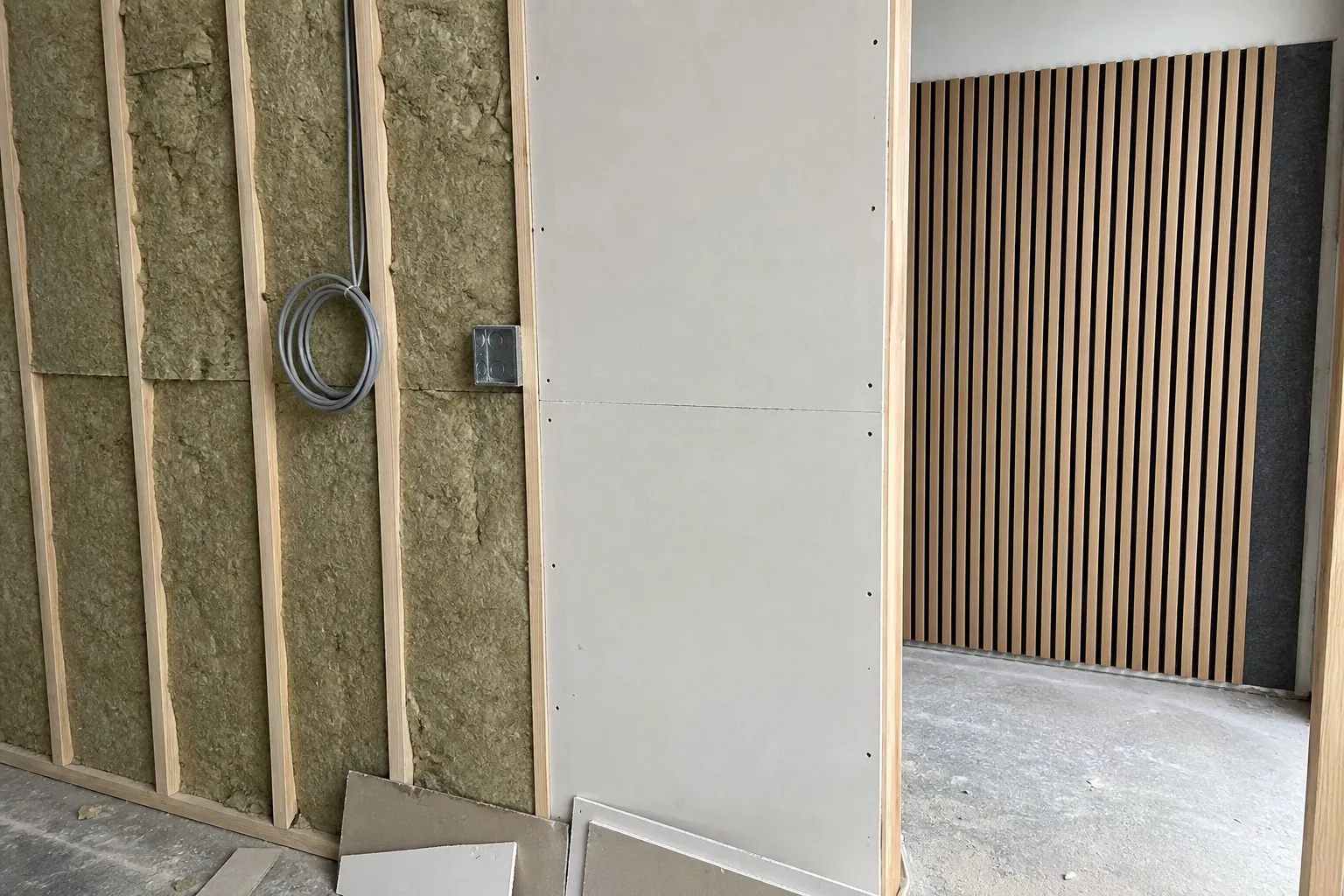
A high NRC indicates that a tested absorptive specimen reduces reflected sound under defined conditions. It does not prove that the product stops sound from passing through a wall.3 STC concerns airborne transmission through a complete separation, so mass, decoupling, airtightness, cavities, structural connections, doors, glazing, and flanking paths all matter.
I Explain Absorption and Isolation as Different Jobs
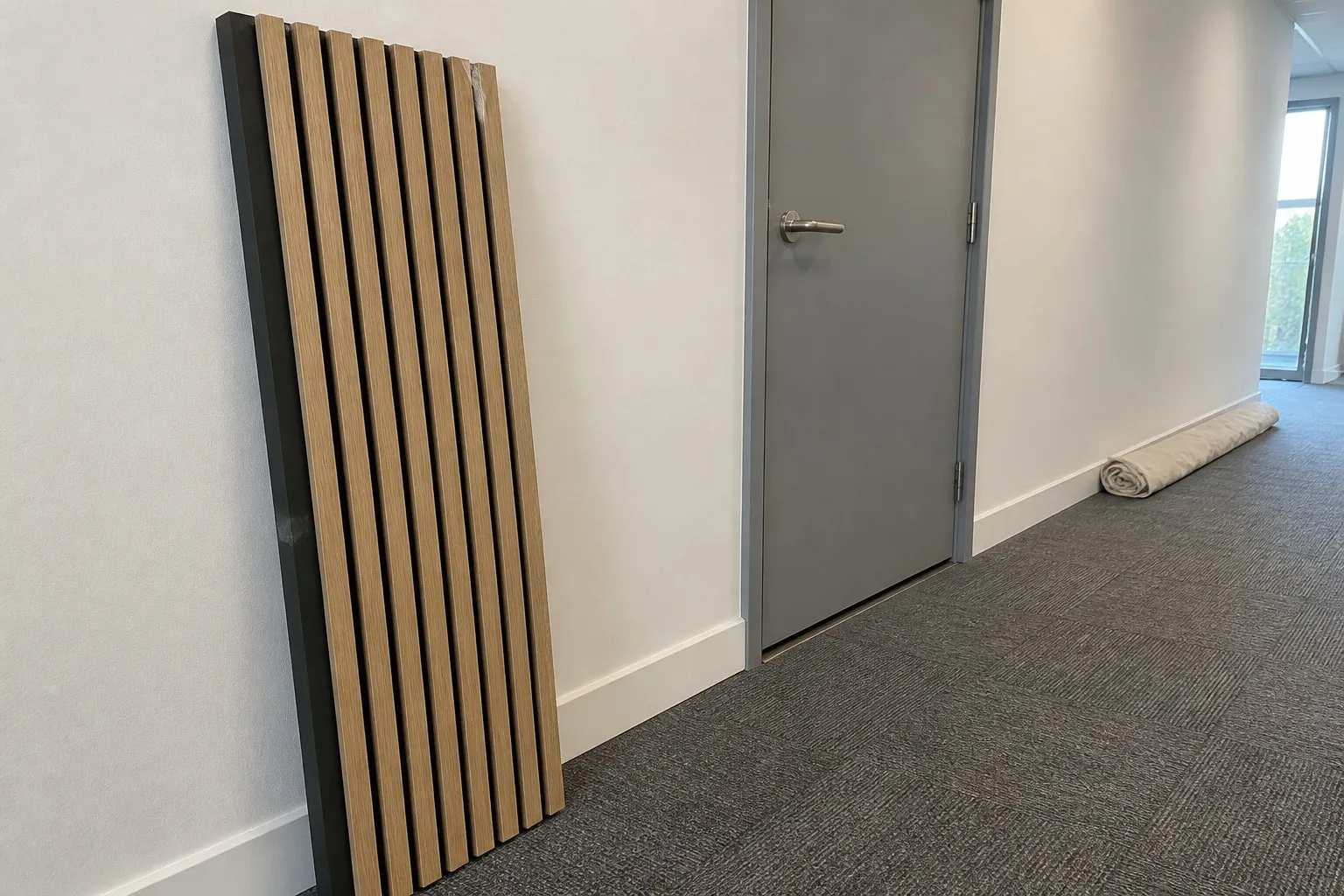
A wood slat acoustic panel typically combines decorative lamella strips with an absorptive felt backing. Depending on the tested configuration, it can help control reflections in offices, hospitality interiors, retail areas, or residential amenity spaces. Its architectural purpose is usually to add sound absorption and a finished visual surface.
A separating wall has a different job. It must resist the movement of airborne sound from one space to another. Designers may improve that performance through combinations of mass, cavity depth, insulation, resilient separation, multiple board layers, staggered or independent framing, and careful sealing.
I use the following distinction when speaking with project teams:
- Absorption reduces sound energy reflected back into the same space.4
- Isolation reduces sound energy transmitted into another space.
- Diffusion redistributes reflected sound but does not necessarily absorb or isolate it.5
- Masking adds controlled background sound and does not physically block transmission.6
These strategies may appear in the same project, but I do not substitute one for another.
I Watch for Hidden Transmission Paths
Even a tested partition can underperform in the field when adjoining components create weaker paths.7 I ask buyers to examine:
- Unsealed wall perimeters
- Back-to-back electrical outlets
- Recessed equipment
- Doors without suitable perimeter and drop seals
- Lightweight or poorly sealed glazing systems
- Shared ceiling plenums
- Continuous raised floors
- HVAC ducts and transfer grilles
- Junctions between walls, floors, and façades
- On-site penetrations added after inspection
A decorative treatment installed on one face may improve conditions inside that room, but I would not promise that it will resolve neighbor noise or confidential speech leakage. A person may perceive the treated room as less reverberant while sound transmission through the boundary remains insufficient.
I remember an inquiry in which the design team asked for a higher acoustic-panel “soundproofing score” because voices were audible beyond a meeting-room wall. I did not recommend a finish upgrade as the first response. I asked about the partition construction, door seals, ceiling plenum, and glazing. That conversation reframed the purchase from a panel comparison into a review of the transmission path.
Can One Decorative Panel Have a Meaningful STC Rating?
Buyers sometimes need a simple value for a tender schedule, while the product category does not support such a simple answer. If I provide an isolated number without the tested assembly, the project team may apply it to a wall that differs completely from the laboratory specimen.
I treat an STC claim for one decorative acoustic panel cautiously. STC normally belongs to the complete tested assembly, not to a finish in isolation.8 A panel supplier should identify any relevant assembly test precisely and should not imply that the same result applies to different walls, substrates, junctions, or installation conditions.
I Give a Scope-Accurate Tender Response
When a tender asks for the STC of a wood slat or PET acoustic panel, I would use wording similar to this:
This decorative acoustic panel is intended to provide sound absorption within the room. We can submit the applicable NRC or sound-absorption test report for the tested product configuration. The STC requirement should be assigned to the complete separating wall or partition assembly. Installation details should maintain the continuity and airtightness of the specified partition, subject to review by the project’s acoustical and architectural consultants.
This answer does not evade the requirement. It assigns the requirement to the package that controls it.
I would avoid writing that a panel “does not reduce the existing wall STC” unless evidence and installation details support that statement. Fasteners, service penetrations, removed wall layers, open edges, and changes to junctions can affect the overall construction. A safer procurement objective is to require the decorative-panel installation to avoid compromising the specified isolation assembly, with details reviewed and coordinated before installation.
I Split the Specification Into Two Performance Lines
A clear tender can separate the responsibilities:
| Specification line | Suggested requirement |
|---|---|
| Decorative acoustic finish | Provide absorption performance supported by a report for the proposed product configuration |
| Separating partition | Meet the project’s specified airborne sound-isolation requirement as a complete assembly |
| Interface coordination | Preserve board continuity, seals, perimeter treatment, and tested wall components |
| Substitution review | Compare product construction, mounting, thickness, backing, and test scope |
| Site quality control | Inspect penetrations, joints, doors, glazing, and above-ceiling conditions |
| Final verification | Use field testing where the consultant or contract requires it |
I recommend that architects avoid generic phrases such as “acoustic wall with high NRC and STC” unless the drawings and schedules identify separate absorption and isolation responsibilities. The word acoustic does not define the performance mechanism.
I Give Sales Teams a Short Qualification Script
I use four questions before discussing products:
- Is the problem echo inside the room or noise coming through from another space?
- What room generates the sound, and where is the listener?
- Does the specification request absorption data for a finish or isolation data for a partition?
- Can the buyer share the wall build-up, door schedule, ceiling detail, and relevant test requirement?
This script helps a manufacturer avoid overselling. It also helps the designer decide whether to request samples and absorption reports, investigate the partition package, or engage a specialist.
How Should I Procure Acoustic Panels Without Creating a Performance Gap?
A visually approved panel can still become a procurement problem if its test configuration, finish, dimensions, or mounting method differs from the specified product. I therefore treat acoustic data, finish control, production consistency, and installation coordination as connected parts of supplier evaluation.
For an absorption-focused package, I compare the offered product with the tested specimen and verify finish samples, panel construction, tolerances, batch consistency, fire documents, environmental documentation, lead time, packaging, and installation details. For an isolation problem, I keep the partition and its junctions under separate technical review.
I Review the Tested Configuration Before Price
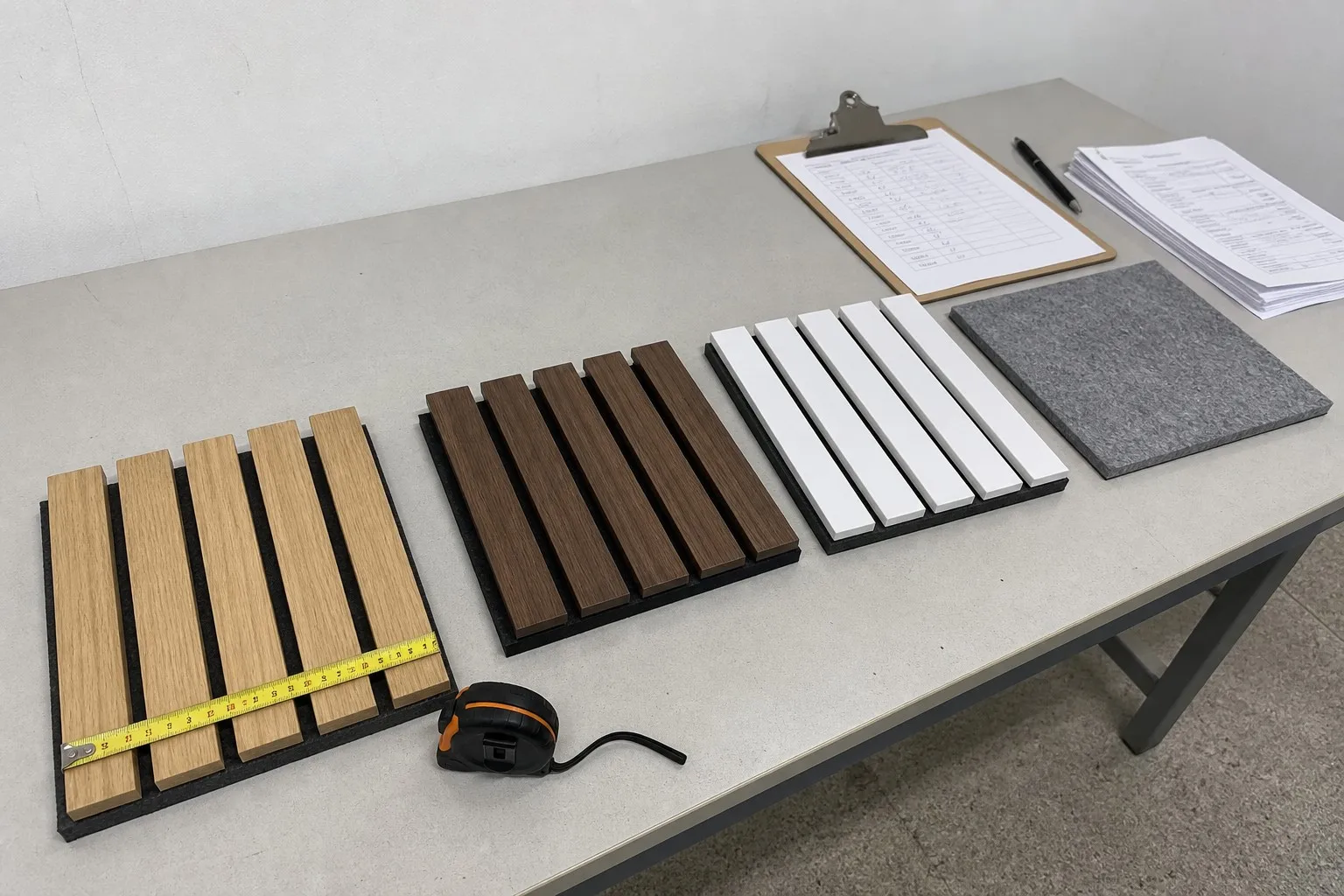
A low quotation has limited value if the proposed product does not match the basis of design. I ask suppliers to identify:
- Overall panel thickness
- Slat or lamella dimensions and spacing
- Core material
- Felt composition and thickness
- Panel width and length
- Mounting system
- Tested backing or cavity
- Permitted installation orientation
- Relevant absorption test report
- Fire-test document applicable to the offered construction
- Production and inspection controls
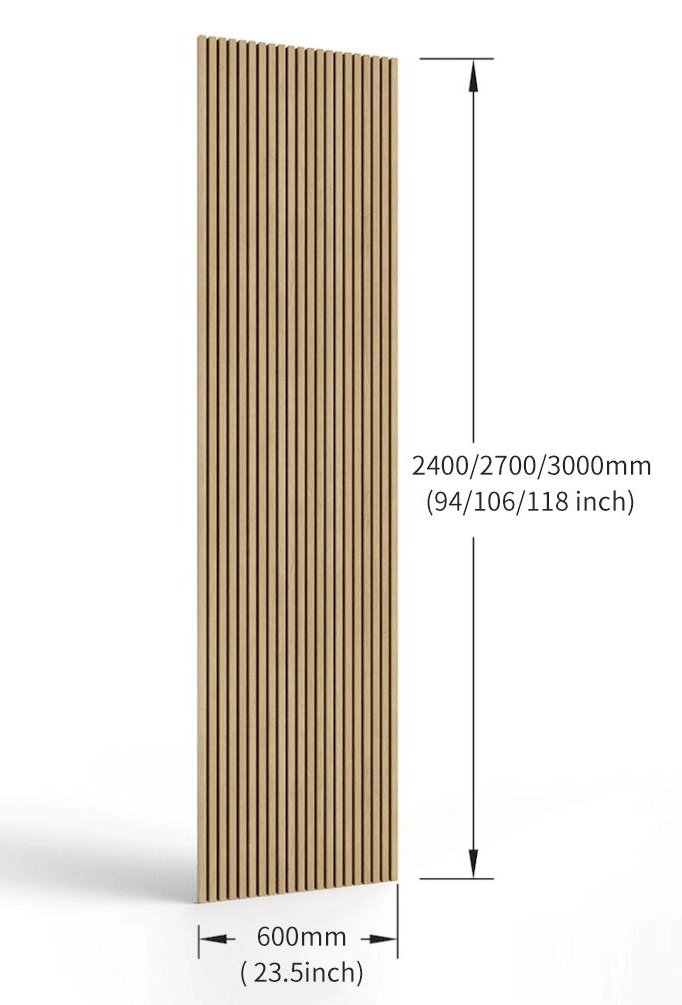
At NF Decor, our standard wood slat formats include widths and lengths such as 600 mm by 2400, 2700, or 3000 mm, with 21 mm standard and 18 mm slim options among the available configurations. However, I do not assume that one test result automatically covers every size, material change, finish, backing, or mounting condition. Buyers should match the report to the product they plan to order.
I Connect Finish Approval With Batch Control
Architects often focus first on acoustic performance, but large projects also depend on visual consistency. Natural veneer can show normal grain and color variation. Engineered or reconstituted veneer can offer greater repeatability across large batches. PVC film can provide wood-grain, solid-color, matte, gloss, or textured effects with another level of visual control.
For procurement, I recommend:
- Approving a physical control sample
- Defining acceptable natural variation
- Recording the finish code and substrate
- Confirming batch planning for phased deliveries
- Reserving material for later replenishment when practical
- Inspecting representative pre-production samples
- Checking carton labels and panel orientation requirements
NF Decor offers natural veneer, engineered veneer, PVC film, and custom color or grain development for OEM/ODM programs. I present these as manufacturing options, not as substitutes for project approval. Buyers should also verify the current scope of FSC, ISO, fire, and acoustic documents against the actual product and destination-market requirements.
I Coordinate Installation With the Existing Wall
When decorative panels are fixed over a rated partition, I ask the project team to protect the underlying construction. The installer should not casually remove board layers, leave open penetrations, or interrupt acoustic seals. The architect, partition supplier, contractor, and acoustical consultant should agree on fixing points and perimeter details.
For critical projects, field performance may differ from laboratory performance because site conditions include flanking paths and workmanship. A qualified professional can advise whether commissioning measurements or field isolation testing is appropriate. My role as a manufacturer-side communicator is to clarify product fit, submit applicable evidence, and highlight mismatches before procurement—not to certify a building’s final acoustic outcome.
Frequently Asked Questions
Is NRC better than STC?
No. I do not rank NRC vs STC as better or worse because they measure different sound-control functions. NRC concerns sound absorption and reflected energy within a room. STC concerns airborne sound transmission through a tested assembly. The project’s sound path determines which evidence is relevant.
Will high-NRC acoustic panels stop sound from entering the next room?
I would not make that promise. High-NRC panels can reduce reflections and reverberation inside the treated room, but they do not automatically stop sound passing through walls, doors, glazing, ceilings, or ventilation paths. I recommend reviewing the complete separating assembly when room-to-room noise is the concern.
Can I ask an acoustic panel supplier for an STC report?
You can ask, but I would check whether the report covers a complete assembly and whether that assembly matches the project. A stand-alone decorative panel does not normally determine wall STC. The supplier should state the tested layers, framing, substrate, seals, mounting, and other assembly conditions.
What report should I request for wood slat acoustic panels?
I usually recommend requesting the applicable sound-absorption report, including the test standard, mounting method, specimen construction, thickness, backing, and laboratory details. Buyers should compare that configuration with the proposed panel. They should also verify fire and environmental documents required by the contract.
Do I need an acoustical consultant?
I recommend specialist input when the project has strict speech-privacy, hospitality, healthcare, education, studio, cinema, mechanical-noise, or code-related requirements. A manufacturer can explain product data, but a qualified acoustical professional can evaluate room geometry, transmission paths, flanking, background noise, and complete construction details.
Conclusion
I use NRC vs STC as a decision framework rather than a score comparison. NRC-related evidence helps me evaluate absorption for reflections and reverberation inside a room. STC-related evidence helps the project team evaluate airborne transmission through a complete assembly. A decorative acoustic panel should not be presented as the sole source of a wall’s isolation performance.
If your project needs sound-absorbing wall panels, NF Decor can support B2B buyers with product options, samples, customization, and applicable test documents. Send us your specification, finish reference, target dimensions, installation concept, and required standards so our team can help identify the correct submittal package.
Related technical guides
- What Is NRC Rating? A Plain-English Guide for B2B Acoustic Panel Buyers
- What Are Acoustic Panels Made Of? A Materials Guide for Importers and Distributors
"Sound transmission class", https://en.wikipedia.org/wiki/Sound_transmission_class. Authoritative acoustics references distinguish NRC, a single-number expression of sound absorption, from STC, a single-number classification of airborne sound transmission loss for a tested construction. Evidence role: definition; source type: government. Supports: Definitions distinguishing noise reduction coefficient as an absorption measure from sound transmission class as an airborne sound-isolation classification for constructions.. ↩
"Prior listening in rooms improves speech intelligibility - PMC - NIH", https://pmc.ncbi.nlm.nih.gov/articles/PMC2921430/. Building-acoustics guidance explains that absorptive treatment primarily changes reverberation within a room, whereas inter-room speech privacy depends on the full separation and on weak paths such as doors, joints, penetrations, and connected assemblies. Evidence role: mechanism; source type: government. Supports: Guidance explaining that room absorption affects reverberation and that speech privacy between rooms depends on the separating construction and associated flanking or leakage paths.. ↩
"Recent advances in the sound insulation properties of bio-based ...", https://bioresources.cnr.ncsu.edu/resources/recent-advances-in-the-sound-insulation-properties-of-bio-based-materials/. Absorption ratings quantify the fraction of incident sound absorbed by a tested surface under specified conditions; they are not transmission-loss ratings and therefore do not establish the airborne isolation of a wall. Evidence role: mechanism; source type: research. Supports: Evidence that absorption coefficients characterize reflected-energy absorption rather than airborne transmission loss through a separating element.. ↩
"[PDF] A Review of Diffuse Reflections in Architectural Acoustics", https://digitalcommons.unl.edu/cgi/viewcontent.cgi?article=1013&context=archengfacpub. In acoustics, sound absorption refers to the dissipation of part of incident sound energy by a material or surface, reducing the energy available for reflection into the same space. Evidence role: definition; source type: encyclopedia. Supports: The acoustic definition of absorption as removal or dissipation of part of incident sound energy rather than reflection back into the space.. ↩
"Noise Control Basics Acoustical Product Directory 2015 A Practical ...", https://extnag.tacc.utexas.edu/Download_PDFS/u330AF/244302/noise_control__basics_acoustical__product-directory_2015_a__practical_guide_for__room_acoustics__sound_is.pdf. Acoustic diffusion describes the scattering and more even spatial distribution of reflected sound; it is a different mechanism from absorbing sound energy or increasing transmission loss through a separating construction. Evidence role: definition; source type: research. Supports: Definitions of acoustic diffusion as scattering or distributing reflected sound and its distinction from absorption and transmission loss.. Scope note: Some diffuser systems can also exhibit incidental absorption, but diffusion alone does not demonstrate a specified absorption or isolation performance. ↩
"Perception of Water-Based Masking Sounds—Long-Term ... - PMC", https://pmc.ncbi.nlm.nih.gov/articles/PMC5515102/. Sound-masking systems introduce controlled background sound to improve speech privacy or reduce distraction by decreasing speech audibility; this approach does not itself add mass, sealing, or decoupling to increase a partition's physical sound insulation. Evidence role: mechanism; source type: government. Supports: That sound masking raises or controls background sound to reduce speech intelligibility or distraction, rather than changing the physical transmission loss of a wall.. Scope note: Masking can improve perceived privacy in an occupied setting, but its effectiveness depends on background level, layout, speech level, and the existing separation. ↩
"[PDF] LAB-FIELD CORRELATIONS FOR AIRBOARNE SOUND ... - GovInfo", https://www.govinfo.gov/content/pkg/GOVPUB-A13-PURL-gpo175941/pdf/GOVPUB-A13-PURL-gpo175941.pdf. Laboratory sound-isolation results represent a controlled test specimen, whereas field performance can be reduced by flanking transmission through connected construction and by leakage or installation deficiencies at joints and penetrations. Evidence role: mechanism; source type: government. Supports: Evidence that flanking transmission and workmanship-related leakage can reduce field sound isolation relative to laboratory performance.. Scope note: The magnitude of any reduction depends on the particular building geometry, connected assemblies, and construction quality. ↩
"Acoustic Lab Testing (ASTM E492-2016, ASTM E90-2016) of Multi ...", https://scholarsbank.uoregon.edu/items/eddec1f1-b324-451c-b480-cdc2304ebd70. Sound Transmission Class is derived from measured transmission loss of a building element or assembly; consequently, an STC result applies to the documented tested construction rather than automatically to an individual finish added in another configuration. Evidence role: general_support; source type: education. Supports: That STC is based on transmission-loss testing of building elements or assemblies and is not inherently a stand-alone rating for a surface finish.. Scope note: A finish may be included in a tested assembly, but the resulting classification remains specific to that documented assembly and test configuration. ↩