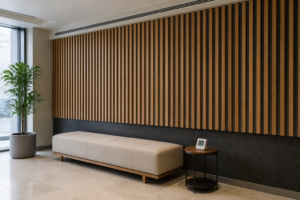
Acoustic panels vs soundproofing is one of the most misunderstood comparisons in noise control. Many people buy decorative wall panels to stop a neighbour’s voice, television, or music, only to remain disappointed. The problem is not always the panel’s quality. The problem is that sound absorption and sound isolation perform different jobs.
Acoustic panels reduce reflections, reverberation, and echo inside a room, while soundproofing reduces sound transmission between spaces.1 If neighbour noise enters through a wall, ceiling, floor, door, window, or connected structure, acoustic panels alone will typically not solve it. Effective isolation requires assessment of the complete building assembly and every possible sound path.2
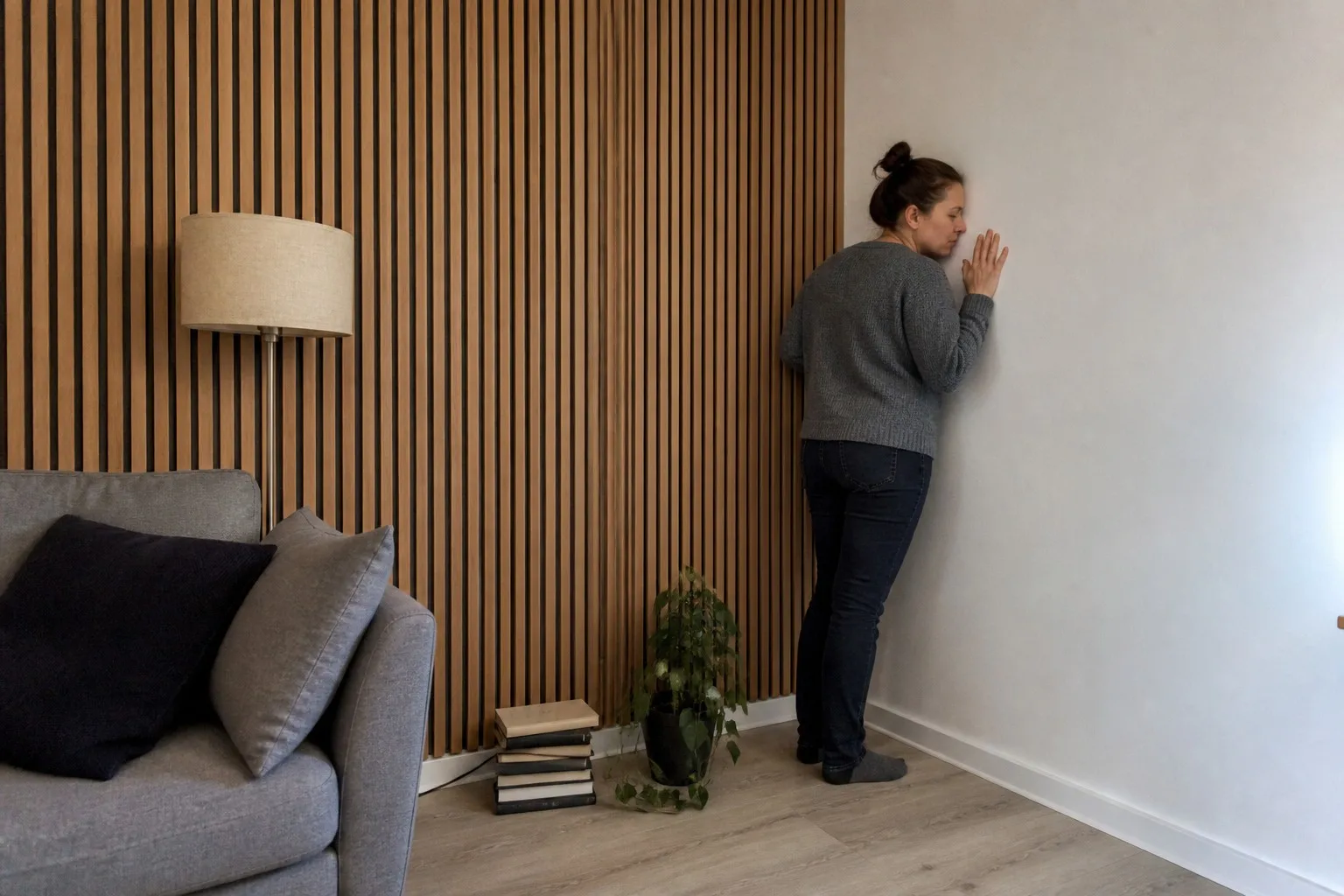
I manufacture acoustic wall panels, but I do not present them as a universal answer to neighbour noise. Our anonymized inquiry records repeatedly show that buyers confuse a quieter-sounding room with a room that blocks outside sound. I use one question to clarify the goal: Am I improving how this room sounds, or reducing sound entering it?
What Is the Difference Between Acoustic Panels vs Soundproofing?
The terminology creates an immediate purchasing risk. Sellers sometimes use “acoustic,” “noise-reducing,” and “soundproof” as if they mean the same thing. They do not. When buyers start with the wrong term, they may compare panel colors and thicknesses before identifying the actual acoustic problem.
Acoustic treatment manages sound energy within a room. Soundproofing addresses sound energy passing between rooms or entering from outside. Acoustic panels may improve speech clarity and reduce reverberation, but neighbour-noise control usually requires changes to walls, floors, ceilings, openings, or structural connections.
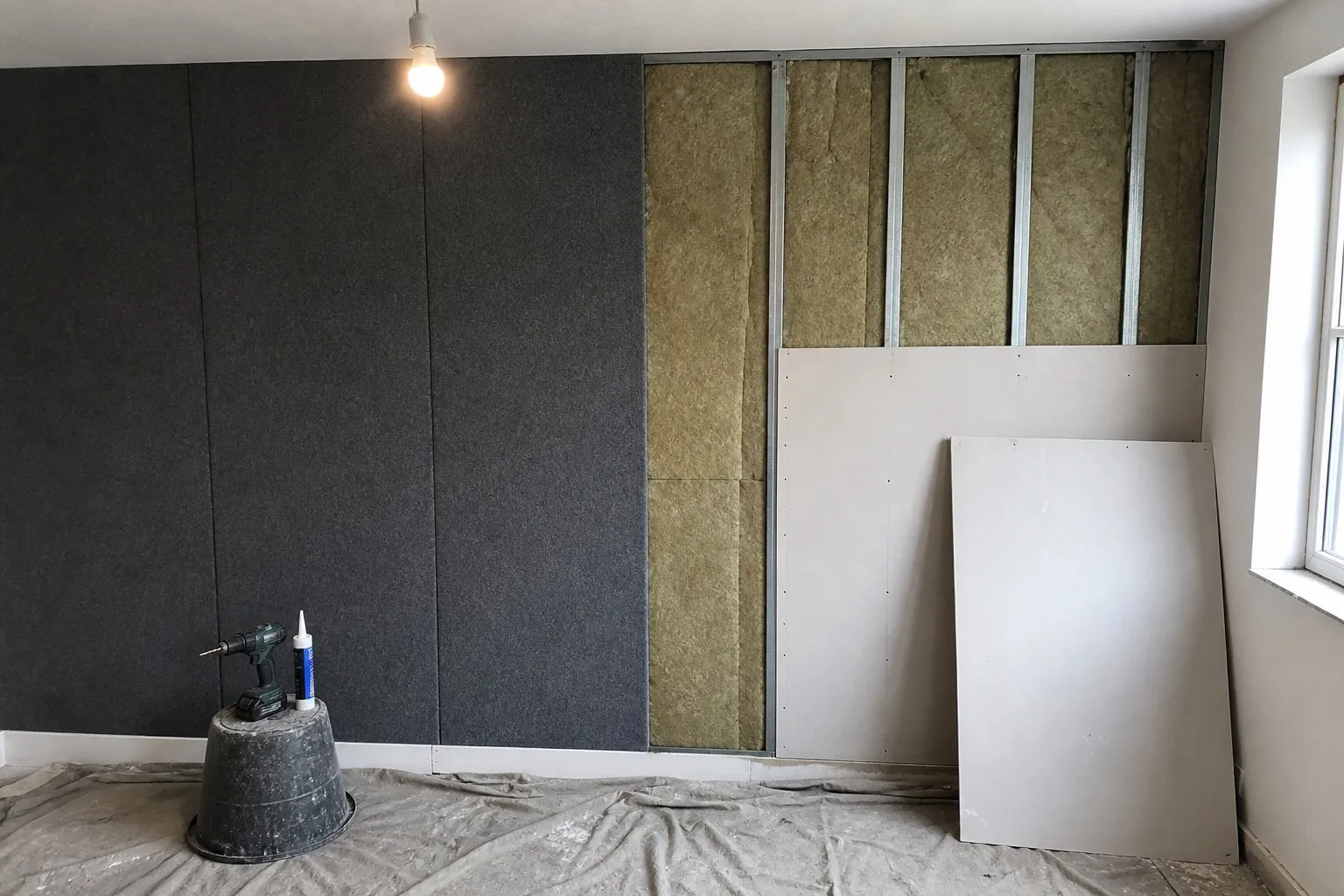
Acoustic panels manage reflections
When a voice, loudspeaker, or television produces sound, the sound travels through the room and reflects from hard surfaces. Painted plasterboard, concrete, glass, tile, and stone can create strong reflections. These repeated reflections may make the room sound loud, harsh, or unclear.
Absorptive products capture part of that reflected sound energy. Common examples include:
- PET felt acoustic panels
- Fabric-wrapped absorbers
- Mineral-fiber ceiling systems
- Perforated or slatted wood systems with absorptive backing
- Wood slat acoustic panels with PET felt behind the lamella strips
- Soft furnishings, carpets, and curtains, although their performance varies
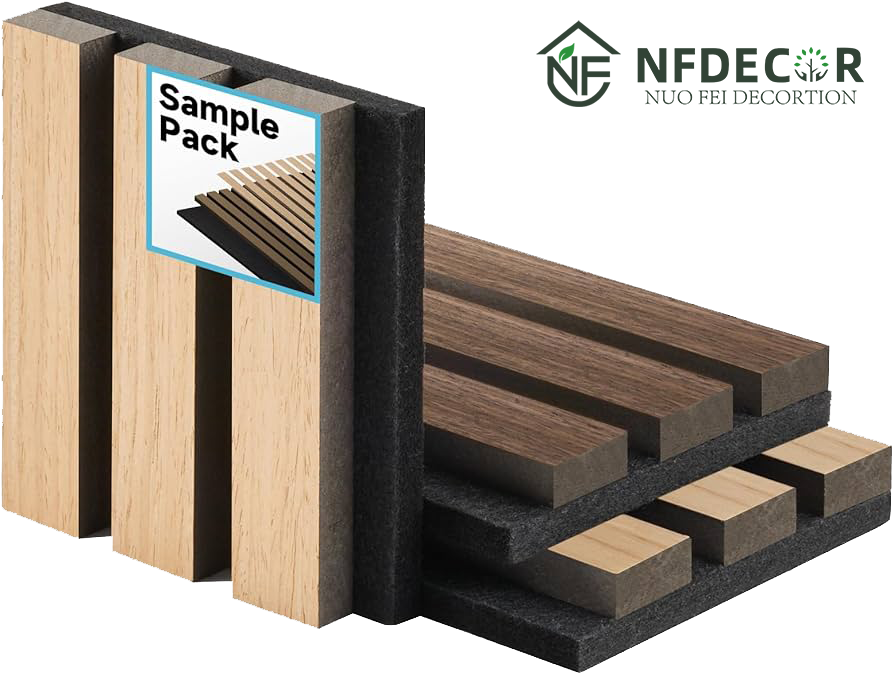
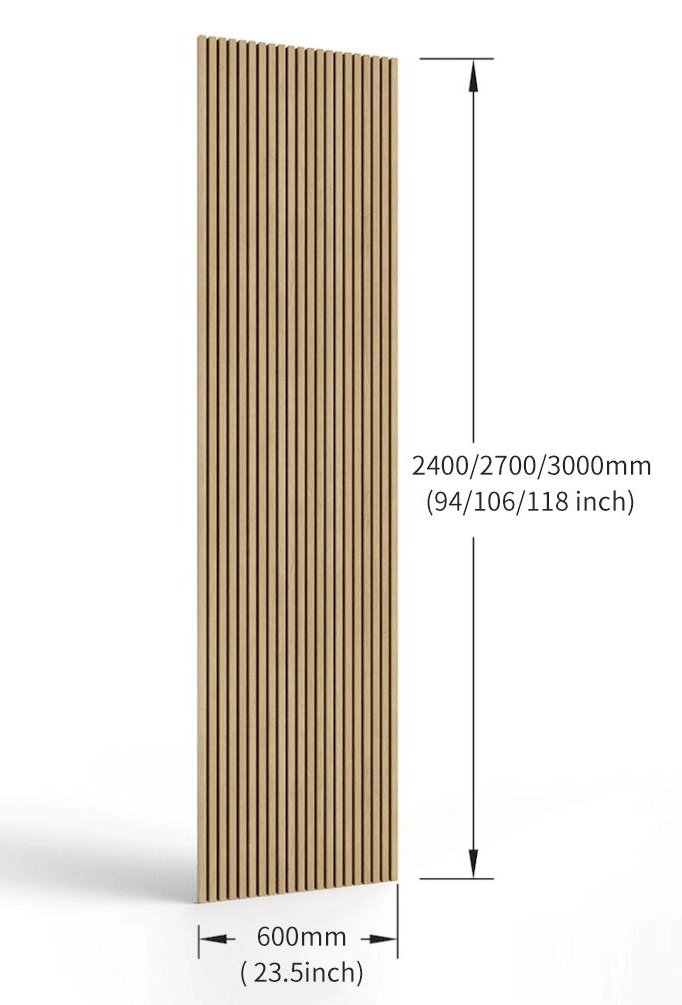
Our wood slat panels, for example, combine decorative lamella strips with an acoustic felt backing. Buyers usually select these products for offices, meeting rooms, hospitality interiors, media spaces, and other rooms where reverberation and design both matter.
Soundproofing manages transmission
Sound isolation works at the boundary between spaces. A wall, floor, ceiling, door, or window must resist the movement of sound from one side to the other. The result depends on the complete construction, not one visible finish layer.
A sound-isolating assembly may rely on several principles:
- Mass can make an assembly more resistant to airborne sound.
- Decoupling can reduce direct vibration transfer between surfaces.
- Cavity absorption can control resonance inside a wall or ceiling cavity.
- Airtightness can limit leakage through gaps and penetrations.
- Structural detailing can reduce flanking transmission around the main partition.
The distinction is simple but important:
Absorption changes the sound inside a space. Isolation changes how much sound travels between spaces.
A room can have very little echo and still receive audible neighbour noise. A partition can also provide useful isolation while the room itself remains reverberant. I therefore treat acoustic comfort and sound isolation as related but separate design tasks.
| Evaluation point | Acoustic panels | Soundproofing construction |
|---|---|---|
| Primary purpose | Reduces reflections inside a room | Reduces transmission between spaces |
| Typical target | Echo, reverberation, speech clarity | Voices, music, traffic, mechanical noise |
| Main evaluation scope | Panel and room coverage | Complete wall, floor, ceiling, and openings |
| Common metric | NRC or frequency-based absorption data | Assembly-level isolation test data |
| Typical work | Surface installation | Construction modification and sealing |
| Key limitation | Does not prove transmission loss | Performance depends on the whole assembly |
Can Acoustic Panels vs Soundproofing Solve Neighbour Noise in the Same Way?
Neighbour noise is frustrating because the source may sound close even when the transmission route is unclear. A person may hear speech beside a shared wall and assume that the wall is the only problem. However, sound can follow several direct and indirect paths through a building.
Acoustic panels and soundproofing do not solve neighbour noise in the same way. Panels may make reflected sound inside the receiving room less lively, but they generally do not provide the construction changes needed for meaningful isolation. The correct response depends on the noise type, transmission path, existing assembly, and installation constraints.
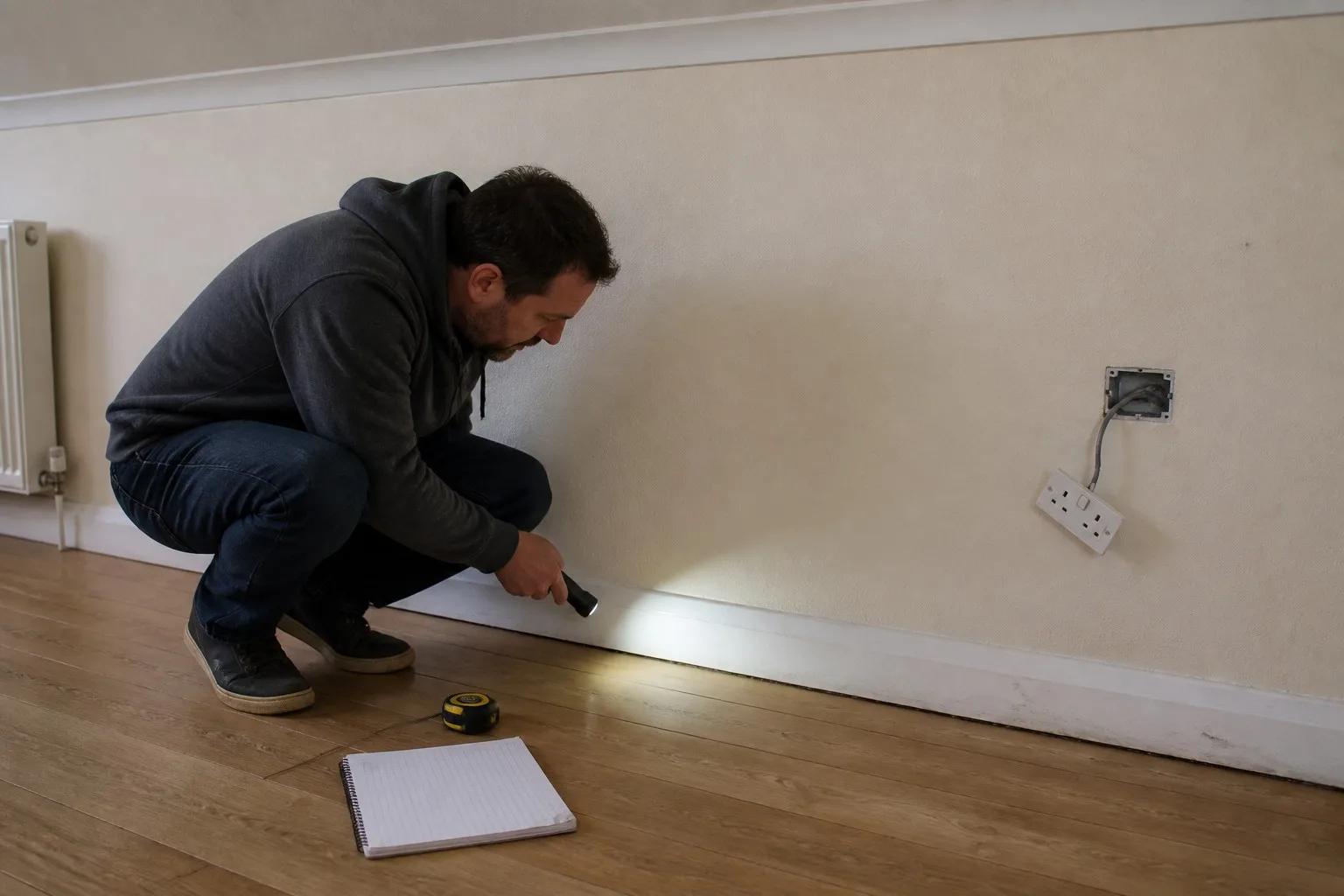
I first identify the noise type
I recommend that buyers describe what they hear before they select any material. Different noises interact with buildings differently.
Airborne noise begins in the air. Common examples include:
- Conversation and shouting
- Television audio
- Music and singing
- Dog barking
- Road traffic
- Some building services
Airborne sound may enter through lightweight partitions, gaps, doors, windows, vents, electrical outlets, or connected ceiling voids.
Impact noise begins with physical contact against a structure. Common examples include:
- Footsteps from an upper floor
- Chairs scraping across a hard floor
- Objects dropping
- Doors slamming
- Exercise equipment
- Plumbing movement fixed to the structure
Impact energy can travel through floors, joists, walls, and other structural connections. Covering the receiving wall with a decorative acoustic panel usually does not interrupt the source of that vibration.
Structure-borne noise travels as vibration through the building. Mechanical equipment, pumps, lifts, and pipework can generate this type of problem. A qualified professional may need to inspect equipment mounts and structural connections.
Sound may bypass the visible wall
I often see inquiry descriptions that say, “The sound comes through this wall.” That description is useful, but it does not confirm the route. A listener’s perception does not always locate the weak point accurately.
Possible paths include:
- The shared partition itself
- Gaps around skirting boards
- Electrical sockets or service penetrations
- Doors and door frames
- Windows and window seals
- Suspended ceiling voids
- Junctions between walls and floors
- Lightweight façade elements
- Ventilation ducts
- Connected structural framing
This bypass movement is often called flanking transmission. It explains why upgrading one surface may produce less improvement than expected. The weakest path can limit the entire system.3
Renters should be especially cautious. Temporary panels may improve room acoustics without altering the building fabric, but they should not be purchased with an assumption that they will isolate neighbour noise. Renters should document the disturbance, inspect obvious gaps, check tenancy rules, and discuss building-related defects with the landlord or property manager before making changes.
Why Does NRC Not Prove Soundproofing Performance?
NRC is frequently used in acoustic panel marketing, so buyers naturally treat a higher value as evidence of better noise blocking. That interpretation creates one of the largest specification errors in this category. A legitimate laboratory absorption result still answers an absorption question, not an isolation question.
The Noise Reduction Coefficient, or NRC, summarizes how much sound a material absorbs under defined test conditions across selected mid-range frequencies.4 NRC does not measure how much neighbour noise passes through a wall.5 A high NRC therefore should not be presented as proof that a decorative panel will soundproof a room.
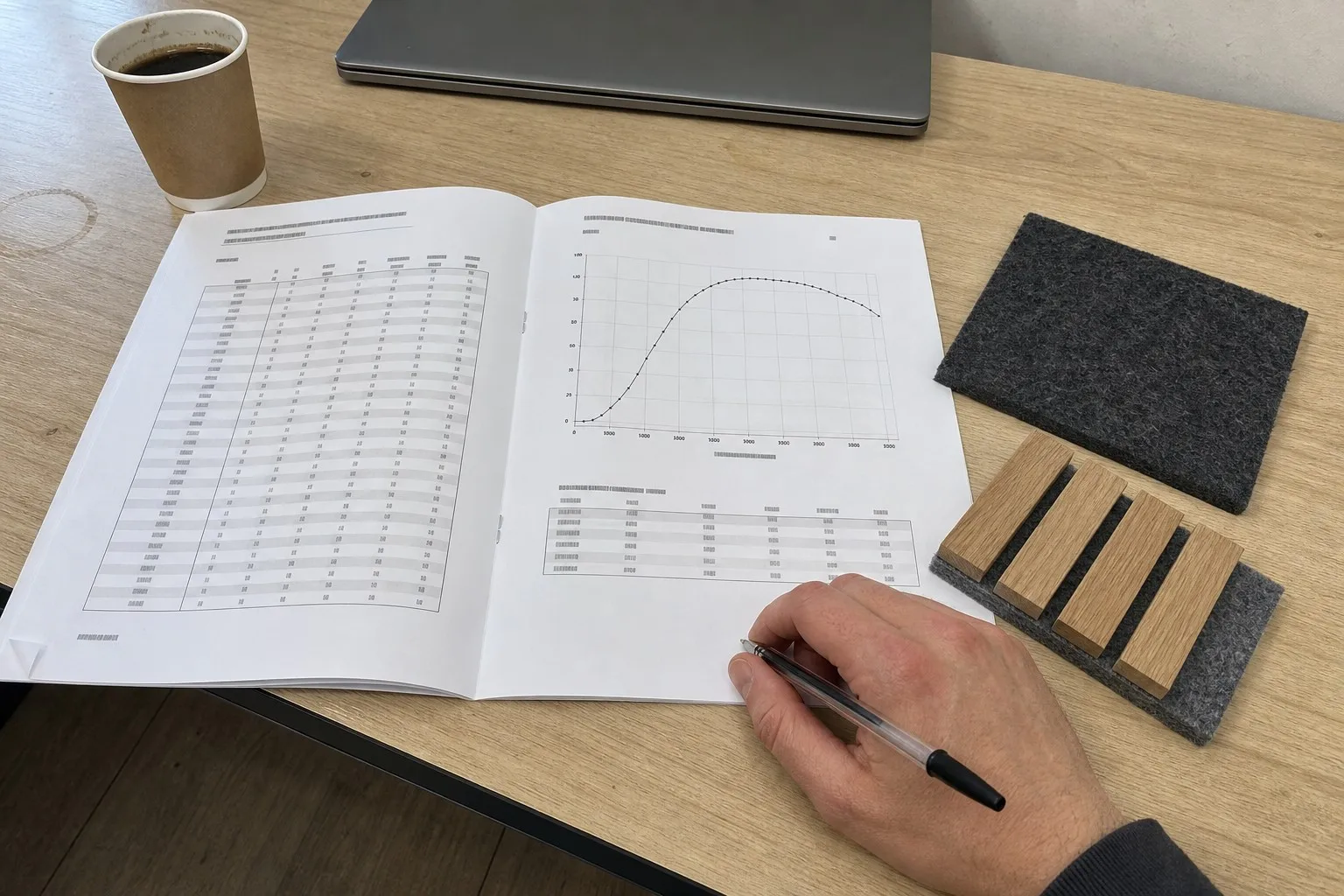
What NRC can tell a buyer
NRC can help buyers compare broad absorption behavior when the products were tested under relevant and comparable conditions. It can support decisions about reverberation control in offices, classrooms, restaurants, meeting rooms, and similar interiors.
However, buyers should review more than the headline value. I recommend asking suppliers for:
- The complete laboratory report rather than a cropped marketing graphic
- The applicable test method
- The product thickness and construction
- The mounting method used during testing
- Any cavity or backing material included in the test
- The specimen size and configuration
- Frequency-specific absorption data when available
- The issuing laboratory and report date
Mounting conditions can significantly affect absorption results.6 A panel tested with an air cavity or extra absorptive backing may perform differently from the same visible panel installed directly against a solid wall. Buyers should compare like with like.
At NF Decor, we treat acoustic documentation as something that buyers should verify against the actual product specification. The same principle applies to FSC, ISO, and fire-related documents. Buyers should check the issuing body, product scope, validity, test construction, and relevance to the intended market. A certificate logo on a webpage is not a substitute for document review.
What NRC cannot tell a buyer
NRC does not establish:
- The sound isolation of a complete wall
- The effect of gaps around doors or windows
- The transmission of impact noise
- The performance of wall-to-floor junctions
- The effect of sockets and service penetrations
- The isolation of low-frequency bass
- The final result in an individual home
Sound isolation uses different test concepts and must relate to a defined building assembly. Even then, laboratory and field conditions may differ7. I do not recommend accepting a fixed decibel-reduction promise without a clearly defined assembly, installation method, test standard, and test conditions.
A decorative panel’s thickness or weight alone also does not guarantee neighbour-noise control. A heavier finish may change part of an assembly, but isolation depends on how all layers connect and whether sound can bypass them. Buyers need assembly-level evidence, not assumptions based on the visible product.
How Should You Evaluate Acoustic Panels vs Soundproofing Before Buying?
A rushed purchase often begins with appearance: oak, walnut, black felt, slat spacing, or panel thickness. Those details matter for interior design, but they come later. I recommend that buyers first define the acoustic task and gather simple evidence about when, where, and how the noise occurs.
Before choosing acoustic panels vs soundproofing work, ask: “Am I improving how this room sounds, or reducing sound entering it?” Acoustic panels may suit the first task. The second task requires investigation of the complete construction, likely sound paths, noise source, permissions, and practical building constraints.
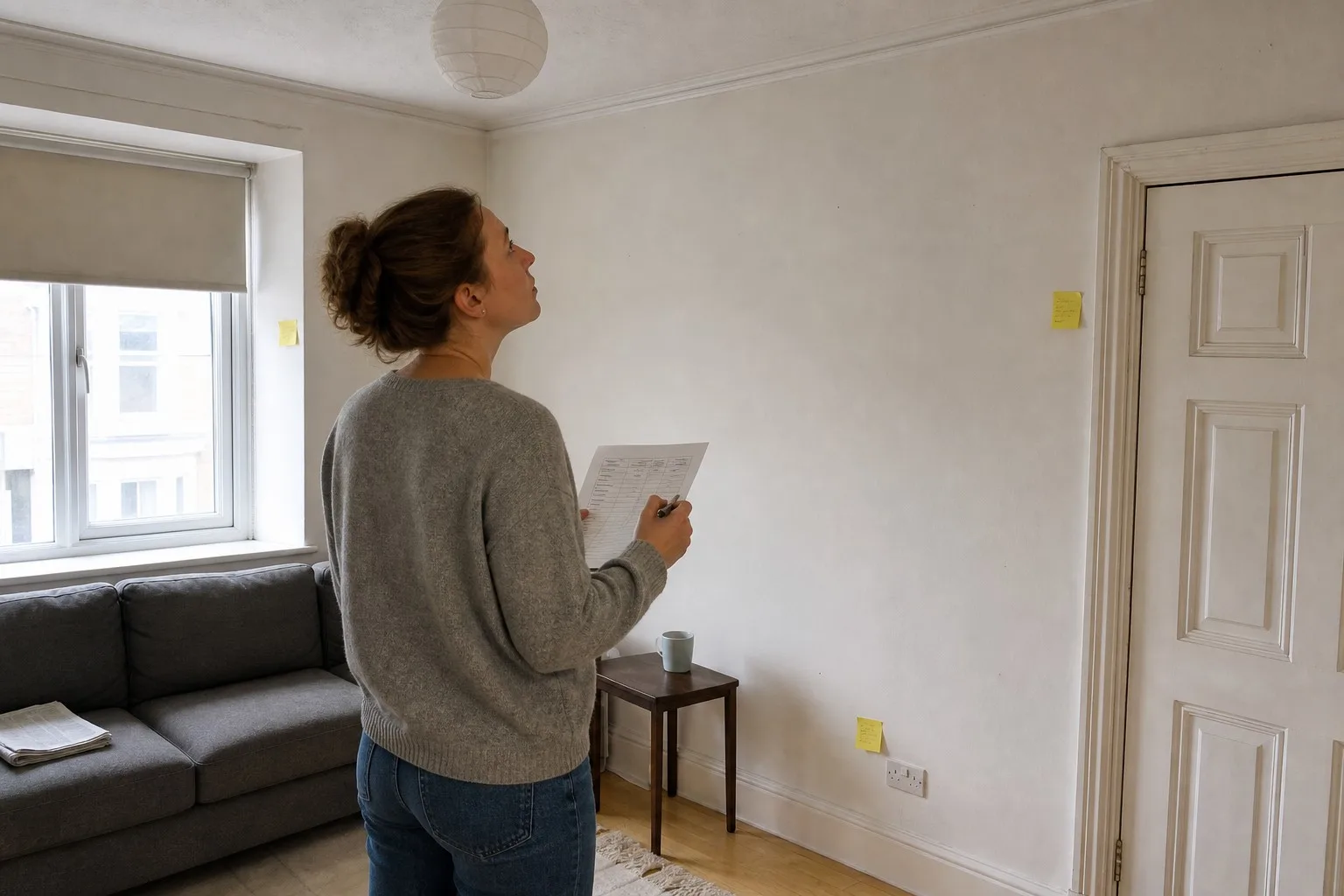
Use a simple pre-purchase test
I suggest following this sequence:
- Describe the sound. Record whether you hear speech, music, bass, footsteps, vibration, plumbing, traffic, or several sources.
- Note the timing. Identify whether the noise is continuous, intermittent, daytime, nighttime, or linked to a specific activity.
- Walk around the room. Listen near doors, windows, sockets, ceiling junctions, floors, and service penetrations.
- Check whether the room itself echoes. Clap once or speak at normal volume. A long, sharp decay suggests a room-acoustic issue, but this informal check is not a professional measurement.
- Separate the goals. Decide whether you need less reverberation, less incoming sound, or both.
- Check permissions. Renters and apartment owners may need approval before modifying walls, floors, façades, or shared elements.
- Seek an on-site assessment. A qualified acoustical consultant or building professional can investigate transmission paths and recommend an assembly-specific response.
A smartphone recording can help document timing, but it should not be treated as a calibrated acoustic test.8 Phone microphones, automatic gain controls, room position, and background noise can distort results.
Match the purchase to the actual problem
| What you notice | Likely task | Appropriate next step |
|---|---|---|
| Speech sounds unclear inside your room | Reverberation control | Assess absorptive coverage and panel placement |
| Video calls have noticeable echo | Room-acoustic treatment | Consider wall or ceiling absorbers |
| A neighbour’s conversation is audible | Sound transmission investigation | Inspect the full separating construction |
| Footsteps come from above | Impact and structure-borne assessment | Evaluate the floor-ceiling system |
| Noise is strongest near a door | Leakage or weak opening | Inspect seals, frame, leaf, and surrounding junctions |
| Bass seems to come from several surfaces | Low-frequency or flanking issue | Seek professional on-site evaluation |
| You need both visual design and less echo | Decorative acoustic treatment | Compare finishes, absorption data, and installation |
| You need less incoming noise and less echo | Two separate tasks | Design isolation first, then add absorption as needed |
This approach prevents a category error. It also helps suppliers provide a more honest recommendation. When an inquiry focuses on a neighbour’s television through a shared partition, I would rather clarify the limitation than suggest that a slatted panel is a guaranteed cure.
What Panels Are Best for Soundproofing?
“What panels are best for soundproofing?” is a common search query, but the question starts with an unreliable premise. It assumes that one surface-mounted panel can solve a building-transmission problem. Some products marketed as soundproof panels may have useful roles, but buyers must examine the tested assembly and installation rather than the label.
No decorative acoustic panel can be called the best soundproofing choice without a defined wall, ceiling, floor, noise source, installation method, and test condition. For neighbour noise, buyers should evaluate a complete isolation system. Absorptive panels remain valuable when the separate goal is controlling reflections inside the room.
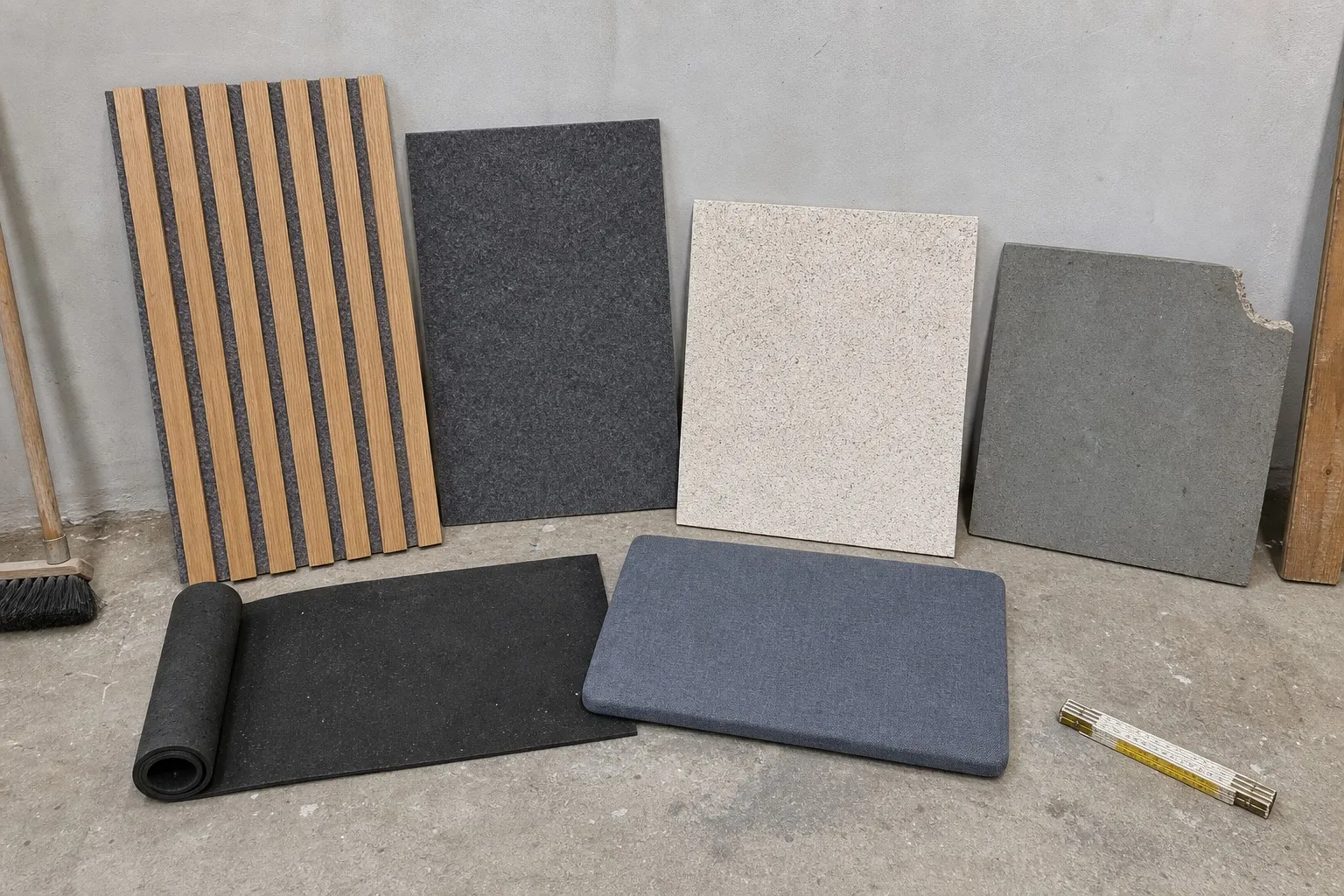
Product names can hide different functions
The word “panel” can describe many unrelated products:
- A PET felt absorber
- A decorative wood slat panel
- A mineral-fiber absorber
- A dense building board
- A resilient wall lining system
- A prefabricated multi-layer isolation component
- A perforated timber panel with cavity insulation
- A movable office screen
These products do not perform the same job. A buyer should ask what was tested, how it was mounted, and whether the result concerns absorption or transmission.
For example, a wood slat acoustic panel may offer a premium decorative finish while helping control reflected sound. Natural veneer can create distinctive grain, while engineered veneer can improve visual repeatability across large batches. PVC film can offer broader choices in wood grain, matte, solid-color, gloss, or textured effects. Those are legitimate procurement considerations for room-acoustic projects. They do not transform an absorption product into a complete sound-isolation system.
I would ask suppliers these questions
Before purchasing any product described as “soundproof,” I recommend asking:
- Does the claim concern sound absorption or sound isolation?
- Was a single material tested, or was a complete wall assembly tested?
- What layers, studs, cavities, fasteners, and sealants were included?
- Did the test use an air gap or additional insulation?
- Does the report apply to the exact product thickness and installation?
- Was the result produced in a laboratory or measured in a building?
- How should doors, windows, sockets, vents, and junctions be treated?
- Who should verify suitability for the intended room?
Buyers should be cautious when a seller promises a universal decibel reduction from attaching a thin decorative layer to any wall. Sound performance cannot be separated from construction details. I also avoid publishing unsupported isolation claims for our acoustic panels because an absorption report cannot justify them.
How Does Effective Neighbour-Noise Soundproofing Change the Wall Construction?
Once buyers understand the limits of acoustic panels vs soundproofing, they need a practical alternative. The answer should not end with “panels will not work.” Neighbour-noise control may require a building intervention that addresses mass, separation, cavity behavior, airtightness, structural paths, and weak openings.
Effective soundproofing typically changes the complete separating construction rather than adding only a decorative absorber. Depending on the diagnosis, a design may use additional layers, isolated framing, resilient connections, cavity insulation, acoustic sealing, upgraded doors or windows, and careful junction detailing. A qualified professional should specify the system for the building.
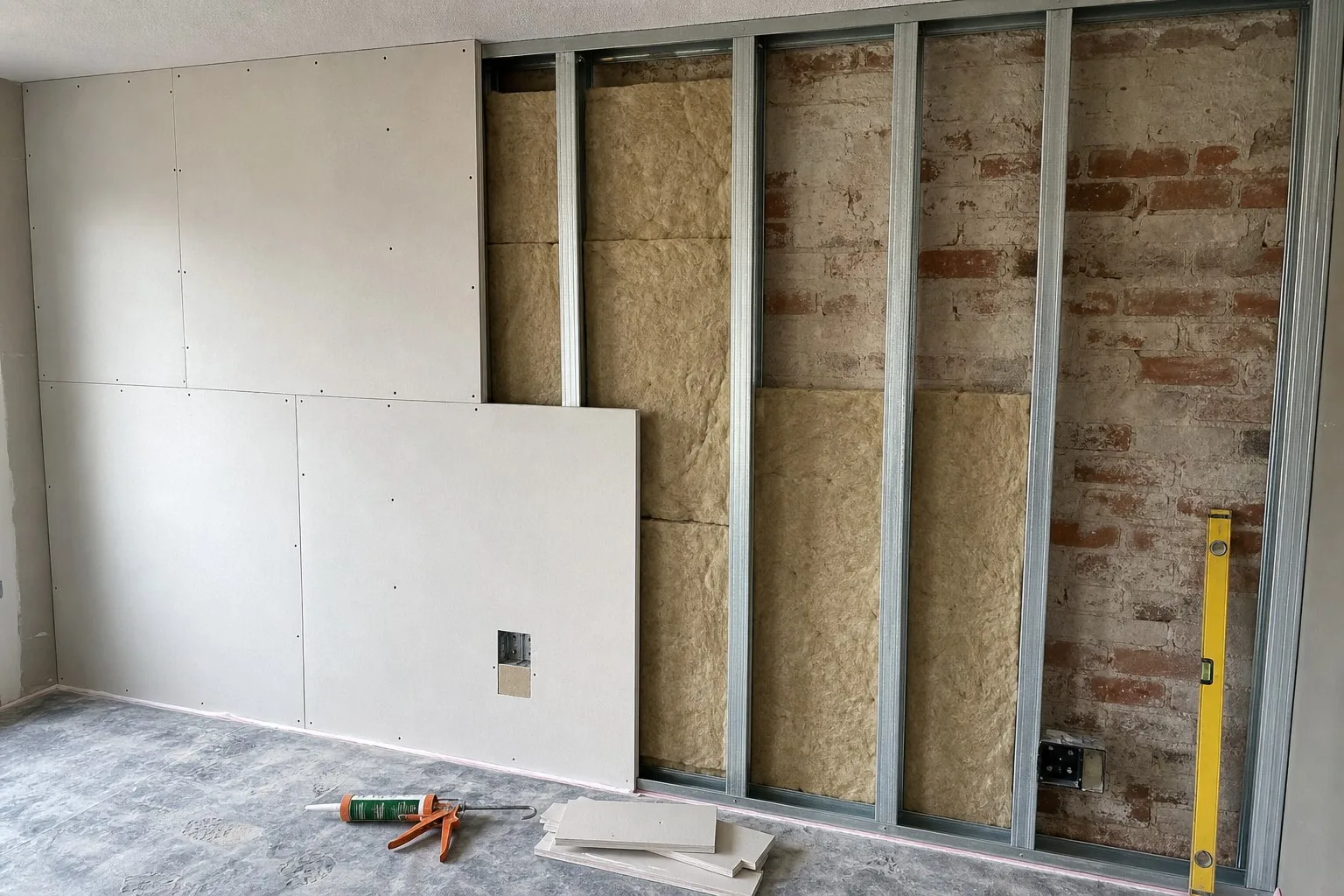
A wall upgrade may involve several coordinated elements
A professional design may consider:
- Additional mass layers: Building boards can increase resistance to airborne transmission when they form part of a tested or engineered assembly.
- Mechanical separation: Independent framing or suitable resilient components may reduce direct vibration transfer.
- Cavity treatment: Appropriate fibrous material may manage energy within the cavity, but cavity fill alone does not soundproof the wall.
- Perimeter sealing: Small gaps can weaken an otherwise substantial partition.
- Penetration detailing: Electrical boxes, pipes, ducts, and recessed fittings require careful treatment.
- Junction design: Floor, ceiling, façade, and adjoining wall connections may create flanking paths.
- Opening upgrades: A lightweight door or poorly sealed window can remain the dominant weakness.
- Source-side treatment: Impact noise is often more effectively addressed near the source, such as within an upper floor system9, subject to access and permissions.
More material is not always better. An incorrectly designed layer can create unexpected resonances, structural loading issues, moisture risks, fire-safety concerns, or installation conflicts. Apartment buildings may also have rules covering shared walls and fire-rated construction.
Acoustic panels can still have a role afterward
Sound isolation work and room treatment can complement each other. After a wall or ceiling assembly addresses transmission, acoustic panels can improve the way the completed room sounds.
I often frame the project as two specifications:
- The building specification manages sound entering or leaving the room.
- The interior acoustic specification manages reflections within the room.
This distinction lets buyers evaluate decorative slat panels, PET felt panels, ceiling absorbers, or other finishes on their real merits. Buyers can then compare absorption documentation, fire-test documents, finish consistency, dimensions, installation details, batch control, and supplier capacity without expecting the panels to perform an unrelated task.
For commercial buyers, I also recommend approving physical finish samples before production. Natural veneer varies by nature, while engineered veneer usually offers stronger color and grain repeatability for phased projects. Buyers should document approved references, tolerances, panel dimensions, felt color, slat spacing, packing requirements, and replenishment expectations.
Frequently Asked Questions
Do acoustic panels block sound from neighbours?
Acoustic panels generally reduce reflections and reverberation inside your room. They do not necessarily stop neighbour noise passing through walls, floors, ceilings, doors, windows, or structural connections. An on-site assessment can identify the likely transmission paths and determine whether the building construction needs modification.
Will covering an entire shared wall with acoustic panels help?
Full-wall coverage may reduce echo and make the room sound less reverberant. However, it does not guarantee meaningful sound isolation. The result depends on the shared wall assembly and all flanking paths. Buyers should not assume that greater surface coverage converts an absorptive product into soundproof construction.
Does a higher NRC mean better soundproofing?
No. A higher NRC indicates greater sound absorption under defined test conditions. NRC does not measure sound isolation through a wall. Buyers should use NRC when comparing room-acoustic treatment and review separate assembly-level evidence when evaluating sound transmission.
Can thick wood slat acoustic panels stop bass noise?
Thickness alone does not prove low-frequency isolation. Bass can travel through walls, floors, ceilings, openings, and structural connections. Wood slat acoustic panels may improve internal room acoustics, but persistent bass transmission usually requires assessment of the complete building system.
Should I install acoustic panels before getting a noise assessment?
You may install acoustic panels if your verified goal is reducing echo or improving speech clarity. If your main goal is stopping neighbour noise, I recommend investigating the sound type and transmission paths first. A qualified acoustical or building professional can help prevent spending money on the wrong solution.
Conclusion
The central lesson in acoustic panels vs soundproofing is that sound absorption is not sound isolation. Acoustic wall panels have a legitimate role in reducing reflections, reverberation, and poor speech clarity. However, neighbour noise may travel through walls, ceilings, floors, doors, windows, gaps, and structural junctions. Effective isolation usually requires changes to the complete building construction.
If you need room-acoustic panels for a verified absorption goal, contact NF Decor to discuss specifications, finishes, samples, OEM options, and procurement requirements. If your priority is incoming neighbour noise, arrange an on-site assessment with a qualified acoustical or building professional before selecting materials.
Related technical guides
- NRC vs STC: Which Rating Does Your Project Actually Need?
- What Is NRC Rating? A Plain-English Guide for B2B Acoustic Panel Buyers
"Soundproofing", https://en.wikipedia.org/wiki/Soundproofing. Acoustic references distinguish absorption, which reduces reflected sound energy in an enclosure, from sound insulation, which limits sound transmission through separating building elements. Evidence role: definition; source type: institution. Supports: Authoritative definitions distinguishing sound absorption within an enclosure from airborne sound insulation or transmission loss through a separating element.. ↩
"Insulation Tax Credit", https://www.energystar.gov/about/federal-tax-credits/insulation. Building-acoustics guidance treats sound insulation as a property of the complete construction, including direct transmission through the separating element and indirect transmission through adjoining paths. Evidence role: mechanism; source type: government. Supports: Guidance explaining that measured or designed sound insulation is affected by the separating element, junctions, openings, and indirect transmission paths.. ↩
"Insulation Tax Credit", https://www.energystar.gov/about/federal-tax-credits/insulation. Because total sound transmission combines direct, leakage, and flanking paths, a relatively weak path can substantially reduce the effective insulation of the overall construction. Evidence role: mechanism; source type: research. Supports: Evidence that sound transmission through openings and flanking paths can dominate the combined performance of an otherwise high-performing partition.. Scope note: The dominant path must be established for the particular building geometry, construction, and noise spectrum. ↩
"Yoga, mindfulness-based stress reduction and ...", https://pubmed.ncbi.nlm.nih.gov/28963884/. NRC is a single-number sound-absorption rating calculated from measured absorption coefficients at specified mid-frequency octave bands under a standardized test procedure. Evidence role: definition; source type: institution. Supports: The standardized definition and calculation of the Noise Reduction Coefficient from absorption coefficients at specified mid-frequency bands.. Scope note: NRC condenses frequency-specific data into one value and may not represent absorption performance at low or high frequencies or under different mounting conditions. ↩
"Epidemiology and transmission of COVID-19 in 391 cases ...", https://pubmed.ncbi.nlm.nih.gov/32353347/. NRC is derived from sound-absorption measurements and is not a measure of airborne sound transmission loss through a wall or of field sound insulation between dwellings. Evidence role: definition; source type: institution. Supports: That NRC is derived from sound-absorption testing and is distinct from sound transmission loss or sound insulation ratings for building assemblies.. ↩
"Critical Materials Innovation Hub", https://www.ameslab.gov/cmi. Absorption testing and experimental studies show that the mounting condition, including air cavities and backing materials, can change a material's measured absorption coefficients and frequency response. Evidence role: mechanism; source type: paper. Supports: Experimental or standardized-test evidence that mounting type, cavity depth, and backing alter measured sound absorption coefficients.. Scope note: The size and frequency range of the change depend on the absorber's thickness, density, geometry, and installation configuration. ↩
"Los Alamos National Laboratory", https://www.lanl.gov/. Laboratory sound-insulation tests characterize specified constructions under controlled conditions, whereas field measurements reflect the completed building and can be affected by workmanship, junctions, and flanking transmission. Evidence role: general_support; source type: institution. Supports: That laboratory and field sound-insulation measurements use different conditions and that field results include installation, junction, and flanking effects.. Scope note: A laboratory result remains useful for comparing tested constructions, but it is not a direct prediction of field performance without project-specific design and installation information. ↩
"Smartphone", https://en.wikipedia.org/wiki/Smartphone. Evaluations of smartphone-based acoustic measurement report that device microphones and applications can vary in calibration and response, so recordings are useful for documenting events but are not substitutes for calibrated sound measurements. Evidence role: general_support; source type: paper. Supports: Evidence on the accuracy limits and calibration variability of smartphone microphones and sound-measurement applications.. Scope note: Some devices and applications can achieve useful screening accuracy when appropriately calibrated, but suitability depends on the device, application, calibration procedure, and measurement purpose. ↩
"Get Into Teaching - Department for Education", https://getintoteaching.education.gov.uk/. Building-acoustics guidance commonly identifies treatments at the impacted floor, such as resilient floor layers or floating-floor systems, as effective approaches for reducing impact-sound transmission. Evidence role: general_support; source type: government. Supports: Guidance that impact-sound control commonly involves floor finishes, resilient layers, floating floors, or other treatments on the impacted floor system.. Scope note: The feasible intervention depends on access to the source room, the existing floor-ceiling construction, building regulations, and the character of the impact source. ↩