Wood acoustic panels can tolerate some humid interior conditions, but architects often receive vague claims about “waterproof” finishes. That confusion can lead to swelling, warping, delamination, and costly replacement. I recommend evaluating the actual moisture exposure and the complete panel construction before approving any wood-based acoustic product.
Wood acoustic panels may be suitable for controlled humid interiors when their complete construction is supported by relevant technical documentation. However, they should not be assumed to withstand condensation, splashing, leaks, prolonged dampness, or direct water exposure. Suitability depends on humidity duration, ventilation, substrate, edges, adhesives, backing, finish, and installation conditions.
In my conversations with architects and designers, the most useful question is rarely, “Is this panel moisture resistant?” I usually ask what kind of moisture the panel will encounter, how long exposure will last, and which exact panel construction has been tested.
What Does Moisture Resistance Mean for Wood Acoustic Panels?
The terms used in product descriptions often create the first specification problem. A finish may resist occasional moisture without protecting the complete panel from prolonged humidity or liquid water. If a project team treats these claims as interchangeable, it can approve a product for conditions beyond its documented limits.
Moisture resistance describes a product’s ability to tolerate specified moisture or humidity conditions with limited damage. Water resistance usually refers to temporary liquid-water exposure under defined conditions. Waterproofing requires a much higher level of protection against water penetration. I do not treat any of these terms as equivalent without supporting test evidence.
Humidity Is Not the Same as Direct Water
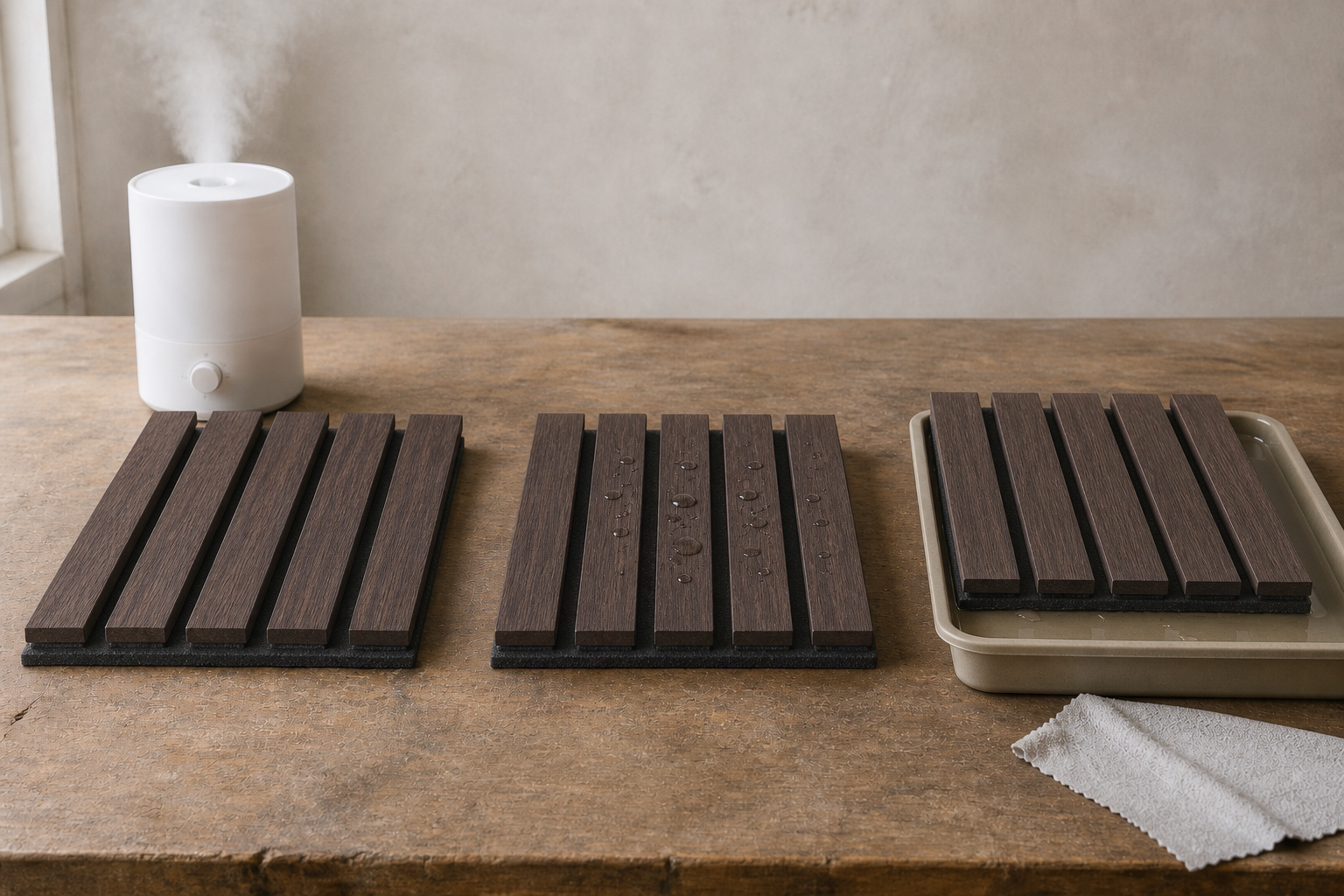
I regularly receive questions about projects in the Middle East and Southeast Asia, where warm weather and seasonal humidity are common. However, high ambient humidity is not the same exposure as a leaking pipe, an open shower, or a wall with recurring condensation.
I find it useful to divide indoor moisture exposure into practical categories:
| Exposure category | Typical example | Main specification concern |
|---|---|---|
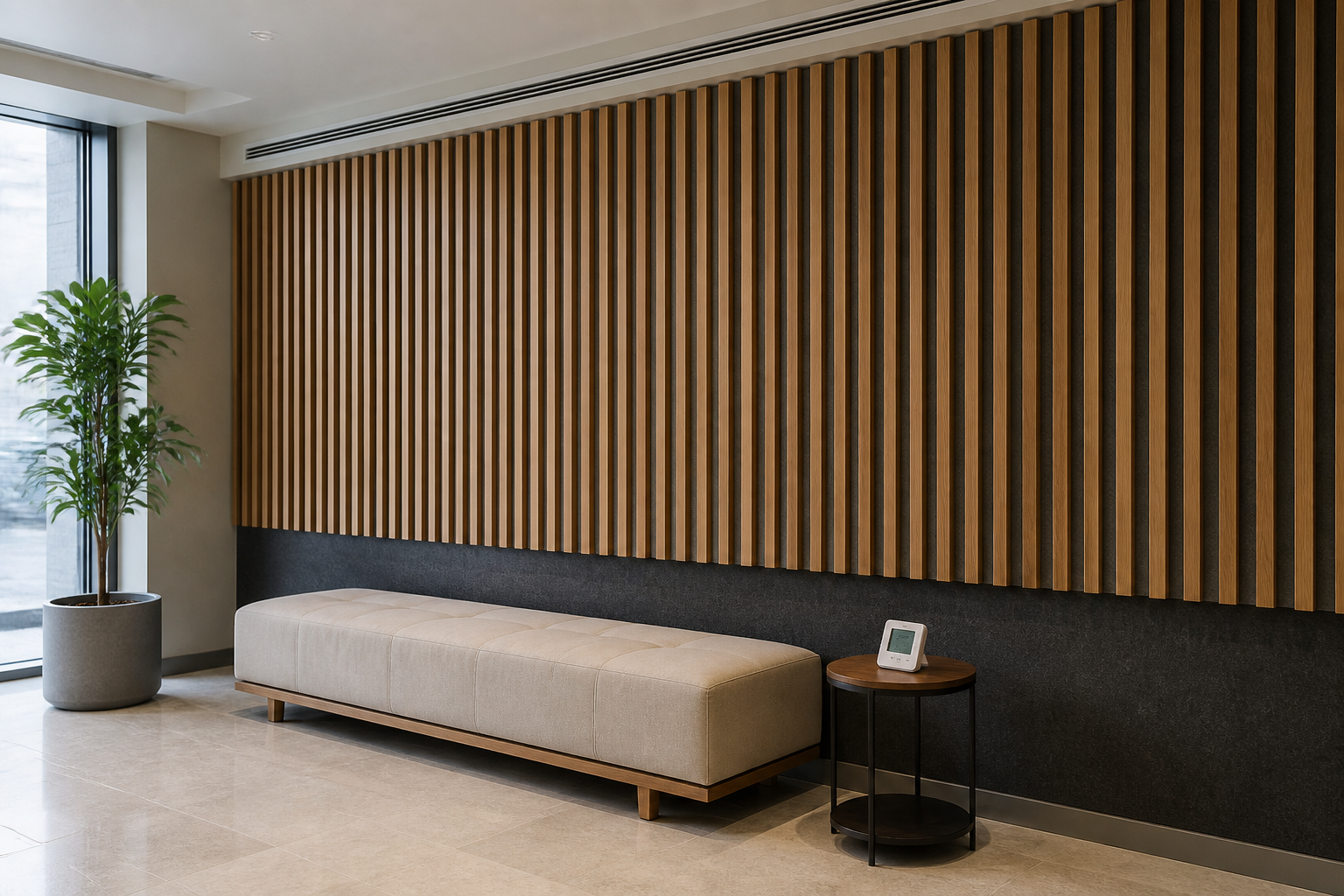
| Controlled interior humidity | Air-conditioned hotel lobby or office | Seasonal changes and HVAC shutdown periods |
| Intermittent elevated humidity | Restaurant, changing room, or coastal interior | Exposure duration and ventilation recovery |
| Condensation risk | Cold wall, glazing perimeter, or poorly insulated surface | Repeated wetting of the panel and rear face |
| Occasional splash | Wash area or nearby sink | Edge entry, surface staining, and adhesive failure |
| Persistent dampness | Basement with an untreated moisture source | Swelling, mold risk, corrosion, and delamination |
| Direct or continuous water | Shower enclosure, exterior rain exposure, or leak-prone zone | Wood-based interior products are generally inappropriate |
These categories are a procurement framework rather than a universal approval table. The project team still needs to compare the actual environment with the supplier’s verified product documentation.
Why “Waterproof Finish” Is an Incomplete Claim
A PVC film can create a relatively easy-to-clean decorative face, but it does not automatically make a complete wood acoustic panel waterproof.1 Water or water vapor may reach the assembly through2:
- Cut edges and routed grooves
- Perforations or slat spacing
- Unsealed rear surfaces
- Fixing points
- Joints between panels
- Adhesive interfaces
- Contact with a damp wall
- Condensation behind the acoustic felt
Natural wood veneer and engineered veneer also behave differently from PVC film, but the visible finish is still only one component. I always review the face, core, edges, adhesive, acoustic backing, and mounting method as one system.
I recommend rejecting any blanket “waterproof panel” claim unless the supplier identifies the test method, sample construction, exposure conditions, acceptance criteria, and limitations.
How Should I Assess Humidity Before Specifying Wood Acoustic Panels?
A room label does not provide enough information for a reliable decision. One bathroom may contain only enclosed washbasins and strong mechanical ventilation, while another may have open showers and constant condensation. I therefore classify the exposure instead of approving panels from the room name alone.
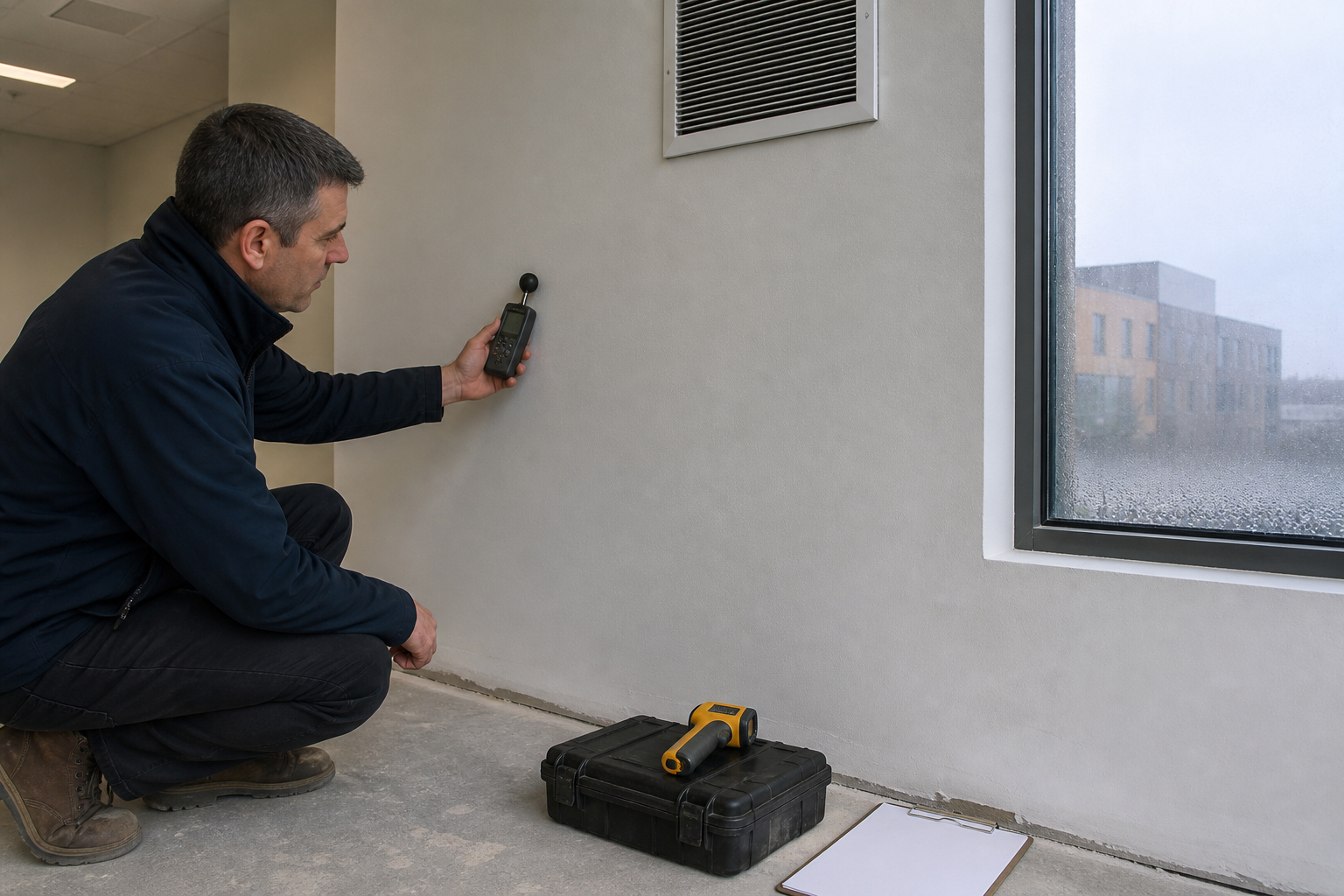
I assess the expected relative-humidity range, exposure duration, condensation probability, ventilation strategy, wall condition, and direct-water risk. I also check whether the room will remain conditioned during weekends or seasonal shutdowns. These factors help the project team decide whether a documented wood construction is appropriate.
Build an Environmental Schedule
I ask architects or contractors to record environmental conditions in the project specification. The schedule should include more than a single design humidity value.
A useful schedule covers:
- Expected minimum and maximum relative humidity
- How many hours or days elevated humidity may continue
- Normal operating temperature
- HVAC operation during nights, weekends, and holidays
- Ventilation and extraction rates specified by the mechanical engineer
- Likelihood of surfaces reaching dew-point temperature
- Location of plumbing, sinks, showers, pools, and wet equipment
- History of rising damp, leakage, or envelope water entry
- Construction moisture in plaster, screed, concrete, or masonry
- Cleaning methods, including sprayed water or wet chemicals
I do not publish one universal relative-humidity limit for all wood acoustic products. Different cores, adhesives, finishes, and manufacturing systems can behave differently. A valid limit should come from the technical documentation for the exact proposed construction, not from an unrelated panel or a general statement about wood.
Evaluate Condensation Separately
Relative humidity alone does not describe condensation risk. Condensation can form when a surface temperature falls below the air’s dew point.3 A cold exterior wall, chilled service, thermal bridge, or uninsulated metal component can therefore wet the panel even when the room’s average humidity does not appear extreme.
I recommend that the architect or building-services engineer assess dew-point conditions where condensation is plausible. The wall build-up may require insulation, a vapor-control strategy, drainage, or another professionally designed solution. An acoustic panel should not be used to hide an unresolved moisture problem.
Check Ventilation and Operational Reality
Design documents may show adequate ventilation, but real operation can differ. Filters can become blocked, extraction systems can be switched off, and hotel rooms can remain closed between guests. I therefore ask who will control the indoor environment after handover.
I also check whether the air gap behind a slatted panel can dry. An air cavity can support acoustic performance, but it should not become a concealed area where humid air condenses against a cold substrate.
For high-risk projects, I recommend that a qualified building-envelope, HVAC, or moisture-control professional review the assembly. The panel manufacturer cannot verify site-wide performance from a room description or photograph.
Which Parts of Wood Acoustic Panels Control Moisture Performance?
A decorative face receives most of the visual attention, but it does not determine performance by itself. I have seen specifications focus on veneer color while leaving the core, adhesive, backing, and cut-edge treatment undefined. That gap can result in a materially different product arriving on site.
The complete panel construction controls moisture response. I evaluate the substrate’s dimensional stability, finish coverage, edge condition, lamination adhesive, PET felt or other backing, joints, fasteners, and wall interface. I also confirm that the tested sample matches the product that the factory will manufacture for the project.
Review the Substrate
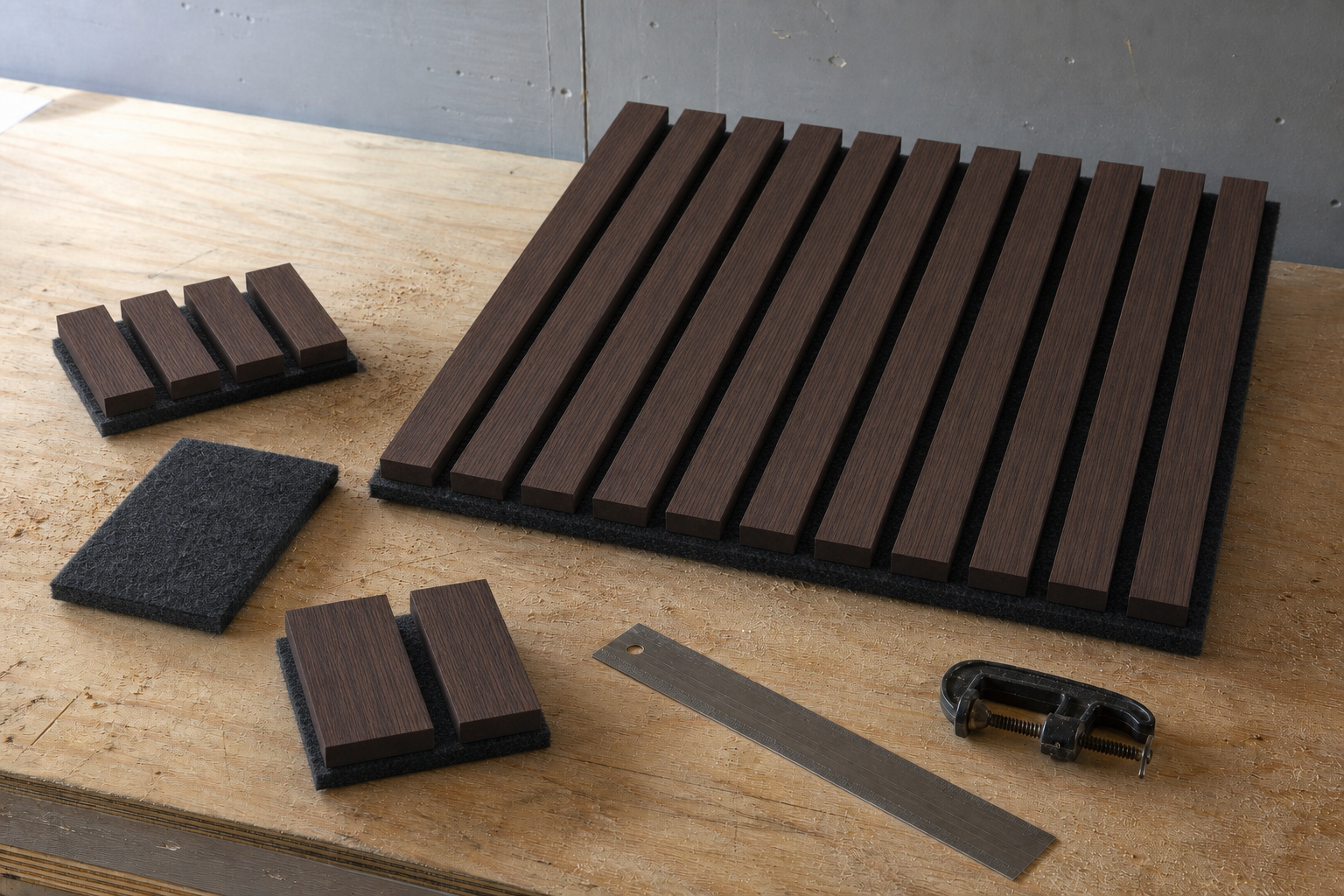
Many slatted acoustic panels use a wood-based slat or lamella structure over an acoustic felt backing. The exact core composition matters because wood-based substrates can change dimension when their moisture content changes4.
I ask the supplier to identify:
- The substrate type and nominal density
- The standard and slim panel thicknesses
- Manufacturing tolerances
- Any relevant moisture or thickness-swelling data
- Storage and conditioning requirements
- Whether the stated data applies to the finished panel or only the raw board
- Whether cut edges require sealing
- Whether special substrate options are available for the proposed exposure
A substrate test result should not automatically be presented as proof that the finished acoustic panel passed the same evaluation. Lamination, machining, grooving, edge exposure, and felt attachment can change how the final assembly responds.
Compare Surface Finish Options Carefully
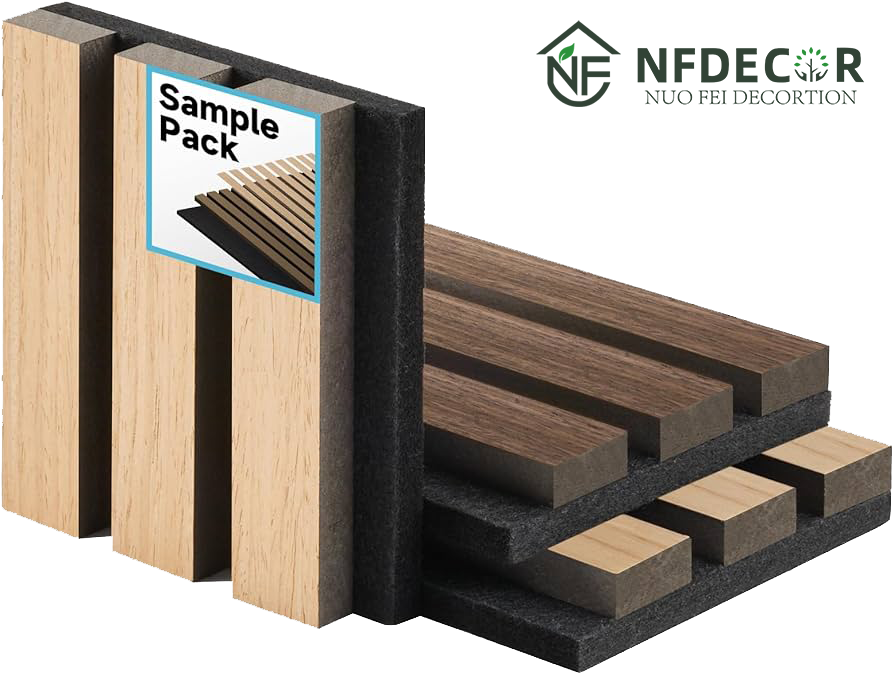
At NF Decor, we manufacture finishes across three broad families: natural wood veneer, engineered or reconstituted veneer, and PVC film. Each family offers different design and batch-control benefits, but I do not describe any finish as a universal solution for wet environments.
| Finish family | Main procurement advantage | Moisture-related question to verify |
|---|---|---|
| Natural wood veneer | Authentic grain and premium appearance | How are the veneer, coating, edges, and color variation controlled? |
| Engineered veneer | More consistent grain and color across large batches | Does the documented construction match the project’s adhesive and core? |
| PVC film | Broad choice of wood grain, solid, matte, gloss, and textured effects | Are edges, joints, perforations, and the rear face protected or exposed? |
Natural veneers such as oak, walnut, teak-look, or rosewood-look selections can support a premium interior. However, the supplier should define the coating system, maintenance requirements, and acceptable environmental conditions.
Engineered veneer can help distributors and large projects maintain visual repeatability across production batches. That consistency does not remove the need to verify moisture-related performance.
PVC film can offer practical surface cleaning and extensive color options. However, I emphasize that a film-faced slat still contains edges, grooves, backing, adhesive lines, and fixing points. The face film cannot justify a whole-panel waterproof claim by itself.
Examine Adhesives, Backing, and Edges
Adhesive performance is particularly important because failure may appear as bubbling, lifting, or delamination rather than obvious substrate swelling. I ask whether the adhesive is appropriate for the supplier’s documented service conditions and whether the test sample used the same adhesive system.
The backing also needs review. PET acoustic felt may contribute to sound absorption5 and visual contrast between slats, but the project team should verify its composition, thickness, fire documentation, and moisture-related limitations. An acoustic result such as an NRC value also applies to a defined panel and installation build-up.6 I do not transfer that result to a modified construction without confirmation.
Edges deserve equal attention. Site cutting can expose the core even when factory edges have protective treatment. The installation instructions should state whether installers must reseal cuts and which compatible product they should use.
How Can I Verify Moisture Claims for Wood Acoustic Panels?
Marketing language can make a narrow test result appear broader than it is. A supplier may show a substrate data sheet, a short immersion demonstration, or a certificate for another product. Without checking the tested sample and conditions, the design team cannot know whether the evidence supports the proposed installation.
I verify the test method, laboratory identity, report date, sample description, conditioning procedure, exposure duration, measured result, and acceptance criteria. I then compare those details with the purchase specification. A credible report should support only the exact construction and conditions covered by its scope.

Request a Complete Evidence Package
I recommend requesting the following documents during supplier evaluation:
- Product technical data sheet
- Full construction description
- Substrate specification
- Finish and adhesive identification
- Dimensional tolerance information
- Installation and edge-treatment instructions
- Storage and acclimatization guidance
- Relevant laboratory reports
- Declaration of tested sample dimensions
- Test conditions and exposure duration
- Maintenance and cleaning instructions
- Written limitations and excluded applications
Several test methods may be relevant depending on the product and claim. Tests can address water absorption, thickness swelling, humidity exposure, condensation, or coating performance.7 However, the buyer should verify the standard’s scope and current edition with the laboratory or qualified consultant. A named standard alone does not prove suitability for a specific room.8
Match the Report to the Ordered Product
I use a simple traceability check before accepting technical evidence:
| Verification point | Question I ask |
|---|---|
| Product identity | Does the report name the same model or construction? |
| Core | Is the tested substrate identical to the ordered substrate? |
| Finish | Did the sample use the same veneer, film, and coating system? |
| Adhesive | Was the same lamination and backing adhesive used? |
| Thickness | Does the tested thickness match the project specification? |
| Edge condition | Were edges sealed, exposed, or otherwise prepared? |
| Exposure | Does the test represent humidity, condensation, splash, or immersion? |
| Result | Does the report state measured changes and acceptance criteria? |
| Limitation | Does the document exclude prolonged dampness or direct water? |
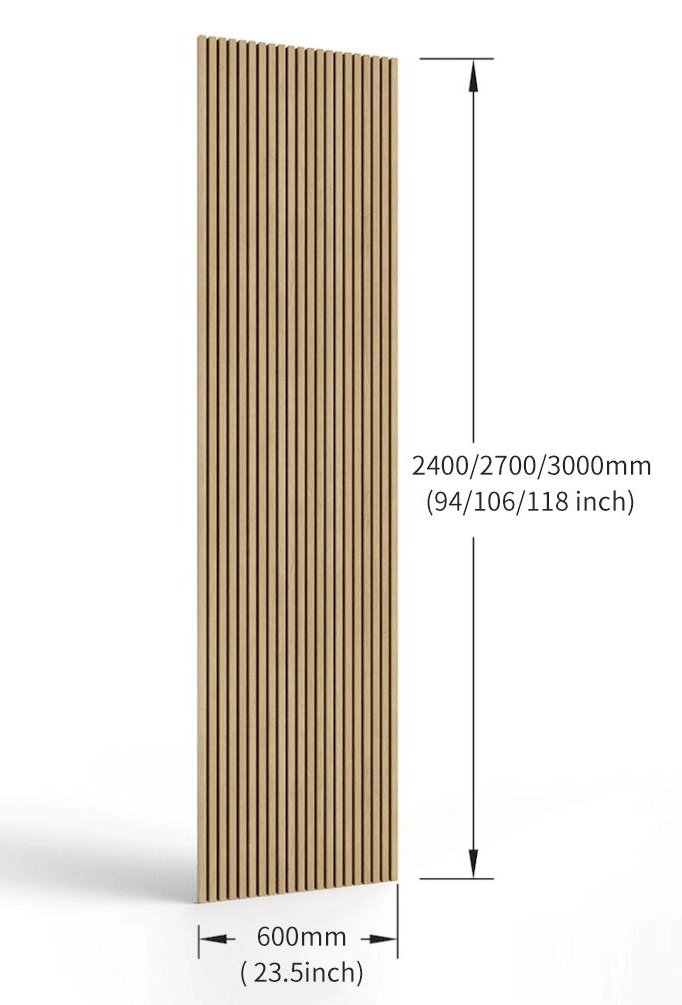
This check matters when a product range includes 21 mm standard panels, 18 mm slim panels, different slat geometries, and multiple finishes. A result for one version may not automatically cover another.
Keep Other Certifications in Context
NF Decor reports ISO and FSC certification within our business documentation, and buyers should request current copies and verify their scope and validity. However, FSC documentation concerns responsible sourcing rather than moisture performance. A general management-system certificate also does not prove that an acoustic panel is suitable for condensation or splashing.
Fire and acoustic documents require the same discipline. A fire classification, NRC result, or environmental certificate should identify the relevant construction. A project-specific change to felt, adhesive, core thickness, slat spacing, or mounting build-up may affect whether an earlier result remains applicable.
When Should I Choose an Alternative to Wood Acoustic Panels?
Design teams sometimes try to preserve a preferred wood appearance after the exposure category has already become unsuitable. That choice can create repeated maintenance and replacement costs. I prefer to change the material early rather than rely on a decorative finish to compensate for persistent moisture.
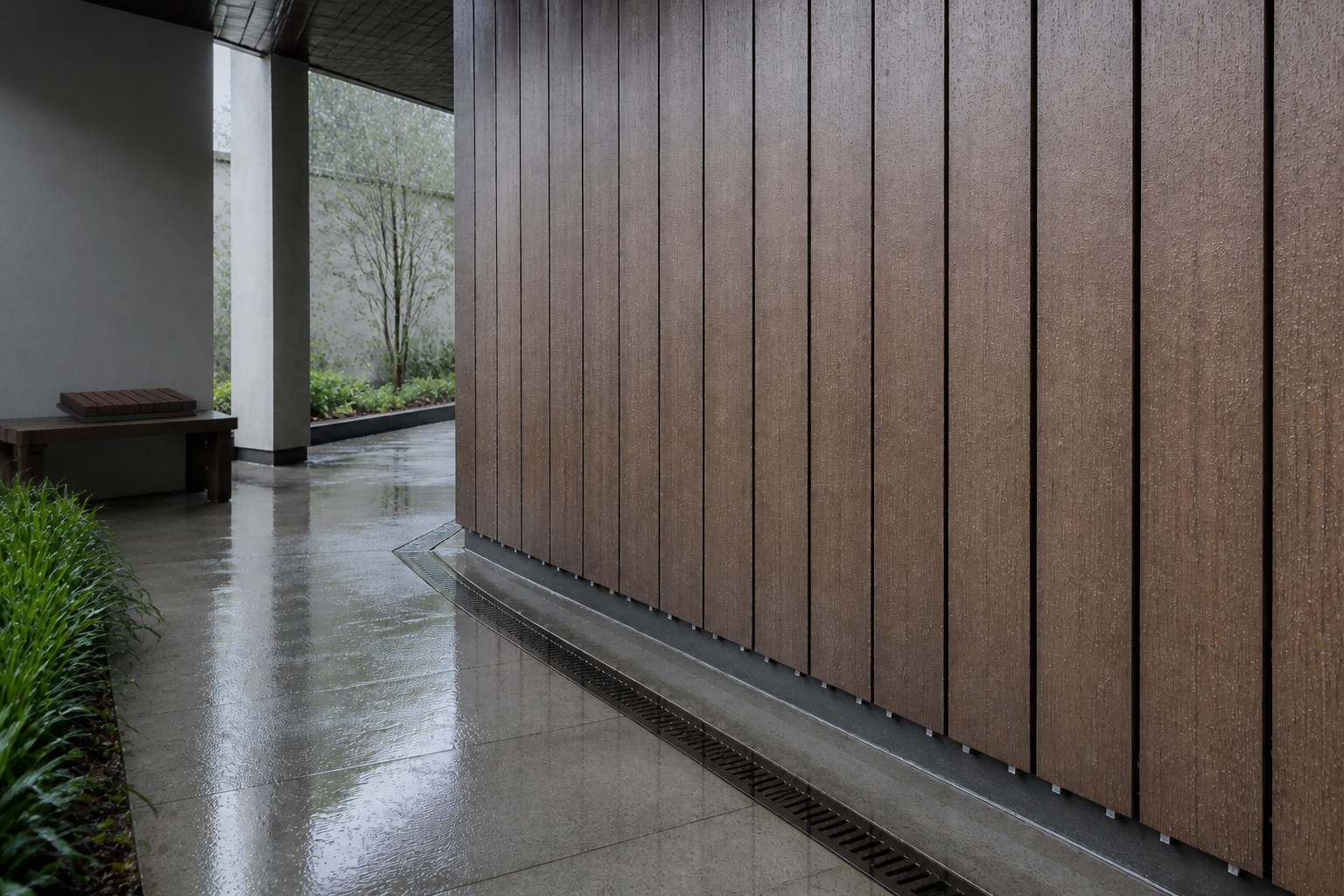
I generally redirect a specification when the location involves prolonged dampness, recurring condensation, direct splashing, uncontrolled leakage, or exterior weather exposure. A WPC exterior panel or another purpose-designed system may be more appropriate, but the buyer must still verify its intended use, installation requirements, drainage, fire performance, and test evidence.
Recognize the Red Flags
I would pause a wood acoustic panel specification when I find any of these conditions:
- The wall has visible damp marks, efflorescence, or mold.
- The room experiences repeated condensation.
- The panel will sit inside a shower or direct splash zone.
- Cleaning crews will spray the wall with water.
- The installation is outdoors or exposed to wind-driven rain.
- The substrate has not dried after wet construction work.
- The HVAC system cannot maintain the documented service conditions.
- The project team cannot provide ventilation or dew-point information.
- The supplier relies only on a face-film claim.
- The test report covers a different core, thickness, adhesive, or finish.
The contractor should correct leaks, rising damp, and envelope defects before installation.9 Surface sealing cannot reliably compensate for water entering from behind the panel.10
Consider WPC for Direct Exterior Exposure
NF Decor’s core indoor range includes wood slat acoustic panels, flexible tambour panels, PET felt products, suede acoustic wood panels, and other decorative acoustic systems. These products serve interior design and sound-control needs under their documented conditions.
For exterior or persistently wet applications, I guide buyers toward a product line designed for that exposure, such as an appropriate WPC exterior panel. NF Panelux, our sister brand, covers soft-stone and exterior panel categories. However, I still ask buyers to verify the exact product’s weathering documentation, fixing method, thermal movement allowances, fire requirements, and local code compliance.
A WPC product is not an automatic substitute for every acoustic requirement. The architect should separately confirm:
- Whether acoustic absorption is required
- Whether the assembly needs a tested NRC or equivalent result
- Whether the product is suitable for indoor, semi-exposed, or fully exposed use
- Whether drainage and ventilation are required
- Whether local fire and facade rules apply
- Whether expansion joints and fixing spacing are defined
I recommend qualified professional evaluation whenever moisture control, facade safety, fire performance, or code compliance affects the decision.
Frequently Asked Questions
Can I install wood acoustic panels in a bathroom?
I do not approve panels based on the word “bathroom” alone. I check whether the location is outside splash zones, whether extraction controls humidity, and whether condensation can occur. The exact panel construction must have documentation supporting the expected conditions. Open showers and persistently wet areas usually require another material system.
Does PVC film make a wood acoustic panel waterproof?
No. I treat PVC film as the visible surface finish, not proof of whole-panel waterproofing. The core, edges, grooves, adhesive, rear face, felt, joints, and site cuts may remain exposed. The supplier should provide evidence for the complete panel construction and the specific type of water exposure.
What relative humidity can wood acoustic panels tolerate?
I do not use one universal relative-humidity threshold. The allowable range and exposure duration should come from documentation for the exact panel, finish, adhesive, and substrate. The project team should also assess temperature, condensation, ventilation, wall moisture, and HVAC shutdown periods.
Should panels be acclimatized before installation?
Many wood-based interior products require storage and acclimatization under defined site conditions.11 I recommend following the product-specific installation instructions rather than applying a generic period. The room and wall should be dry, HVAC conditions should be stable, and packaging should be handled as the supplier specifies.
What documents should I request from a wood acoustic panel supplier?
I request a technical data sheet, full construction details, installation guidance, storage limits, relevant test reports, and written application exclusions. I also match the report’s core, finish, adhesive, dimensions, edge condition, and backing to the ordered product. Buyers should verify certificate scope and validity independently.
Conclusion
Wood acoustic panels can work in some controlled humid interiors, but moisture resistance is never a simple yes-or-no finish claim. I recommend classifying the exposure, checking ventilation and condensation risk, treating the wall substrate, and verifying the complete panel construction against relevant documentation. Prolonged dampness, direct water, and exterior exposure usually call for another material, including a properly evaluated WPC system. Contact NF Decor to discuss your project conditions, request samples, and review the exact panel specification and available technical documents before procurement.
Related technical guides
- Can Acoustic Panels Be Used Outdoors? What You Need to Know Before Specifying
- NRC vs STC: Which Rating Does Your Project Actually Need?
"Water Penetration Resistance – Design and Detailing", https://www.gobrick.com/media/file/7-water-penetration-resistance-design.pdf. Water resistance of a building-panel assembly depends on continuity at joints, edges, penetrations, and interfaces; a water-resistant exposed facing alone does not establish watertight performance of the complete assembly. Evidence role: general_support; source type: research. Supports: That moisture resistance of an assembly depends on joints, edges, penetrations, interfaces, and other continuity details rather than the exposed face alone.. Scope note: This support addresses assembly-level moisture control generally and does not test any particular PVC-faced acoustic panel. ↩
"BSD-012: Moisture Control for New Residential Buildings", https://buildingscience.com/documents/digests/bsd-012-moisture-control-for-new-residential-buildings. Moisture may enter or accumulate within panel and wall assemblies through discontinuities such as joints, edges, penetrations, and interfaces with damp adjoining materials. Evidence role: mechanism; source type: research. Supports: That water can bypass nominally protective surfaces through discontinuities, interfaces, penetrations, and moisture transport from adjacent materials.. Scope note: The cited building-science principles are general and do not quantify ingress for a specific acoustic-panel design. ↩
"DEW AND FROST DEVELOPMENT", https://www.weather.gov/source/zhu/ZHU_Training_Page/fog_stuff/Dew_Frost/Dew_Frost.htm. Condensation occurs when moist air contacts a surface at or below its dew-point temperature, causing water vapor to change phase into liquid water. Evidence role: mechanism; source type: government. Supports: The physical relationship between dew-point temperature, surface temperature, and condensation.. ↩
"Chapter 13: Drying and control of moisture content and dimensional ...", https://research.fs.usda.gov/treesearch/62261. Wood and wood-based materials change dimensions as their moisture content changes, generally swelling as moisture is gained and shrinking as moisture is lost. Evidence role: mechanism; source type: government. Supports: That changes in wood moisture content produce shrinkage and swelling, with the magnitude depending on material structure and grain direction.. ↩
"Evaluation and comparison the properties of acoustic boards made ...", https://bioresources.cnr.ncsu.edu/resources/evaluation-and-comparison-the-properties-of-acoustic-boards-made-of-date-palm-fiber/. Fibrous polyester (PET) felt can provide sound absorption by dissipating acoustic energy within its porous structure; measured absorption depends on thickness, density, frequency, and mounting conditions. Evidence role: mechanism; source type: paper. Supports: That polyester/PET fibrous felt can absorb sound energy, with performance influenced by material and installation parameters.. Scope note: Material-level findings do not establish the NRC or acoustic performance of a finished slatted panel assembly. ↩
"ASTM C423 Absorption Testing: Test Method, Mounting ...", https://acousplan.com/blog/astm-c423-absorption-testing-guide. The Noise Reduction Coefficient (NRC) is derived from laboratory sound-absorption measurements of a specified test specimen and mounting condition, so it is not inherently transferable to altered assemblies. Evidence role: definition; source type: institution. Supports: That NRC is derived from laboratory sound-absorption measurements performed on a defined specimen under specified test conditions.. Scope note: The NRC is a single-number rating and does not describe absorption at every frequency or under all field installation conditions. ↩
"PEER-REVIEW ARTICLE", https://bioresources.cnr.ncsu.edu/BioRes_07/BioRes_07_Unsecured/BioRes_07_3_3093_Garay_Lab_Testing_P3_Particleboards_Residues_2446.pdf. Moisture-related material tests are property-specific: methods for water absorption, thickness swelling, humid exposure, condensation, and coating durability employ different specimens, exposures, and evaluation criteria. Evidence role: general_support; source type: institution. Supports: That moisture-related test methods measure distinct properties and use defined exposure conditions and assessment criteria.. Scope note: The existence of a relevant test method does not demonstrate that a particular product has passed it or is suitable for a particular installation. ↩
"Inspection", https://thedocs.worldbank.org/en/doc/735641553266058843-0090022019/original/Section6Inspection.pdf. A conformity claim or test report demonstrates performance only within the scope of its stated method, specimen, and conditions; fitness for a particular use requires comparison with the actual service environment. Evidence role: general_support; source type: institution. Supports: That test standards define particular methods and scopes, while suitability depends on whether the tested conditions represent the intended use.. Scope note: Application-specific suitability may also depend on design, installation, maintenance, and local regulatory requirements beyond the tested product property. ↩
"A Brief Guide to Mold, Moisture and Your Home | US EPA", https://www.epa.gov/mold/brief-guide-mold-moisture-and-your-home. Public-health and building-moisture guidance recommends correcting water intrusion and moisture sources promptly, because persistent dampness can damage materials and promote mold growth. Evidence role: expert_consensus; source type: government. Supports: That moisture sources and water intrusion should be corrected promptly to prevent material damage and mold growth.. Scope note: This guidance supports remediation of moisture sources generally and does not prescribe a specific panel-installation sequence. ↩
"[PDF] Preservation Brief 1 - National Park Service", https://www.nps.gov/orgs/1739/upload/preservation-brief-01-cleaning-masonry.pdf. Where water enters from the rear or within an assembly, durable moisture control requires source correction and appropriate drainage or drying pathways; an exposed-face seal alone may not prevent concealed wetting. Evidence role: mechanism; source type: research. Supports: That moisture-control strategies must manage water at the source and allow drainage or drying, rather than relying exclusively on exposed surface treatments.. Scope note: The principle is general building-envelope guidance and does not evaluate the effectiveness of any particular sealing product. ↩
"[PDF] Joining and Reassembling of Wood", https://research.fs.usda.gov/download/treesearch/66341.pdf. Wood-based interior materials are commonly conditioned before installation so that their moisture content approaches that expected in service, helping reduce subsequent dimensional movement. Evidence role: general_support; source type: education. Supports: That wood products should be conditioned to expected service moisture and temperature conditions to reduce dimensional movement after installation.. Scope note: Required acclimatization procedures and durations vary by product construction, site conditions, and manufacturer instructions. ↩