Buying a wall panel by appearance is easy. Buying it in bulk, with the right specification, documents, finish consistency, packing, and shipping terms, takes a more disciplined process. I use the following five-step framework when discussing a wood slat acoustic panel order with an importer, distributor, or project buyer.
1. Start With the Project, Not the Product Photo
Problem: A visually attractive sample can encourage a buyer to move too quickly, before room use, finish consistency, document requirements, and order responsibilities are clear.
Importers should choose wood slat acoustic panels by first defining room function, visual standard, required evidence, quantity basis, installation conditions, and delivery scope. A sample can confirm appearance and handling, but it cannot replace a written specification, applicable test documents, approved control sample, packing agreement, and commercial terms.

I start with a short project brief. It stops a conversation from becoming “send me your best panel” and turns it into a comparable sourcing exercise. Our bulk sourcing guide also explains why supplier type and responsibility matter, not just the quoted item.
An anonymous office inquiry in NFDecor’s site records illustrates the issue. The buyer wanted quieter meeting areas, a consistent finish across several rooms, and documents for project review. The physical sample alone was not enough to complete the selection. That is a useful reminder: acoustic intent, design control, and paperwork must be assessed together. No performance outcome should be assumed from that inquiry.
| Brief item | What I ask the buyer to define |
|---|---|
| Application | Meeting room, corridor, reception, retail, or other use |
| Visual target | Veneer tone, slat rhythm, felt color, and acceptable variation |
| Evidence | Named test method, report format, and reviewing party |
| Installation | Wall/ceiling, substrate, orientation, and installer constraints |
| Delivery | Destination, quantity basis, Incoterm, and required date window |
Before requesting a quotation, I recommend sending this brief through the NFDecor contact page. It gives both sides the same starting point and exposes unanswered questions before price becomes the only comparison.
2. Freeze a Purchase Specification Before Comparing Quotes
Problem: Two quotations may use the same product name while referring to different panel thicknesses, lengths, veneers, felt details, tolerances, or packing assumptions.
A bulk wood slat acoustic panel specification should identify panel construction, overall dimensions, thickness option, veneer and finish reference, lamella layout, felt backing, tolerances, approved sample, packing method, labeling, and required documents. Quotes are only comparable when suppliers acknowledge the same revision-controlled specification and record every exception in writing.
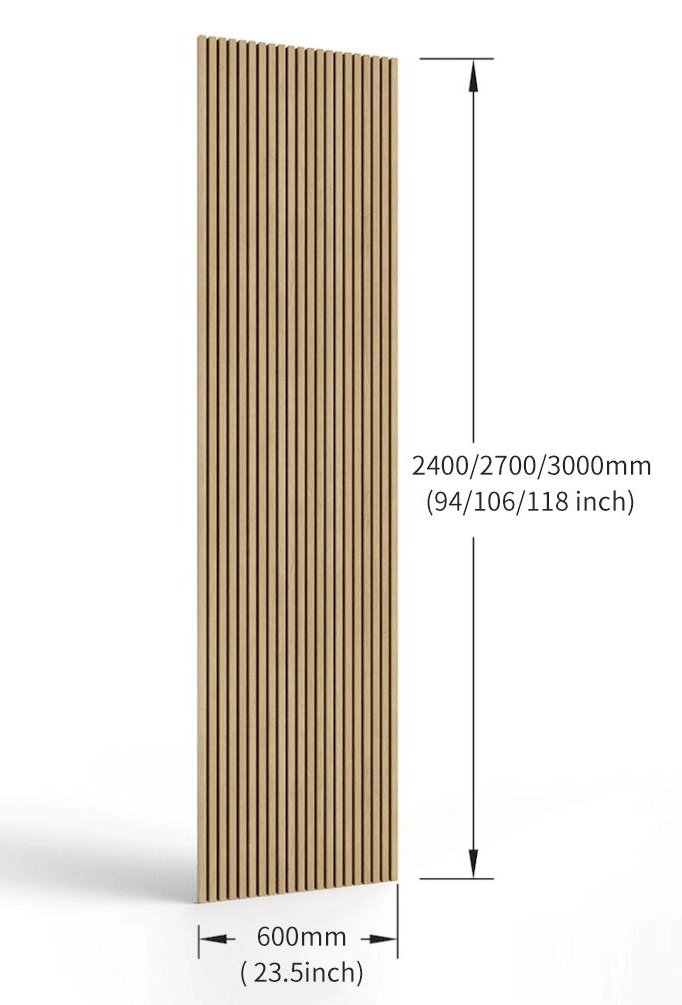
NFDecor wood slat panels use veneered lamella strips with an acoustic felt backing. The current wooden acoustic panel product page lists 600 mm widths with 2400, 2700, or 3000 mm lengths, plus a 21 mm standard option and an 18 mm thin option. These listed choices are a starting point, not permission to assume every combination is available for every order.
I put the specification in an attachment with a date and revision number. The supplier should confirm it line by line before issuing the pro forma invoice or sales contract.
Minimum specification checklist
- Product construction: veneered lamella strips plus acoustic felt backing
- Overall size: select and confirm the required listed length and width
- Thickness: identify 21 mm standard or 18 mm thin version
- Appearance: veneer species/reference, finish, felt color, and variation limits
- Geometry: slat width, gap, layout, edges, and agreed tolerances
- Quality reference: signed or clearly identified approval sample
- Packing and labels: carton contents, protection, marks, and barcode needs
- Documents: drawing, data sheet, test reports, and shipment paperwork
The materials guide for importers can help a buyer ask more precise construction questions. I also ask for a quotation-deviation column. A blank “confirmed” is weaker than a clear list of exceptions, because small dimensional or finish changes can affect installation and room-to-room consistency.
3. Verify NRC and Compliance Documents, Not Sales Labels
Problem: Buyers may receive an NRC number, “fireproof” wording, or certification logos without enough information to determine whether the evidence applies to the offered construction.
To verify acoustic or fire-performance claims, importers should request the complete report, test method, laboratory identity, specimen construction, mounting or installation details, report date, and result pages. They should then match the tested specimen to the quoted panel. A logo, summary sheet, or unsupported number is not a substitute for traceable evidence.

For sound absorption, NRC is commonly derived from testing under ASTM C423, while ISO 354 is another recognized laboratory method for measuring sound absorption in a reverberation room.12 The result can depend on the complete tested assembly and mounting condition. I therefore do not publish or infer an NRC value unless a relevant report supports the exact claim.
For surface-burning characteristics, ASTM E84 addresses flame spread and smoke development under its stated test conditions.3 It should not be reduced to a vague “fireproof” label. The buyer must determine which code, standard, classification, and project acceptance process applies in the destination market. NFDecor’s certification overview is a practical question-setting resource, not a substitute for project-specific review.
| Document check | Accept only when it shows |
|---|---|
| Acoustic report | Method, specimen, mounting, laboratory, date, and result |
| Fire-related report | Exact standard, tested construction, result/classification, and scope |
| Material claim | Traceable product description and issuing body where applicable |
| Quote match | Written link between report specimen and offered SKU/construction |
I ask for documents before bulk approval and send them to the buyer’s consultant, code reviewer, or customer when required. If the construction differs, I record the gap instead of presenting the report as universal proof.
4. Build a Traceable Sample-to-Bulk Approval Process
Problem: A sample may look correct, yet the bulk order can still diverge because the approved reference, natural veneer variation, production specification, labels, or inspection rules were never fixed.
A reliable sample-to-bulk process uses a coded approval sample, signed specification, agreed appearance range, pre-production confirmation, production inspection criteria, and shipment release records. Importers should photograph and retain the approved sample, define what natural variation is acceptable, and require written approval for any material, dimension, finish, or packing change.
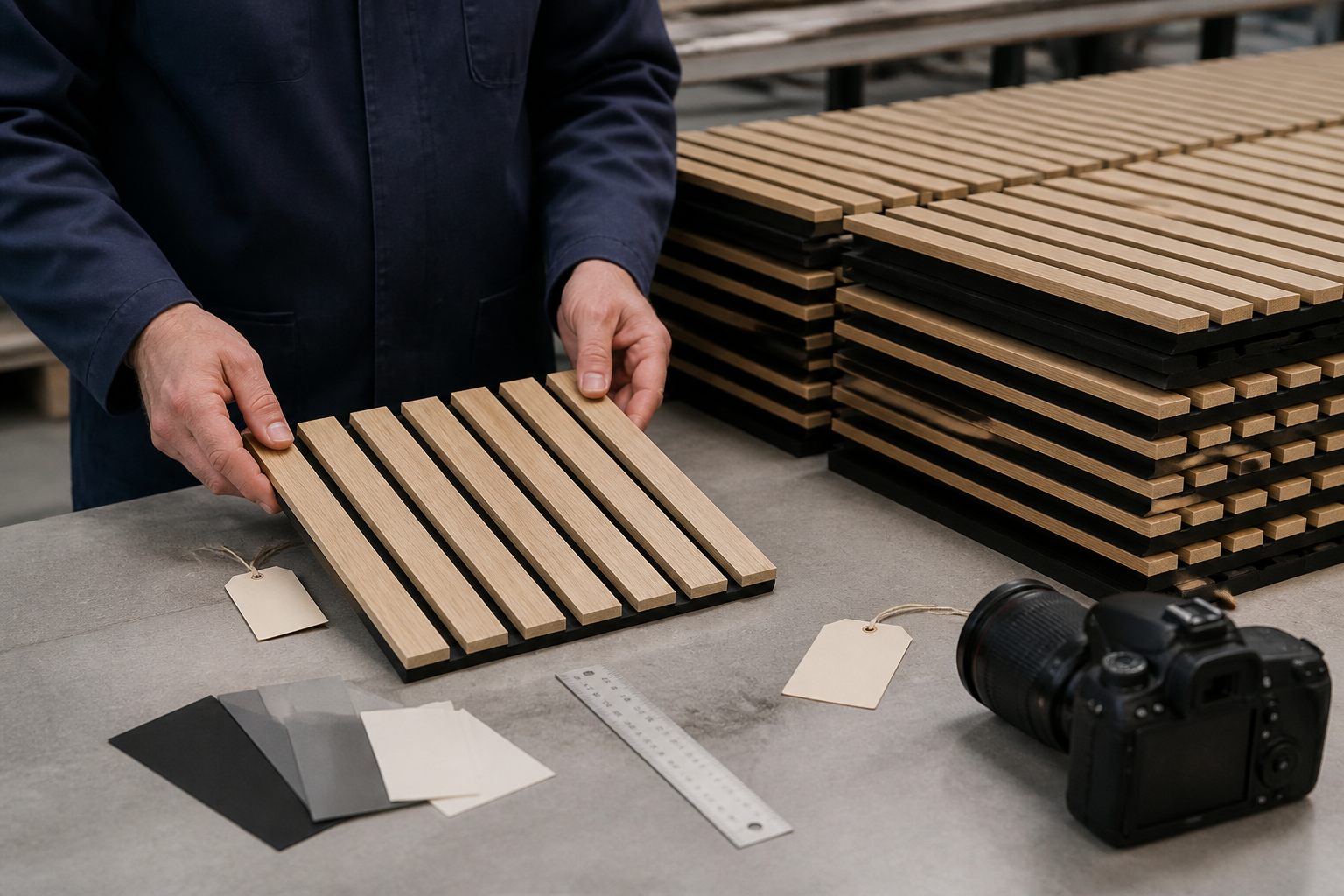
I treat the sample as one controlled record, not the whole contract. Veneer is a natural material, so “exactly identical” may be unrealistic; however, an undefined range is also risky. The buyer and supplier should agree how tone, grain, sheen, felt color, slat alignment, edges, and surface defects will be judged.
A practical approval path is:
- Request stage: Reference the current specification revision in the sample request.
- Sample review: Check dimensions, construction, finish, felt, edges, labeling, and handling.
- Approval record: Assign a sample code; add dated photos and written comments.
- Pre-production check: Confirm that materials and packing match the approved basis.
- Bulk inspection: Use agreed sampling and acceptance criteria rather than a vague “good quality” standard.
- Release: Close deviations in writing before shipment authorization.
The NFDecor manufacturer page provides useful context for discussing production and customization, but I still recommend documenting the exact controls for each purchase order.
| Control point | Record to retain |
|---|---|
| Visual approval | Coded sample and calibrated-reference photos where practical |
| Dimensional approval | Drawing, tolerance table, and measurement record |
| Change control | Description, reason, impact, and buyer authorization |
| Shipment release | Inspection report, packing photos, and approved deviations |
If a buyer needs third-party inspection, I include its scope and timing in the order documents. The objective is not to promise zero variation; it is to make decisions traceable before the goods leave the factory.
5. Confirm MOQ, Packing, and Shipping as One Commercial System
Problem: A low unit quote can hide mismatched MOQ assumptions, weak packing, inefficient loading, unclear Incoterms, or responsibilities that appear only after the order is placed.
Importers should confirm MOQ, order mix, carton quantity, protective materials, pallet or crate requirements, package dimensions and weight, loading plan, shipping marks, Incoterm, destination charges, and damage-claim procedure before paying a deposit. These details should be supplier-confirmed for the specific order rather than copied from a generic product listing.

I do not state a fixed NFDecor MOQ, price, lead time, capacity, or freight figure without a current, order-specific confirmation. Those variables can change with size, finish, quantity mix, packaging, production schedule, and route. Instead, I ask for a landed-cost comparison on one defined specification and one delivery scope.
Incoterms 2020 clarify selected seller and buyer obligations, but the rule must be named with a precise place—for example, not merely “FOB” without the agreed port.4 For loading and securing cargo transport units, the CTU Code provides practical international guidance.5
Commercial confirmation list
- MOQ for the exact size, thickness, finish, and mixed-SKU request
- Quantity per carton and total carton count
- Corner, face, edge, moisture, and compression protection
- Pallet/crate treatment and destination restrictions, if applicable
- Package dimensions, gross/net weight, and loading orientation
- Container/loading plan and unused-space assumptions
- Incoterm 2020 rule plus named place or port
- Required shipping documents, marks, and barcode format
- Inspection release, damage evidence, claim notice, and remedy process
I request actual packing drawings or photos before final approval and check whether long panels need special handling at the warehouse and jobsite. A quote should separate product, packing, inspection, inland transport, freight, and destination-side assumptions where relevant. When ready, buyers can contact NFDecor with the specification, quantity mix, destination, and requested trade term for order-specific confirmation.
Frequently Asked Questions
What is the first document I should send when requesting a bulk quote?
Send a revision-controlled buying brief covering application, construction, dimensions, thickness, finish, quantity mix, documents, packing, destination, and Incoterm. This makes supplier replies comparable and highlights exceptions early.
Can I select a panel based only on a physical sample?
No. A sample helps evaluate appearance, construction, and handling, but it does not establish acoustic performance, fire-related status, bulk consistency, packing, or commercial responsibility. Pair it with the approved specification and relevant reports.
How should I check an NRC claim?
Request the complete acoustic test report and compare its method, specimen construction, thickness, backing, mounting, laboratory, and results with the quoted panel. If they do not match, ask the supplier to explain the difference without assuming the value transfers.
What should I ask about MOQ and shipping?
Ask for order-specific MOQ, mixed-SKU rules, carton quantity, package dimensions and weight, protection method, loading plan, named Incoterm place, shipping documents, and claims procedure. Do not rely on a generic listing for current terms.
Next Step
A dependable bulk purchase starts with a clear brief, not a broad request for “best price.” I recommend compiling the five controls above into one enquiry package and asking the supplier to acknowledge every line. To discuss a current project without assuming performance or commercial terms, send NFDecor your specification and destination details.
References
- ASTM C423-22, Standard Test Method for Sound Absorption and Sound Absorption Coefficients by the Reverberation Room Method. ↩
- ISO 354:2003, Acoustics — Measurement of sound absorption in a reverberation room. ↩
- Intertek, ASTM E84: Standard Test Method for Surface Burning Characteristics of Building Materials. ↩
- International Chamber of Commerce, Incoterms 2020. ↩
- UNECE, IMO/ILO/UNECE Code of Practice for Packing of Cargo Transport Units (CTU Code). ↩