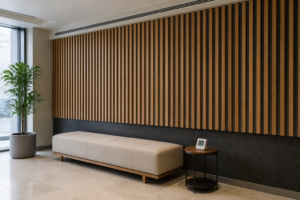
NRC rating is one of the first specifications that importers and distributors ask me about when comparing acoustic panels. The confusion begins when buyers assume that a higher number automatically means better soundproofing. That mistake can lead to the wrong product category, difficult customer conversations, and unsuitable specifications. I help buyers separate echo control from sound blocking before they compare ratings.
An NRC rating indicates how much sound a material can absorb inside a room, helping reduce reflected sound and echo. It does not measure how effectively a wall or partition stops sound from passing between rooms. For B2B buyers, the right approach is to define the noise problem first, then verify that the tested panel configuration matches the product being purchased.
I have found that this distinction makes procurement discussions much clearer. A restaurant, office, hotel corridor, or meeting room may need better speech comfort inside the space. A private office or hotel partition may instead need less sound transmission. Those are related acoustic concerns, but they require different evaluation methods.
What Does an NRC Rating Actually Measure?
An NRC rating can sound technical, so many buyers rely on the number without reviewing the test context. That creates risk when product listings compare panels as though every rating measures the same performance. I encourage buyers to treat NRC as useful evidence, but only for the specific job it was designed to describe.
NRC, or Noise Reduction Coefficient, is a single-number indicator of a material’s sound-absorption performance.1 It summarizes how much incident sound a tested material absorbs rather than reflects at selected mid-range frequencies.2 A higher NRC generally means more sound absorption in the tested setup, which can help reduce reverberation and echo within a room.3
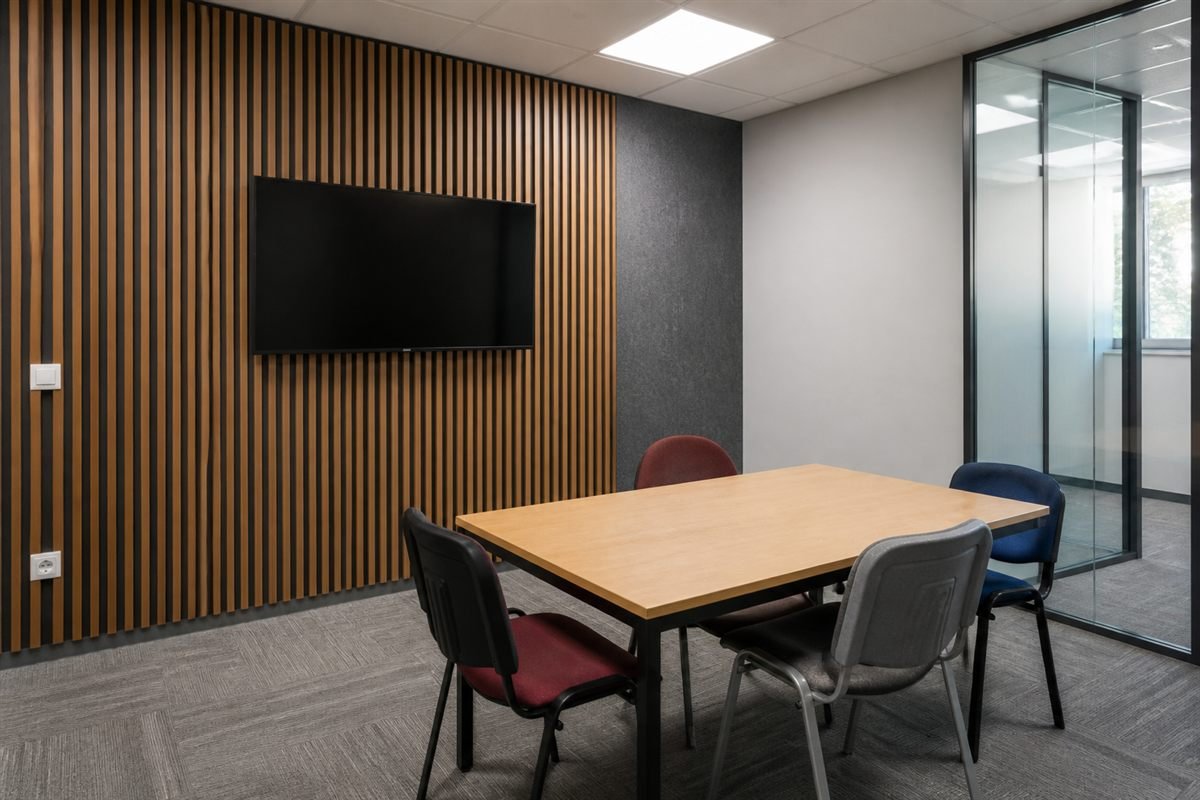
NRC in plain English
When sound waves strike a hard surface, such as glass, concrete, tile, or painted gypsum board, much of that sound energy can reflect back into the room. Multiple reflections can make a space feel noisy, echoey, or tiring for conversation.
An absorptive surface helps reduce a portion of that reflected energy. This is where an NRC rating is relevant.
For example, acoustic wall panels with porous felt, mineral-fiber components, open surfaces, or engineered backing systems may absorb sound energy. The amount absorbed depends on the product’s materials, thickness, air gap, mounting method, and other construction details.
In procurement terms, I describe NRC as an indicator that helps buyers assess whether a product is intended to support interior sound absorption.
How NRC is commonly calculated
In the United States, NRC testing is commonly associated with ASTM C423, a test method for sound absorption and sound absorption coefficients using a reverberation room. The NRC figure is traditionally calculated from absorption coefficients at four frequencies:
- 250 Hz
- 500 Hz
- 1,000 Hz
- 2,000 Hz
The average is rounded to the nearest 0.05 under the applicable method.4 Buyers should verify the current test method, laboratory report, mounting condition, and calculation basis directly in supplier documentation. Standards can be updated, and test reports may use different methods or reporting formats in different markets.
I do not treat an NRC figure as a complete acoustic design. I treat it as one procurement data point that needs a verified product specification behind it.
What an NRC rating does not tell you
An NRC figure does not provide a full frequency-by-frequency absorption profile. It also does not automatically predict how a panel will perform in every installed room.
It does not answer questions such as:
- How much sound will travel through a partition?
- Will speech privacy improve between two offices?
- Will low-frequency bass be adequately controlled?
- Will the room meet a project-specific acoustic target?
- Will the same result occur if the installer changes the mounting method?
For these reasons, I recommend that distributors request the full test report or a controlled technical datasheet when NRC is part of a sales claim. A single number is convenient, but the construction behind that number matters.
Does a Higher NRC Rating Mean Better Soundproofing?
This is the question I hear most often in manufacturer-side presales conversations. A buyer may compare two decorative panels and ask whether the higher-rated product is “more soundproof.” The concern is reasonable, but the wording combines two different acoustic tasks that should be evaluated separately.
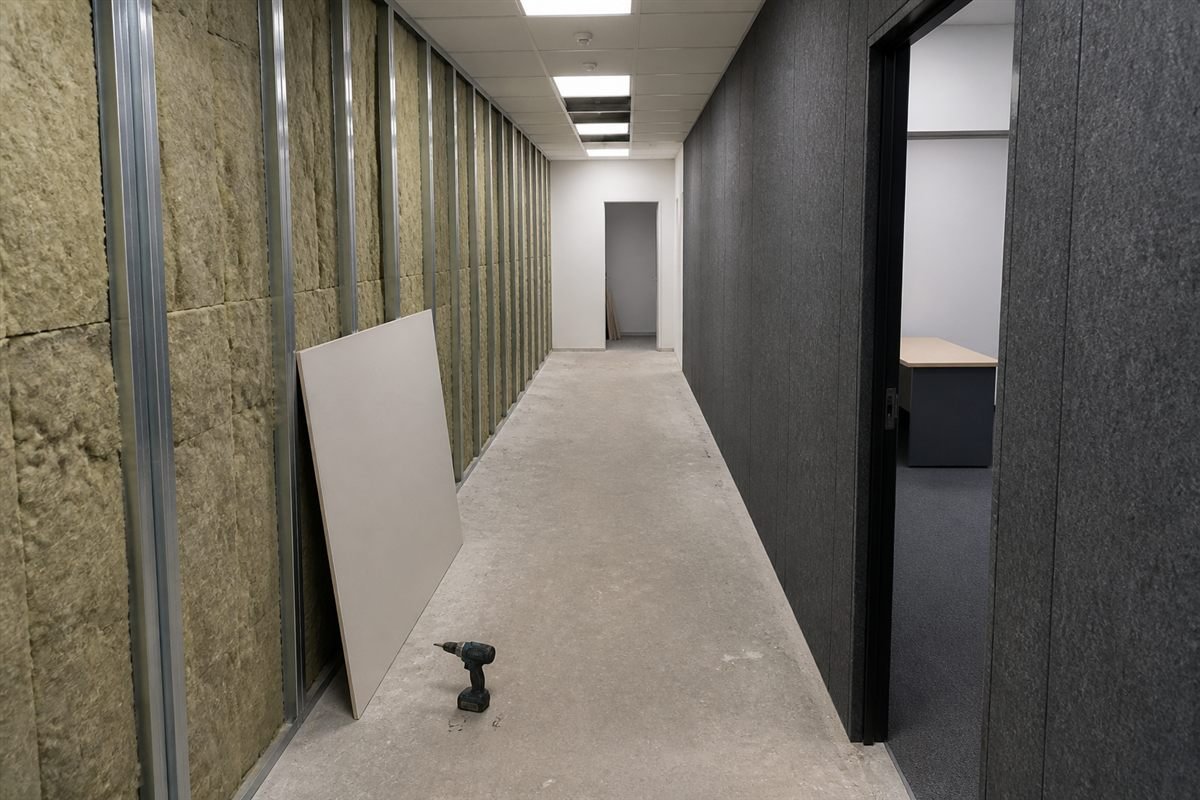
A higher NRC rating does not mean better soundproofing.5 It generally indicates greater sound absorption in the tested configuration, which can reduce echo within a room. Soundproofing concerns sound transmission through walls, floors, ceilings, doors, and gaps6, so buyers need separate partition-system data for that task.
Start with the presales question
Before I discuss an NRC rating, I ask a simple question:
Are you trying to reduce echo in the room, or stop sound from passing through a wall or partition?
The answer changes the product category that a buyer should investigate.
If the goal is less echo in a café, conference room, office, showroom, lobby, or restaurant, absorptive wall or ceiling treatments may be relevant. In that situation, NRC can help compare sound-absorption options.
If the goal is to limit speech transfer between meeting rooms, hotel rooms, apartments, classrooms, or consulting rooms, the buyer needs to assess the whole separating assembly. The relevant considerations may include wall mass, insulation, framing, resilient components, penetrations, doors, seals, glazing, and installation quality.
Sound absorption versus sound transmission
The following table helps separate the two concepts during supplier evaluation:
| Buyer’s question | Primary acoustic issue | Typical product or system focus | Is NRC the main metric? |
|---|---|---|---|
| “This restaurant sounds too loud.” | Echo and reverberation within one space | Absorptive wall and ceiling finishes | Often relevant |
| “Speech is unclear in our conference room.” | Reflected sound and room acoustics | Absorptive treatment, layout, ceiling treatment | Often relevant |
| “People can hear calls through office walls.” | Sound transmission between spaces | Full wall/partition assembly, doors, seals | Not sufficient |
| “Guests hear neighboring hotel rooms.” | Sound transmission and flanking paths | Partition, floor/ceiling, doors, service penetrations | Not sufficient |
| “The lobby feels harsh and noisy.” | Interior reflection control | Decorative acoustic panels and ceiling solutions | Often relevant |
Why the distinction protects your product selection
A decorative acoustic panel can be a valuable addition to an interior design package. It can contribute to a more comfortable acoustic environment when selected and installed appropriately. However, a wall-mounted absorptive panel is not automatically a sound barrier.
I have seen buyers use “soundproof” as a broad marketing term because it is familiar to end users. For B2B listings and project submittals, I suggest more precise wording:
- Sound-absorbing wall panel
- Acoustic panel for echo and reverberation control
- Decorative wall treatment with documented NRC performance
- Panel intended to support room acoustic comfort
These descriptions are more accurate than claiming that an NRC-rated panel will stop sound transmission. They also reduce the risk of a distributor promising results that depend on a complete building assembly or a qualified acoustic design.
Why Does NRC Rating Depend on Product Configuration?
A product name alone does not carry an NRC rating. Buyers can encounter a similar-looking panel in several thicknesses, felt densities, wood-slat spacings, backings, and installation methods. If they assume one report applies to every variation, they may unintentionally misrepresent the product to a project buyer.
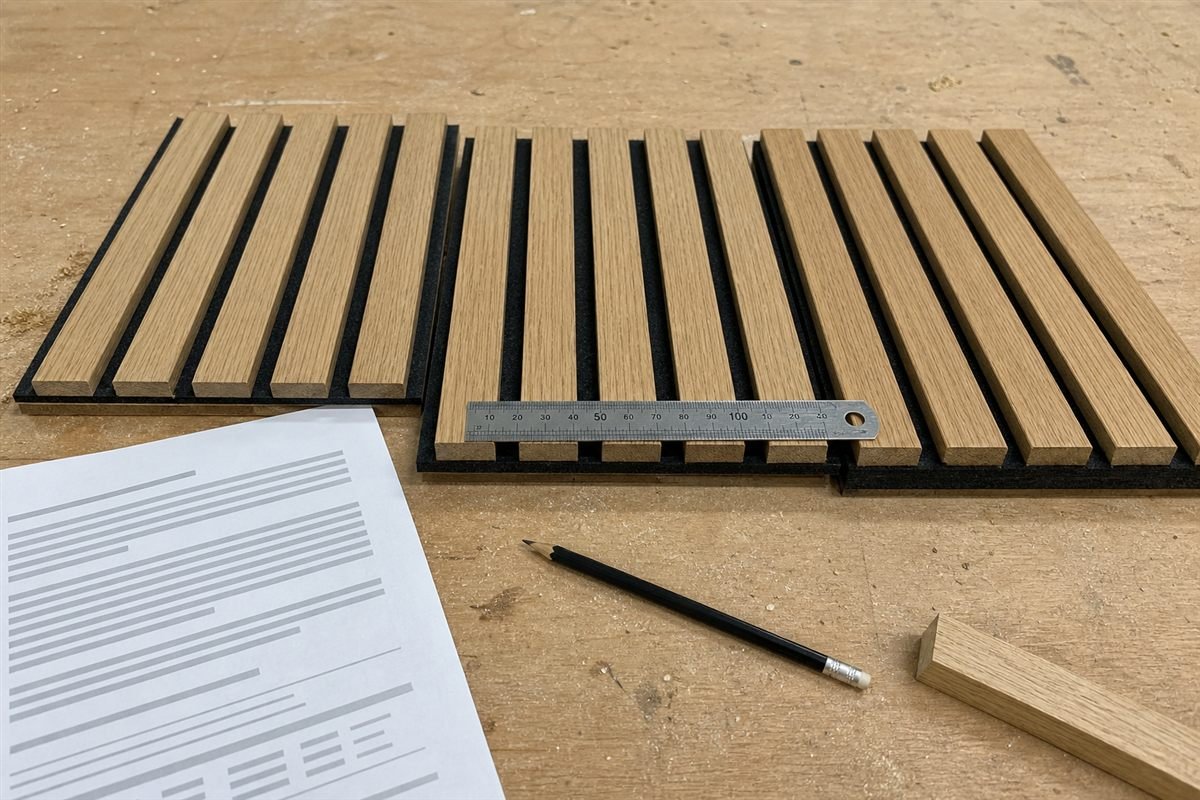
An NRC rating belongs to the exact product configuration that was tested.7 Changes to panel thickness, facing material, backing, air cavity, mounting method, or substrate can change sound-absorption performance.8 Buyers should match the report’s tested construction to the configuration they plan to source, sell, and install.
Review the tested configuration, not just the headline number
When I prepare technical information for an importer, I recommend that they compare the purchase specification against the test documentation line by line. This practice is especially important for customized decorative acoustic panels.
A useful document review should identify:
-
Product construction
Check the panel’s layers, core material, facing, slat material, felt material, and backing. -
Panel thickness
A 9 mm panel, a 12 mm panel, and a 21 mm panel should not be assumed to perform identically. -
Mounting method
Direct mounting, batten mounting, and mounting with an air cavity can produce different absorption results. -
Substrate or support
A panel tested over a rigid backing may behave differently from the same panel installed over open framing or insulation. -
Tested dimensions and coverage
Laboratory test specimens follow defined conditions. A small decorative feature wall and a large treated area will not create the same room effect. -
Test standard and laboratory details
Buyers should verify the named standard, report number, test date, laboratory identity, and any stated mounting designation.
Why air gaps and installation details matter
One common area of confusion involves the air space behind an acoustic panel. An air cavity can influence sound absorption, particularly at lower frequencies relative to a direct-mounted condition.9 However, I do not recommend that buyers assume a cavity will always produce a specific result without documentation.
The installed assembly matters. For example, a wooden slat acoustic panel might be sold in a standard felt-backed format. A project may then install it:
- Directly against a finished wall;
- Over timber battens;
- Over metal framing;
- With mineral wool behind the panel;
- With a specified cavity depth.
Each approach can create a different acoustic system. The product may remain visually similar, but the relevant tested configuration may no longer be identical.
A practical supplier-document checklist
| Document or detail | Why I ask for it | Buyer action |
|---|---|---|
| NRC test report | Confirms the reported rating and test context | Request the complete report when required |
| Product datasheet | Connects the test to a commercial SKU | Match material and thickness to the PO |
| Installation guide | Identifies mounting assumptions | Check whether the project method matches |
| Material specification | Confirms felt, wood, backing, and core details | Control substitutions before production |
| Certification documents | Supports compliance review where applicable | Verify validity, scope, and issuing body |
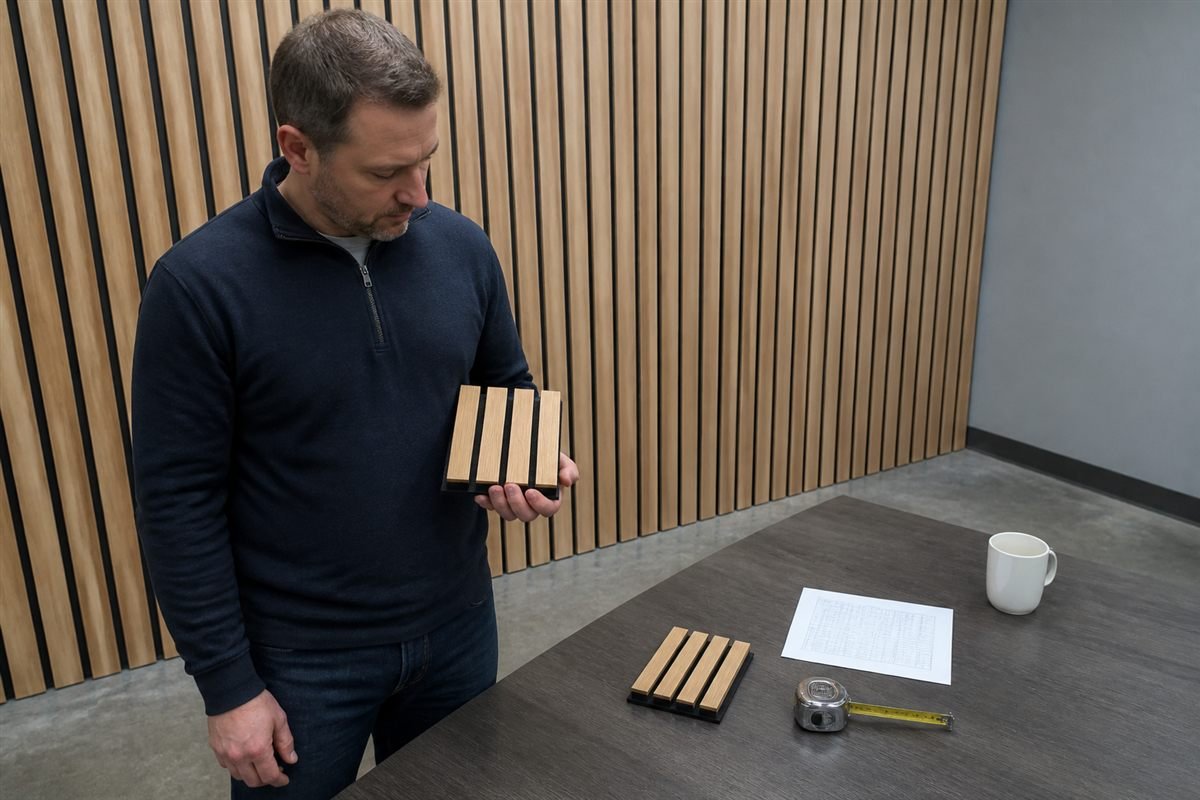
| Sample approval record | Creates a physical reference for production | Retain an approved control sample |
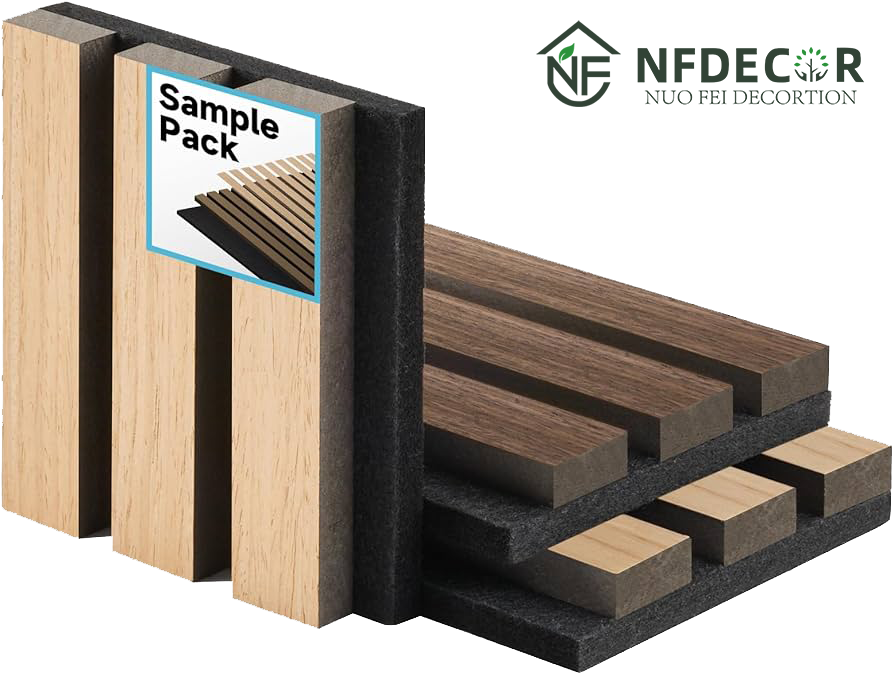
At NF Decor, we provide product information for buyers evaluating wooden slat acoustic panels, felt wall panels, suede acoustic wood panels, tambour panels, hexagon panels, and artistic 3D wall panels. I still advise each buyer to verify which documents apply to the exact selected product. Certifications such as CE, SGS, ISO, and FSC should also be reviewed as documents with defined scope, rather than treated as universal proof of every project requirement.
How Should Buyers Compare NRC Rating When Sourcing Acoustic Panels?
Importers often need a simple way to compare multiple suppliers quickly. The temptation is to rank quotations from the highest NRC rating to the lowest. That can be useful as an initial filter for a defined sound-absorption application, but it is not a complete purchasing method.
Buyers should compare NRC rating only after defining the space, the primary noise problem, and the intended installation. Then they should evaluate tested configuration, material quality, customization capability, documentation, sampling, production controls, and delivery reliability alongside the reported absorption value.
Build the brief before requesting quotations
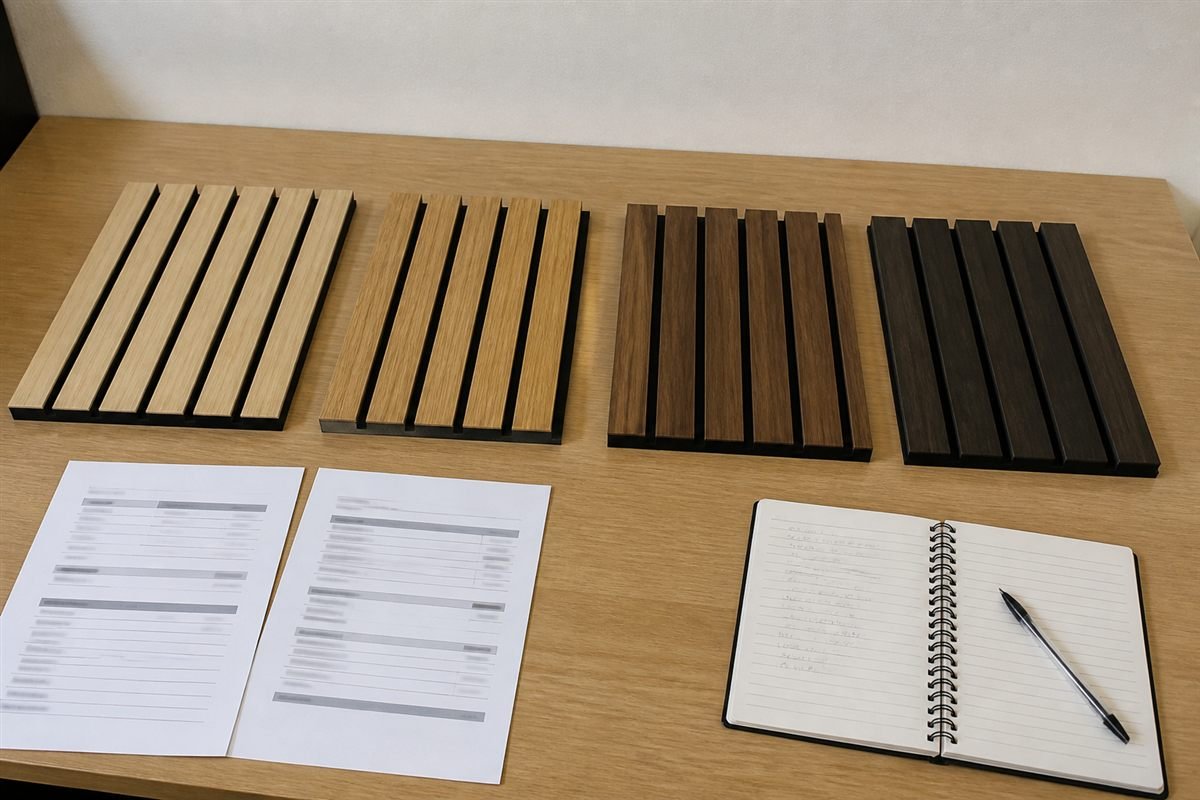
I recommend that a distributor creates a short procurement brief before contacting suppliers. This makes quotations easier to compare and reduces repeated revisions later.
The brief can include:
- Intended room type, such as office, restaurant, hotel, school, retail space, or conference room;
- Main concern: echo control, visual decoration, speech comfort, privacy, or a combination;
- Wall or ceiling installation location;
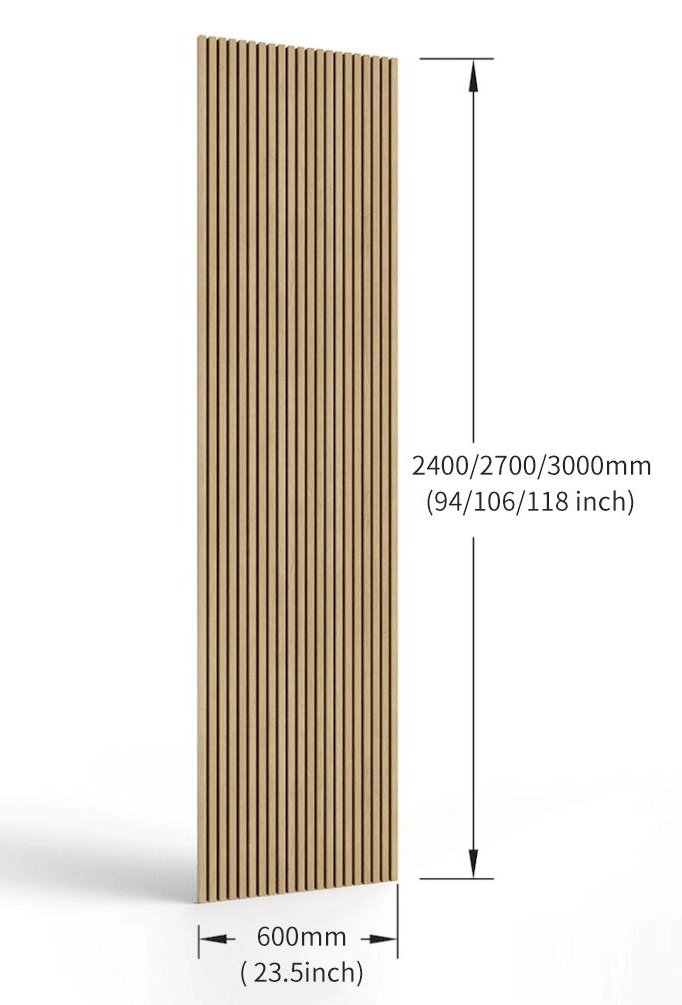
- Required panel dimensions;
- Preferred finish, color, wood veneer, fabric, or felt tone;
- Required fire, material, sustainability, or market-access documents;
- Expected purchase volume;
- Target delivery date and destination port;
- Need for samples, mockups, or third-party inspection.
Compare supplier claims with evidence
A responsible supplier comparison should separate claim, evidence, and commercial capability.
| Evaluation area | Questions I suggest asking | Evidence to request |
|---|---|---|
| Sound absorption | What exact configuration achieved the stated NRC rating? | Test report and matching datasheet |
| Product consistency | Can the factory control color, slat spacing, and panel dimensions? | Approved samples, tolerances, QC process |
| Customization | Can the supplier make requested sizes and finishes? | Technical drawing and pre-production sample |
| Capacity | Can the supplier meet volume and lead-time requirements? | Production plan and factory information |
| Compliance | Which documents apply to this SKU and destination market? | Current certificates and declarations |
| Packaging | How will panels be protected in container shipment? | Packaging specification and loading plan |
| Communication | Who handles technical questions and production changes? | Named contact and documented approval process |
Evaluate the whole commercial risk
For a high-volume order, a marginal difference in a reported NRC value may matter less than whether the supplier can reproduce the tested configuration consistently. I encourage buyers to ask whether the material supplied for their order matches the approved sample and technical sheet.
At NF Decor, our manufacturing background includes more than 30 years of panel production, five production lines, and monthly capacity exceeding 50,000 m². Those facts can help buyers assess scale, but they should not replace their own due diligence. I recommend that importers review samples, verify documents, confirm order specifications, and consider independent inspection where the project risk justifies it.
A qualified acoustic professional should evaluate application-specific requirements, especially when a project has contractual acoustic targets, privacy expectations, regulated requirements, or complex room conditions.
Frequently Asked Questions
What is a good NRC rating for acoustic wall panels?
A good NRC rating depends on the room, the treated surface area, the installation method, and the actual acoustic problem. I do not recommend one universal threshold. Buyers should first confirm that they need sound absorption, then compare tested products configured for the intended installation.
Is NRC rating the same as soundproofing?
No. An NRC rating measures sound absorption, which helps reduce reflections and echo within a room. Soundproofing concerns reducing sound transmission between spaces. A partition’s sound-control performance depends on the complete wall, floor, ceiling, door, sealing, and installation system.
Can the same acoustic panel have different NRC ratings?
Yes. The same visual panel design may have different results when thickness, backing, mounting method, air gap, insulation, or substrate changes. I recommend that buyers request documentation for the exact configuration they intend to purchase and install.
Should importers request an NRC test report from every supplier?
If NRC is part of the product claim or project specification, I believe importers should request supporting documentation. The buyer should review the test method, tested construction, mounting details, laboratory information, and whether the report matches the commercial product being quoted.
Does an NRC rating guarantee results after installation?
No laboratory rating guarantees a specific on-site result.10 Room dimensions, surface finishes, furniture, ceiling treatment, installation quality, panel coverage, and noise source all affect real-world conditions. A qualified professional can assess project-specific acoustic performance where needed.
Conclusion
An NRC rating is a useful sound-absorption indicator, but it is not a universal score for better acoustics or stronger soundproofing. I encourage B2B buyers to begin with the actual task: reduce echo within a room or reduce sound transmission between spaces. Then, buyers can select the correct product category and verify that the stated rating matches the exact panel construction and installation method. If you are sourcing decorative acoustic wall panels for distribution or commercial projects, contact NF Decor to discuss samples, customization options, technical documents, and production requirements.
Related technical guides
- NRC vs STC: Which Rating Does Your Project Actually Need?
- What Are Acoustic Panels Made Of? A Materials Guide for Importers and Distributors
"Noise reduction coefficient - Wikipedia", https://en.wikipedia.org/wiki/Noise_reduction_coefficient. Noise Reduction Coefficient (NRC) is a single-number rating used to summarize the sound-absorption behavior of a material under standardized test conditions. Evidence role: definition; source type: encyclopedia. Supports: NRC is a single-number rating derived from sound-absorption measurements and used to characterize absorptive materials.. ↩
"Application of Scirpus grossus fiber as a sound absorber - PMC", https://pmc.ncbi.nlm.nih.gov/articles/PMC11002279/. NRC summarizes measured sound-absorption coefficients at specified mid-frequency octave bands; absorbed acoustic energy is correspondingly not returned to the room as reflected sound. Evidence role: mechanism; source type: research. Supports: NRC is calculated from measured sound-absorption coefficients at specified octave-band frequencies and represents energy absorbed rather than reflected.. ↩
"Introduction to Acoustics", https://pages.uoregon.edu/ftepfer/SchlFacilities/AcousticsIntro.html. In room acoustics, added sound-absorbing surface area reduces reflected acoustic energy and can reduce reverberation; a higher NRC denotes greater absorption for the particular tested configuration. Evidence role: mechanism; source type: education. Supports: Increasing sound absorption in a room can reduce reflected sound and shorten reverberation, while NRC characterizes absorption for a tested specimen.. Scope note: The resulting change in reverberation depends on room volume, total absorption, source characteristics, and the area and placement of treatment. ↩
"Meteorological Measurement Error Analysis based on ...", https://hps.ne.uiuc.edu/numug/archive/2005/presentations/presentations/Wastrack.ANS_error_calcs.pdf. Under the ASTM NRC calculation convention, the arithmetic mean of the designated octave-band absorption coefficients is reported after rounding to the nearest 0.05. Evidence role: mechanism; source type: institution. Supports: The applicable NRC procedure averages absorption coefficients at designated frequencies and rounds the result in 0.05 increments.. Scope note: The precise calculation must be checked against the edition of the applicable test standard because standards and reporting conventions may be revised. ↩
"SSA Acoustics", https://www.portlandoregon.gov/bds/appeals/index.cfm?action=getfile&appeal_id=13924&file_id=14151. NRC is an absorption rating for materials tested in a room-acoustics context; it is not a measure of airborne sound transmission loss through a wall, floor, or partition. Evidence role: definition; source type: government. Supports: NRC measures sound absorption, whereas sound insulation between rooms is evaluated with transmission-based metrics and assembly tests.. Scope note: Sound-isolation performance depends on the complete construction and may be reported using other metrics, such as transmission-loss data or sound transmission class. ↩
"new construction acoustical design guide", https://www.highpointnc.gov/DocumentCenter/View/1103/Wyle-New-Construction-Acoustical-Design-Guide-April-2003-PDF?bidId=. Building sound isolation is governed by transmission through separating elements and by leakage or flanking routes such as joints, service penetrations, door perimeters, and connected structural paths. Evidence role: mechanism; source type: government. Supports: Airborne sound can pass through separating constructions and via openings, joints, penetrations, and flanking paths.. Scope note: The relative importance of each path varies with the building design, construction quality, and frequency range. ↩
"Comparison of ASTM and ISO sound absorption test methods", https://www.academia.edu/47039179/Comparison_of_ASTM_and_ISO_sound_absorption_test_methods. Sound-absorption test results obtained under reverberation-room methods apply to the specimen construction, dimensions, and mounting condition described in the test record. Evidence role: general_support; source type: institution. Supports: Reverberation-room absorption results are reported for the specimen and mounting condition actually tested.. Scope note: A report may be informative for similar products, but it is not direct proof of identical performance after material, geometry, or installation changes. ↩
"A preliminary study of effect of air gap on sound absorption ...", https://www.academia.edu/1559344/A_preliminary_study_of_effect_of_air_gap_on_sound_absorption_of_natural_coir_fiber. Experimental and theoretical studies of porous and panel absorbers show that thickness, backing conditions, air cavities, and mounting arrangements can materially alter frequency-dependent sound absorption. Evidence role: mechanism; source type: paper. Supports: Material thickness, backing, cavity depth, and mounting conditions affect measured sound-absorption coefficients of acoustic treatments.. Scope note: The magnitude and frequency range of the change depend on the specific material, geometry, and installation assembly. ↩
"acoustic absorption of structural membranes", https://upcommons.upc.edu/bitstreams/502601a9-62d2-4307-984c-b201c751d240/download. For many porous absorbers, an air cavity behind the material changes the acoustic impedance of the assembly and can increase absorption at lower frequencies relative to direct mounting. Evidence role: mechanism; source type: paper. Supports: An air space behind a porous absorber can modify its absorption spectrum and commonly increases absorption at lower frequencies compared with direct mounting.. Scope note: This effect is configuration-specific and does not establish a fixed performance improvement without measurements for the actual assembly. ↩
"acoustical testing services", https://www.nist.gov/document/acoustics-applicationpdf. Laboratory acoustic ratings characterize performance under specified controlled test conditions; installed room performance also depends on room geometry, surface distribution, treatment area, installation quality, and sound-source conditions. Evidence role: general_support; source type: research. Supports: Laboratory measurements are made under controlled conditions, while field acoustic outcomes depend on room geometry, installation, furnishings, coverage, and other site variables.. Scope note: Laboratory data remain useful for product comparison when the tested configuration and intended installation are appropriately matched. ↩