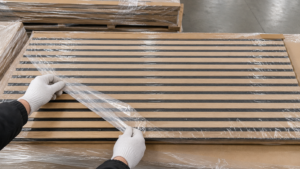
Every direct-bond project we quote starts with the same quiet argument, and it is never really about the panels. The buyer has a wall schedule, a delivery date and a price per square metre. Somewhere between those three things, the question of whether the wall will actually hold the panel gets deferred to the morning the crates are opened.
By then the adhesive has usually been chosen by whoever reached site first. Nobody has written down what the wall is made of, what is painted on it, or which trade accepted it as ready. When an edge lifts later, the panel takes the blame, the adhesive supplier points at the substrate, and the wall contractor points at the panel. Nobody can prove anything, because nothing was recorded.
The way out is not a stronger adhesive. It is an approval sequence that treats direct bond acoustic panel adhesive coverage as a measured, recorded quantity rather than an assumption: accept the wall zone by zone, get the adhesive, the primer and the existing finish approved in writing by the parties who own them, prove the bond on the real wall, and put all of it into the commercial pack before the order is placed. That sequence is what follows.
1. Is This Wall Actually Suitable for Direct Bonding?
A wall schedule says “paint grade plaster” or “fair-face concrete” and everyone nods. Neither line tells you whether the surface will accept an adhesive, and by the time anyone checks, the panels are usually already in the building.
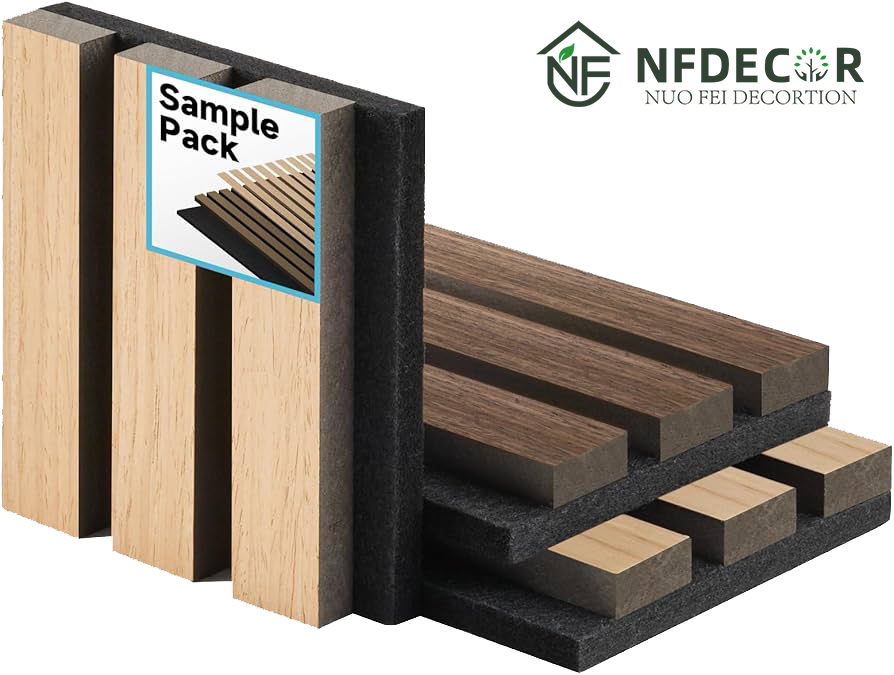
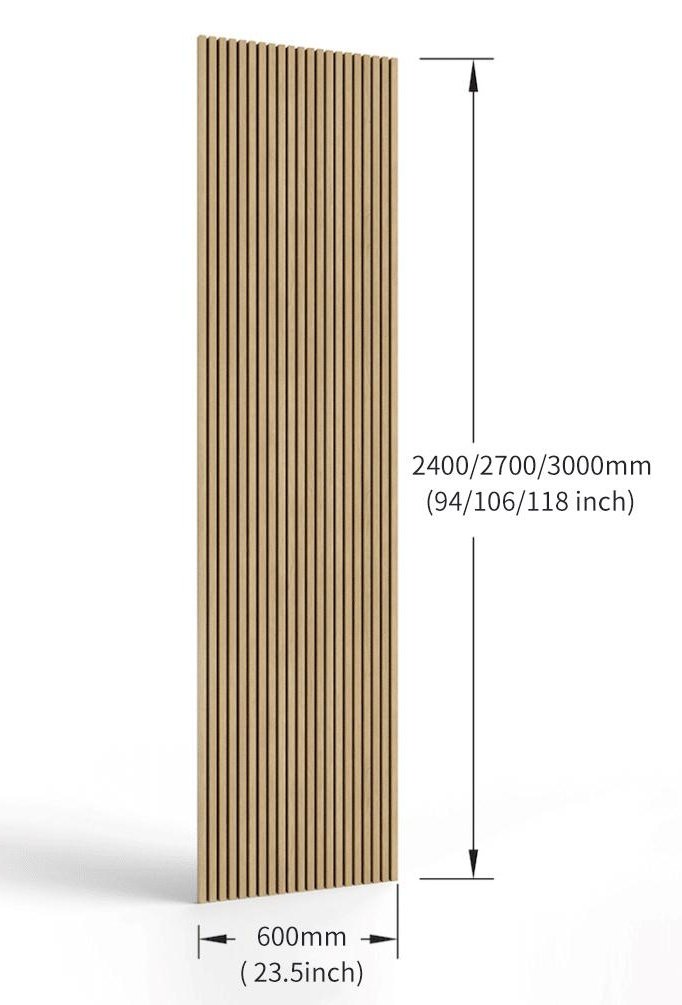
Agitation / Answer: Bond performance is decided at the surface, not in the container. Our panels are frameless rectangles of parallel wood slats carried on a continuous black PET felt, so there is no cavity behind them to swallow a hollow, a chalky coat or a damp patch. Each wall zone must be accepted or rejected before panels ship, in writing, with photographs.
Solution
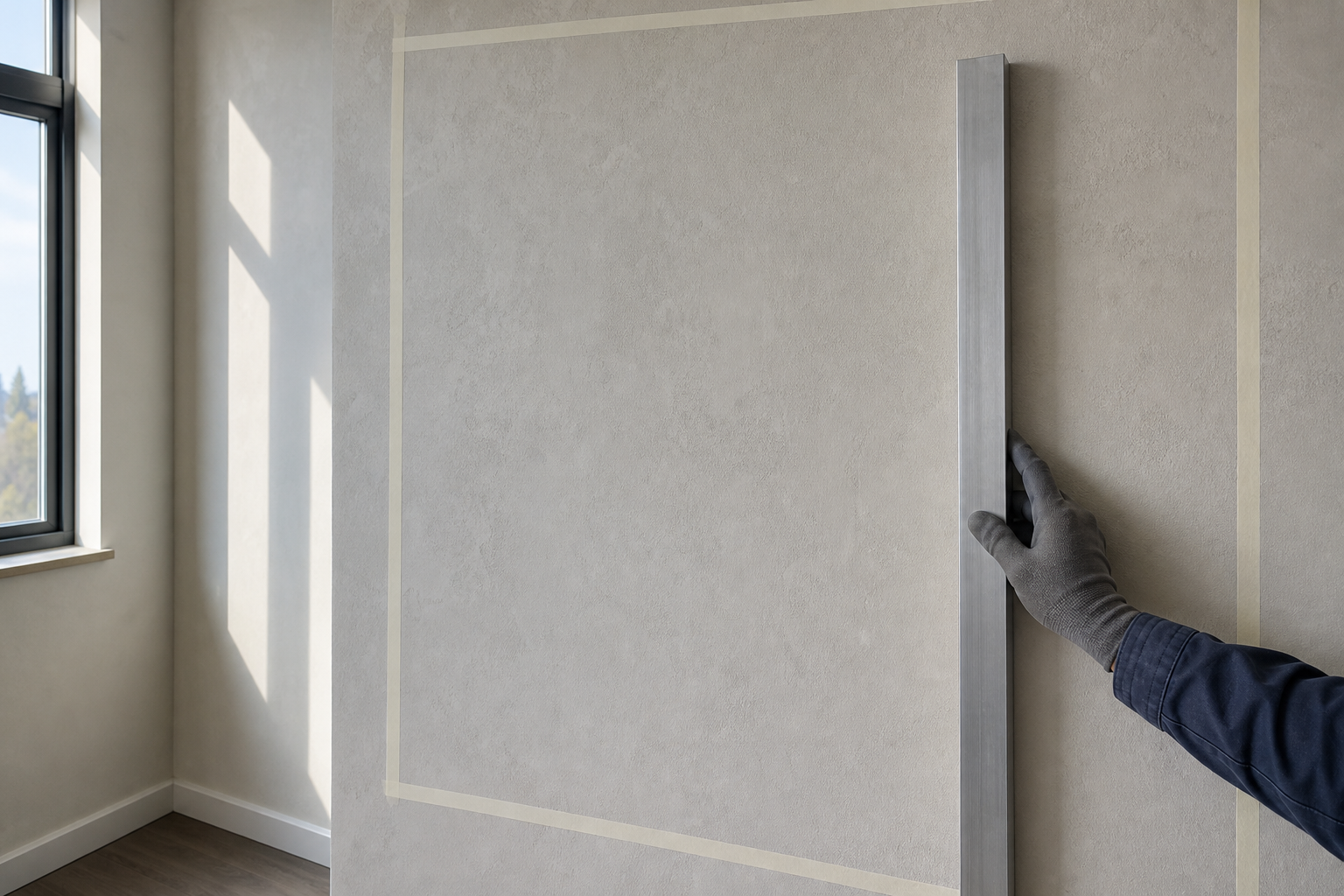
We start with a wall walk, not a spreadsheet. We take the elevations and a roll of masking tape and mark every zone that will receive panels, because one room can hold painted plasterboard, a skimmed column, a tiled splashback and bare concrete within a few metres. Each zone carries an identifier through the project: trial, adhesive batch, consumption log, snag list.[1]
The checks are physical. Is the surface sound, or does a light scrape lift a chalky coat? Is there dust, oil, release agent, silicone or grease that will sit between the felt and the wall? Has the wall been sealed or painted with something the approved adhesive was never assessed against? Is it dry and ventilated enough for the specified system? Is it flat enough for the felt to sit in continuous contact rather than bridging a step?
Two distinctions prevent most arguments later. Panel flatness is a product characteristic we control and you can inspect on delivery, and it is a separate check from wall flatness, as our note on panel flatness and bow inspection explains. And the felt is an acoustic and separation layer, not a levelling layer: it will not fill a hollow or bridge a ridge, which is why a failing wall is rejected rather than compensated for with extra adhesive, a distinction we also draw in PET felt versus wood slat panels.
Where a zone fails, we record it and stop. “Prepare and re-inspect” or “do not bond here” are the only two outcomes, and both belong in writing before production is released. Recently plastered or humid buildings need caution, since drying is slow and uneven; the wall-by-wall view in our guide to wood acoustic panels in humid interiors is the one we use on site.
| What the inspector sees | Decision before any panel is opened |
|---|---|
| Chalking, dusting or flaking coating | Reject the zone until the coating is removed or prepared exactly as the approved system requires |
| Glossy, sealed or recently painted finish | Do not assume compatibility; obtain written confirmation from the adhesive supplier |
| Friable plaster, soft skim or hollow render | Reject the zone and refer it to the wall trade |
| Damp, cold or newly finished wall | Do not bond; record the condition and hold the panels |
| Step, ridge or hollow beyond the system’s allowance | Refer to the wall owner; never build up with adhesive |
| Bare concrete with form release agent or dust | Clean per the approved method, then re-inspect the zone |
2. Who Approves the Adhesive, Primer, and Existing Wall Finish Together?
Three parties usually assume the other two have approved something. The contractor assumes the supplier’s datasheet covers painted plaster. The supplier assumes the paint was removed. The buyer assumes both have signed something.
Agitation / Answer: Compatibility is a written, three-way statement, not a phone call. The adhesive supplier approves the adhesive, the primer and the substrates it may touch; the wall owner approves the finish and its preparation; the applicator confirms it can work to those instructions. Until those three signatures sit on one page, no adhesive order should be placed.
Solution
We ask for a single approval sheet per project, and we ask for it before the purchase order, not after the first elevation. It is short, but it forces the decisions nobody wants to own.
The adhesive supplier’s section names the product by its datasheet reference and revision, states whether a primer is required and which one, lists the substrates and finishes it has been assessed against, and gives the application method and the protection period before the bond is disturbed. The wall owner’s section identifies each existing finish, who applied it, how it will be prepared, and which zones are excluded. The applicator’s section confirms crew competence, tools, access and the sequence it will follow. The buyer consolidates the three, issues a revision number, and reissues it whenever a product, a finish or a wall zone changes.
Two boundaries keep this honest. We manufacture panels; we do not approve adhesives, primers or wall assemblies, and we will not certify somebody else’s bond. Equally, an adhesive supplier cannot approve a coating they have never seen, so a site sample of the actual finish usually has to travel to them. That sample is cheap; discovering the incompatibility after a wall is clad is not.
Language matters here as well. Adhesion, primer and substrate are defined terms in adhesive standards,[2] and using them loosely is how a “primer” becomes a “sealer” in one email and a “bonding agent” in the next. Keep the words on the approval sheet identical to the words on the datasheet, and keep the revision that was approved in the handover file.

3. What Should a Real Trial Bond Prove Before the Crew Starts?
Trials are often done on an offcut of plasterboard in the site office, at a comfortable height, by the person who will not be installing. That proves the adhesive sticks to plasterboard. It proves very little about the wall.
Agitation / Answer: A trial is only evidence if it happens on the actual wall, at full height or on a representative bay, using the approved adhesive, primer and tools, and if somebody watches it through the protection period in the datasheet. Anything less is a demonstration, and a demonstration cannot be used to release a wall for production.
Solution
We ask for the trial to be built where the risk is highest: a bay that shares the substrate, the finish and the site conditions of the largest wall area. Where the wall is full height, the trial panel should run from finished floor to the ceiling line, because the top and bottom edges are where a bond tells the truth.
Before anything is opened, the crew photographs the bare wall with the zone identifier and a straightedge across the surface, so the starting condition is documented rather than remembered. Then the approved sequence is followed exactly: preparation, primer if the datasheet requires it, adhesive applied by the specified method, panel positioned, and the joint alignment checked against neighbouring panels using the same setting-out rules as production, which are covered in our guide to joints, edges and cutouts.
What we watch for is behaviour, not a number. Does the panel creep or slide after positioning? Does the felt compress evenly, or is the panel sitting on high points? Do wall defects telegraph through the slats? Does an edge lift as the adhesive takes up? Are the slat lines still parallel to the joint and to the ceiling? Photographs are taken at each interval the datasheet specifies, plus one with the trial still in place before it is removed or accepted.
If the trial misbehaves, the answer is not more adhesive. The zone goes back to the wall trade, the adhesive supplier is asked for a revised instruction, and the trial is rebuilt. And remember what a trial cannot prove: acoustic performance belongs to the whole assembly, not to the bond, which is why we keep the acoustic discussion separate, as in our article on flanking paths and the assembly-level view taken by WoodWorks.[3]

4. How Do You Record Adhesive Use So It Survives a Procurement Audit?
Adhesive usually arrives on a separate delivery note, in a quantity nobody checks, against walls nobody labelled. By the final account, the litres on the invoice and the square metres on the wall have no relationship anyone can defend.
Agitation / Answer: Record consumption by zone, not by project. Weigh containers before and after each wall area, log the batch code, the panel count and the reason for any loss, and reconcile the total against the quoted allowance. A measured record turns adhesive from an arguable extra into a quantity your buyer can forecast, audit and challenge.
Solution
Every adhesive and primer container is weighed when it is issued to a zone and again when the zone is closed, on the same scale, with the reading written on the container label and in the log. The difference is the consumption for that zone, and dividing it by the clad area gives a figure the project can actually use.
The log needs to be short enough that crews fill it in. Ours carries the zone identifier, the substrate and finish recorded at acceptance, the panel count and clad area, the adhesive product, datasheet revision and batch, the primer batch where used, container weights in and out, the computed quantity, any loss with a stated reason such as a trimmed panel or a rejected zone, the applicator, the date, and the conditions observed on the day.
That record then does three jobs. Commercially, it lets a buyer compare measured consumption with the allowance in the quotation and with the coverage the adhesive supplier’s datasheet implies, and challenge either one with evidence. Logistically, it shows which zones consumed more than expected, which is usually a substrate story rather than an adhesive story, and it feeds the next phase’s order quantity, the same logic we describe in choosing wood slat panels for bulk orders. Contractually, it is the only document that answers “how much adhesive did this wall take” without an argument. A current safety data sheet belongs in the same file, since handling and ventilation duties travel with the product rather than with the panel.[4]
We deliberately publish no consumption figure of our own. Coverage belongs to the adhesive the project specifies, applied by the method its supplier approved, on the substrate the wall owner accepted, and only a measured record from that combination means anything.
5. What Should the Quotation and Handover Pack Actually Contain?
Most direct-bond quotations are a panel price per square metre and a delivery line. The adhesive, the primer, the trial, the records and the question of who accepts the wall are all left to be discovered later, usually by the person holding the snag list.
Agitation / Answer: A comparable quotation itemises the whole direct-bond scope and states its boundaries. Panels, adhesive and primer responsibility, surface preparation, the trial and its attendance, the approval documents, the records, the spares and the handover sign-off all belong on the page. Anything absent from the quotation becomes a variation or an argument.
Solution
We structure our own offer, and ask installers to structure theirs, around seven lines. First, the panel: size, slat geometry, felt, finish batch and the inspection criteria at delivery, which is where our packaging and veneer variation guidance becomes relevant to what actually arrives. Second, adhesive and primer: who supplies, who pays, and which approval sheet governs them. Third, surface preparation: explicitly included or explicitly excluded, zone by zone. Fourth, the trial: who builds it, who attends, who signs it off, and whether it is a priced item. Fifth, documentation: the approval sheet with its revision, the datasheets that were approved, trial photographs and the consumption log. Sixth, spares: a quantity agreed for future damage, cut from a compatible batch. Seventh, handover: the boundary between bonded panel and finished wall, the cleaning and protection responsibility, and the sign-off list.
The handover pack should let a stranger reconstruct the job: what the wall was, who accepted it, which adhesive and primer were approved and by whom, what the trial showed, how much material each zone consumed, and which panels were held as spares. Test evidence belongs there too, read honestly rather than quoted as a headline, as described in reading an acoustic panel test report.
What the pack must not contain is invented certainty. We will not put a coverage rate, an open time, a cure time, a pull-off value or a guarantee figure into a quotation, because those belong to the adhesive system the project approves and the conditions on that site. Buyers who receive such figures from a panel supplier should ask which laboratory tested them and on which substrate.

Can Panels Be Bonded Straight Over Existing Paint or Wallpaper?
Only when the adhesive supplier has approved that exact finish in writing and the wall owner has accepted it as sound. Paint can be chalky, glossy, silicone-contaminated or simply incompatible, and wallpaper introduces a layer that may fail before the adhesive does. If approval is not on paper, the finish is prepared or removed as the approved system requires before any panel is opened.
Does Every Wall Need Its Own Trial, or Is One Enough?
One trial can cover a family of walls that share substrate, finish, preparation, adhesive and site conditions. It stops covering them the moment any of those change, or when a new crew takes over. That is why the trial record names the zones it represents. A trial on different plaster in a different part of the building is not evidence for the wall you are about to clad.
Who Should Supply the Adhesive and Primer?
Either party can, provided the approval sheet names the product, the batch traceability and the party responsible for storing it correctly. What must not happen is a split where the buyer assumes adhesive is included and the installer assumes it is not. We price panels; the adhesive and primer sit with whoever is named on the approval sheet, and the quotation should say so in one line.
What Happens If a Wall Fails the Check After the Panels Have Arrived?
The panels stay crated and the zone is not bonded. The failure is photographed, logged against its zone identifier and returned to the wall owner with the observation that caused it. The programme is resequenced around the rejected area, and the trial is not repeated until the wall has been prepared and re-inspected. Bonding into a known-bad zone is the one decision that converts a delay into a replacement claim.
How Do We Compare Two Quotations That Assume Different Adhesives?
Ask both to state consumption on the same basis: measured quantity per clad area, primer included or excluded, loss treatment, and whether the trial and its attendance are priced. Then compare the totals rather than the headline panel rate. Where one quote carries an assumed coverage figure, ask for the datasheet it came from. A quote built on an unapproved assumption is cheaper on paper and more expensive on site.
Send Us Your Wall Schedule Before You Order
If you are specifying a direct-bond package, send us the elevation set with the wall types marked, your delivery window and the adhesive supplier your project intends to use. We will come back with the panel schedule, the zone identifiers we recommend for acceptance records, the trial sequence, and a scope list that separates what we supply from what the wall trade and the adhesive supplier must approve. That conversation costs nothing and usually removes one revision from the programme.
References
- ASTM International. ASTM C840-25, Standard Specification for Application and Finishing of Gypsum Board. https://www.astm.org/standards/c840
- ASTM International. ASTM D907-15(2023), Standard Terminology of Adhesives. https://www.astm.org/standards/d907
- WoodWorks. Acoustics and Mass Timber: Room-to-Room Noise Control (solution paper). https://www.woodworks.org/resources/acoustics-and-mass-timber-room-to-room-noise-control/
- UK Health and Safety Executive. Control of Substances Hazardous to Health (COSHH). https://www.hse.gov.uk/coshh/