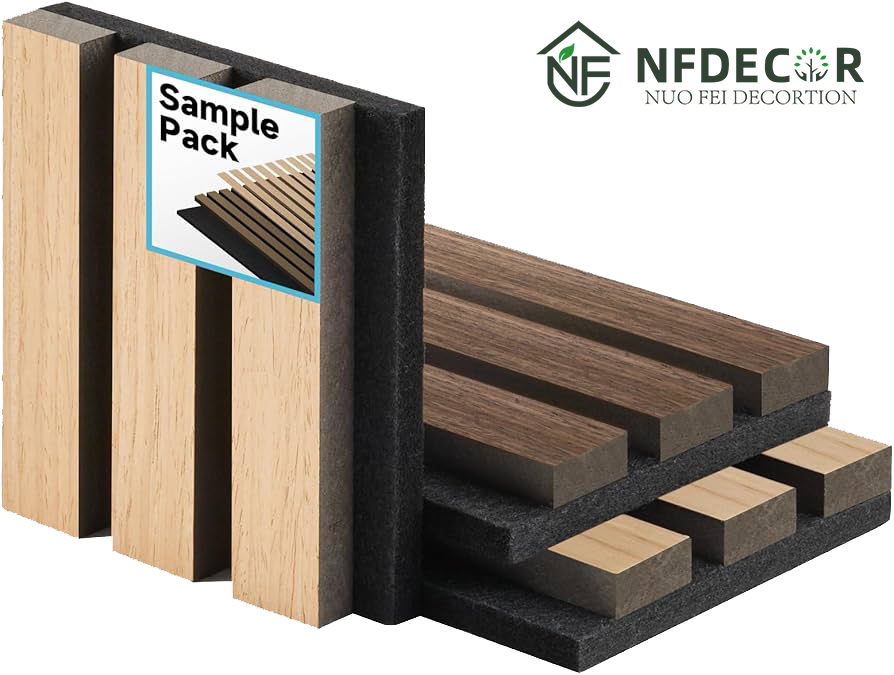
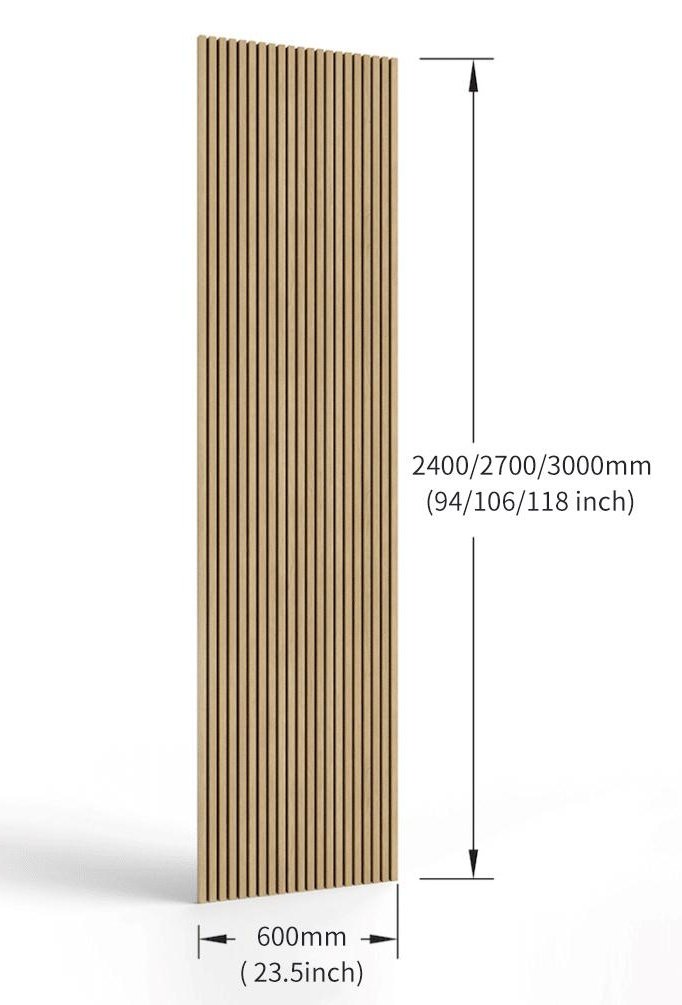
Whenever I review a wood slat acoustic panel package for a project, I start at the back of the panel rather than the front. The face is easy to like: continuous real-wood veneer, straight slats, and a clear protective film that makes every panel look identical in a phone photograph. The back is where the assembly actually exists. A panel of roughly 0.6 m by 2.6 m, with no perimeter frame, is a set of straight continuous veneered slats bonded to a continuous black PET felt, and that single glue line carries everything.
The difficulty is that the back gets inspected once, at goods-in, and then never again. Months after handover a slat lifts at one end, a shadow line opens, and the conversation turns to responsibility. Almost all of that conversation could have been closed at the goods-in stage with a short inspection, four photographs, and one clause written into the purchase order. This article is about that glue line, and about the wood slat acoustic panel delamination that starts where nobody looks.
Where Does the Slat-to-Felt Bond Line Actually Sit on a Wood Slat Acoustic Panel?
Most receiving inspections are written around the face: veneer colour, slat alignment, film condition, general appearance. The back of the panel gets a glance when the pack is opened and no decision at all. On a frameless panel that is a real gap, because the back is not a detail of the product. It is the product.
Agitation / Answer: A wood slat acoustic panel has two bond lines. One runs between each slat and the continuous PET felt; the other between the felt and the wall. This article is about the first, because it disappears behind the panel at installation and it is the only one you can still check at goods-in.
The slat-to-felt line is a face-to-face adhesive joint under a thin, stiff, veneered strip and a needled PET mat. Because the panel has no perimeter frame, there is no rail holding the ends of the slats: the felt is the only continuous element that ties the slats into a single sheet, which is why the panel can be lifted, carried and bonded as one piece. That same continuity is the weakness. A slat that loses adhesion over part of its length has nothing else restraining it, so the released end can rotate slightly away from the felt, open a hairline shadow at the slat edge, and progress along the slat as the felt is progressively peeled.
The failure reads differently from a wall-bond problem. A wall-bond failure tends to show as a whole panel that sounds or feels detached, or an edge of the panel standing off the wall. A slat-to-felt failure is local: one or two slats, usually starting at an end, with the neighbouring slats still flat and the felt field behind them undisturbed. Knowing which of the two you are looking at decides who you call, and it is the first thing I ask for in a project review when a photograph of a lifted slat arrives.
The film matters here only in a negative sense. It protects the veneer face during transport and installation, and it does nothing for the bond line underneath. A panel with perfect film can still have a starved glue line, and a panel with scuffed film can have a perfect one, so film condition is not a proxy for bond quality.

How Should Buyers Inspect the Slat-to-Felt Bond at Goods-In?
Goods-in is the last point at which the back of the panel is genuinely accessible. Once the panel is bonded flat to a wall, the slat-to-felt line is closed behind the assembly, and every later diagnosis has to be made from the face, by inference. Yet most receiving checklists cover the carton, the count and the face, and stop there.
Agitation / Answer: Work the back before the panel leaves its pack. Sight each slat from the end, look for pale felt fibre pulled up with a slat, then press the slat ends by hand. Read the panel as one sheet, and record which pack it came from.
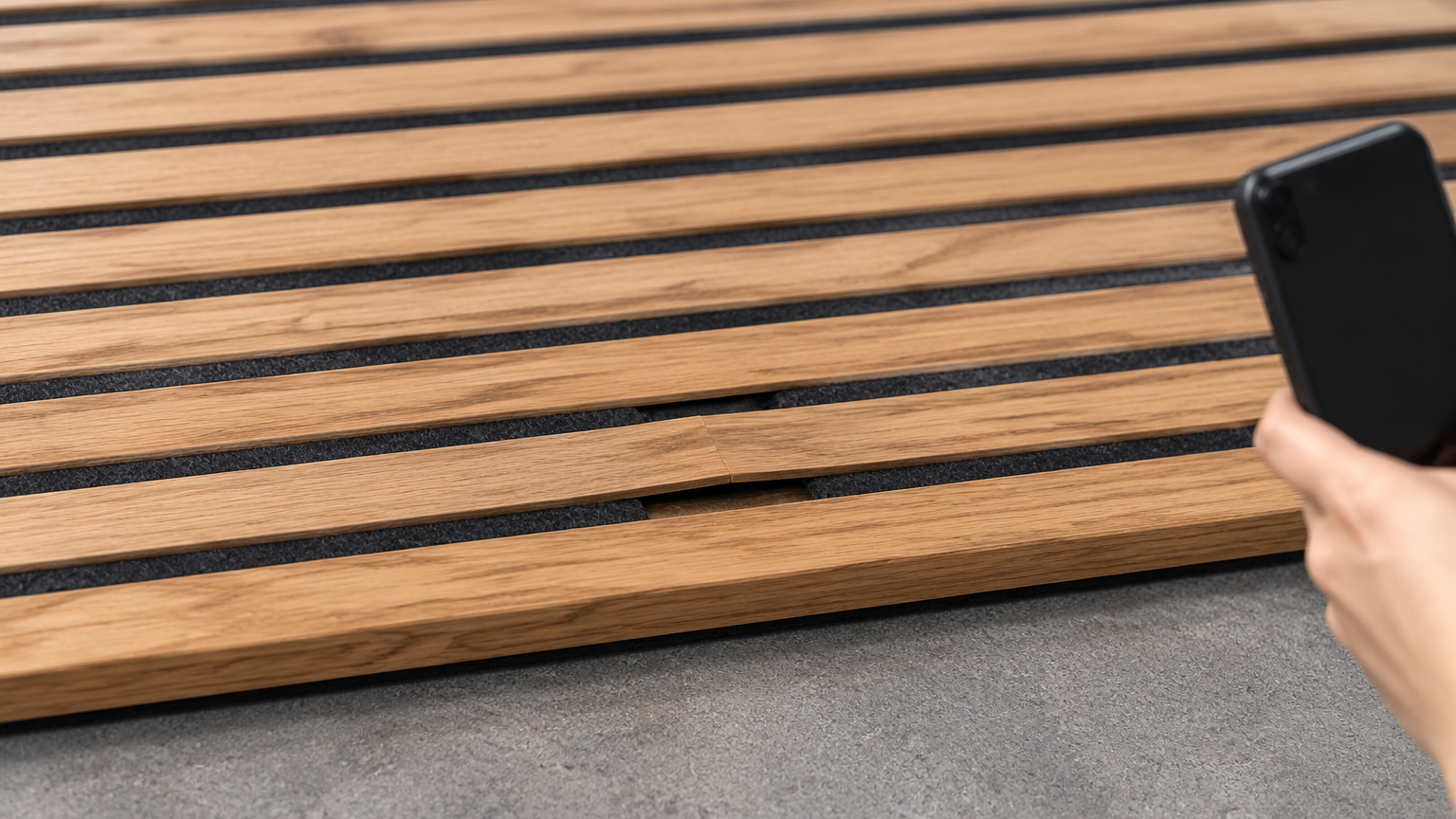
Start with the sample, not the whole delivery. Open the packs that show handling damage first: crushed carton corners, a band that has cut into the wrap, a pallet that has been re-stacked. In each opened pack, take panels from the top, the middle and the bottom of the stack. Two people should lift a panel clear and tilt it so that light rakes across the back at a shallow angle. Raking light is the cheapest inspection tool available: a slat that has released at one end throws a thin shadow along its edge and a slight step against its neighbours, and both vanish under flat frontal light.
Then use your hand. Run a thumb along the exposed felt beside each slat end and press the slat down towards the felt. A bonded end feels solid and moves as one with the sheet; a released end gives, and sometimes clicks as the slat settles back. Do not lever the slat up to test it, because that is how a sound bond line becomes an unsound one, and do not test the same point repeatedly.
Finally, look at the felt itself. Where the felt is exposed in the gaps between slats it should read as one continuous black field with square, clean edges, no torn fibre and no adhesive smears or gloss. A glossy, compressed strip beside a slat is worth photographing even if the slat still feels tight, because it suggests the bond was made under pressure with little adhesive present.
No universal numeric tolerance exists for this joint, and any figure quoted without the maker’s own specification is guesswork.[2] That is why the acceptance rule belongs in the purchase order, agreed before production, so that “acceptable” is a written criterion rather than an opinion formed on the loading dock.
What Evidence Should Be Captured Before a Wood Slat Acoustic Panel Delamination Claim Is Raised?
Claims usually fail on identification, not on merit. A supplier receives a close-up of a lifted slat, cannot tell which panel it is, which pack it came from or how many others are affected, and answers with a general statement about installation. The panel is then either installed anyway, or scrapped, and the evidence goes with it.
Agitation / Answer: A claim survives on batch and position, not adjectives. Photograph the panel label and pack marking, the full back, the released slat under raking light, and the felt beneath it. State how many panels were affected out of how many inspected, and keep the panel.
Build the record in the order the panel travelled. The label on the panel and the marking on the pack are the link to the production batch, and the batch is the link to everything else: the veneer selection, the adhesive run, the packing date, the container. If the label has been removed or is unreadable, photograph the pack and the pallet marking instead and say so plainly, rather than reconstructing an identity you cannot prove.
Express the finding as a count, not a rate you have invented. “Three panels of the twelve opened from pack four show a released slat at the top end” is the kind of line a supplier can act on. It also tells the supplier something useful: whether the problem is scattered across the delivery, which points to a batch or process question, or concentrated in one pack, which points to handling and packing. Cluster and spread are different conversations, and the photographs should let the supplier see which one it is.
Then send one message with everything in it, ask two direct questions, and stop. The first question is whether the supplier classifies the finding as a slat-to-felt bond failure or as damage in transit. The second is what disposition they propose: replacement panels, a written repair method, or a credit. Keep the affected panel, complete and uncut, until that answer arrives in writing. If the supplier asks for a sample, cut it only to their stated dimensions.
| Evidence item | Why it matters | How to capture it |
|---|---|---|
| Panel label and pack marking | Ties the panel to a batch, a run and a container date | One photo per pack, label and marking in the same frame |
| Full back of the affected panel | Shows whether the release is one slat or a pattern | Whole panel, raking light, camera square to the panel |
| Released slat, close up | Shows the shadow line and the length of the release | Raking light at a shallow angle, no flash on the felt |
| Felt surface under the slat | Shows whether fibre has been pulled or adhesive is starved | Same angle, focused on the felt, not the veneer |
| Count of affected panels against panels inspected | Turns an impression into a scope the supplier can price | Written in the message, with pack numbers |
Why Does a Single Slat Release After Handover, and What Should Nobody Do About It?
A lifted slat is visually loud. It sits in the middle of a flat field, it catches light, and it is the first thing a client touches. The instinct on site is to fix it in ten minutes with a cartridge of adhesive and a clamp, close the job, and move on. That instinct destroys the evidence and usually returns the problem.
Agitation / Answer: Isolate the slat, do not press adhesive into it, and do not pin, screw or clip it. A released slat is evidence of an incomplete bond line, and an unknown adhesive over a starved line will fail again with your name on it. Photograph it, trace the batch, and ask the supplier for a written method.
Several mechanisms produce the same visible result, and they are worth separating before anyone touches the panel. The first is a bond line that was incomplete from the start: adhesive present along the middle of a slat but starved at the ends. The second is handling: panels carried by a slat edge rather than by the felt, or dragged across a pack, load the bond line in peel.[1] The third is service movement. Veneered slats and a PET felt respond differently to changes in humidity and temperature, and if the panel is held flat and tight the difference shows up as shear along the glue line, concentrated at the ends.[3]
A fourth mechanism sits behind the panel rather than in it. A wall that is not flat forces the panel into a slight twist when it is bonded, and that twist is stored in the assembly permanently. The slat ends then work against the felt for the life of the installation. This is a wall condition, not a slat defect, and it is why the substrate and adhesive approval step in a direct-bond installation deserves its own record.
What nobody should do is equally specific. Do not introduce any mechanical fixing: no screw, pin, clip or staple belongs in this assembly. Do not fill the gap with a site adhesive whose compatibility with PET felt and with the veneered slat is unknown. Do not clamp a slat hard enough to crush the felt, because a compressed felt pad will not recover. Do not trim or sand the slat to hide the step. And do not remove the defective panel on your own initiative, since a direct-bonded panel comes off together with its adhesive line and the wall behind it may need attention that only the supplier’s method should define.
How Should the Repair or Replacement Be Specified in Writing?
The most common answer to a delamination photograph is a sentence: you can glue it back. That is not a method, it is a permission, and it transfers every technical decision to whoever holds the cartridge. On a bonded assembly with a PET felt face, those decisions are not the installer’s to invent.
Agitation / Answer: Ask for four things in writing before any repair begins: the adhesive specified for a slat-to-PET bond, the coverage and application, the holding method with its duration and temperature range, and the acceptance check. If the supplier will not commit those to paper, replace the panel.
The decision between repair and replacement turns on three questions. How much of the slat has released: an end, or most of its length. Whether the felt under the slat is intact or has been torn, because a torn felt face cannot be re-bonded to a sound line. And where the slat sits in the elevation, because a repair in a prominent field is judged differently from one behind a joinery return. If any of those answers is unclear, replacement is the safer route.
Replacement has its own discipline. The substitute panel has to match the elevation, not just the specification: same veneer batch or an approved selection, same slat pitch and slat width, same felt, same overall size, same film. Mixing a panel from a later run into a continuous run of one batch creates a second, more visible problem while solving the first. Order the replacement against the original batch reference.
The existing panel also has to come off under a written method. A direct-bonded frameless panel is removed as a unit, and the wall behind it will carry adhesive residue, so the removal note should state how the wall is prepared before the new panel goes on, in the same document as the original adhesive and substrate approval.
Finally, hold spare stock. Spares kept from the original batch, stored flat, film on, are what make a same-batch replacement possible a year after handover. The quantity is a commercial decision between buyer and supplier, but the batch reference is not optional: a spare panel without it is only nominally a spare.
| Resolution | When it fits | What must be in writing | What to avoid |
|---|---|---|---|
| Supplier-directed re-bond of one slat | Short release at an end, felt intact, inconspicuous position | Adhesive identity, coverage, holding method and duration, temperature range, acceptance check | Any site adhesive chosen on the day |
| Replacement of the whole panel | Long release, torn felt, prominent elevation, or no written method | Batch reference for the new panel, removal method, wall preparation, re-bond method | A panel from an unmatched batch |
| Deferral with the panel isolated | Evidence still being assessed | Isolation instruction, who is responsible, review date | Installing over an unresolved release |
None of these routes should be improvised on site. The assembly is a straight run of veneered slats on a continuous felt; the repair either restores that condition or replaces the panel.

Talk to our team about a specific elevation. If you are holding a panel with a released slat, send the elevation, the panel size, the slat and felt specification, the batch reference and the photographs described above, and we will tell you what we would check next and whether the case reads as a bond-line issue or a handling issue. Send the details to NFDecor and we will respond with a written view rather than a one-line answer.
Can a lifting slat simply be glued back on site with construction adhesive?
No. A construction adhesive chosen on site has not been assessed against PET felt or against the veneered slat, and it will be applied over a line that failed for a reason nobody has identified. The result is usually a second failure in the same place, with the original evidence destroyed. Ask the panel supplier for a written method, or replace the panel.
Is a small gap at the slat ends at delivery automatically a delamination defect?
Not automatically. A slat end can sit slightly proud for reasons unrelated to the glue line, and a shadow at the end of a slat is not proof of release. The distinguishing evidence is at the interface: whether felt fibre has been pulled up with the slat, whether the slat end moves when pressed, and whether the gap closes. Photograph it and ask the supplier to classify it.
Does the protective film hold the slats in place before installation?
No. The film protects the veneer face during transport and installation and has no structural role. Panels should still be carried and handled by the felt and the panel edges, not by a slat, and the film should stay on until the installation method says otherwise. A panel that only looks intact because the film is tight around it has not been inspected.
Can wood slat acoustic panel delamination be detected once the panel is on the wall?
Only partially. Once bonded, the back of the panel is inaccessible, so the check is limited to what can be seen and felt at slat ends and at exposed felt in the gaps. That limitation is the argument for a proper goods-in inspection: it is the only stage at which the whole bond line can be seen.
How many spare panels should be held for slat repairs?
There is no universal number, and any figure quoted without reference to the project is a guess. What matters more than the quantity is the batch: spares drawn from the original production batch, stored flat with the film on, are what allow a replacement panel to match the elevation later. Agree the quantity in the contract and record the batch reference with it.
References
- ASTM International. ASTM D903-98(2017), Standard Test Method for Peel or Stripping Strength of Adhesive Bonds. https://www.astm.org/d0903-98r17.html — used for the point that peel behaviour is measured as a comparative characteristic under defined pretreatment, temperature and test speed, not as a field acceptance value.
- ASTM International. ASTM D905-08(2021), Standard Test Method for Strength Properties of Adhesive Bonds in Shear by Compression Loading. https://www.astm.org/d0905-08r21.html — used for the point that wood-adhesive bond tests are comparative, that wood failure is common in strong joints, and that measured values are not design allowables.
- ASTM International. ASTM D1002-10(2019), Standard Test Method for Apparent Shear Strength of Single-Lap-Joint Adhesively Bonded Metal Specimens by Tension Loading. https://www.astm.org/d1002-10r19.html — used for the caution that bond strength from a small specimen varies with adherends, bonding process, temperature and moisture, and should not be read as a performance guarantee for a different joint.
Related reading on this site: wood slat acoustic panel manufacturing · PET felt wall panels · checking flatness and bow before acceptance · pallet and carton packaging · joints, edges and cutouts · adhesive coverage and substrate approval · reading an acoustic panel test report · wood acoustic panels in humid interiors