Acoustic panels for schools and classrooms can reduce distracting sound, but an impressive rating alone does not make a product suitable. Architects face added risks when test reports cover a different construction, surfaces become difficult to maintain, or installation changes performance. I recommend a gated evaluation that addresses safety, durability, and acoustics in that order.
Acoustic panels for schools and classrooms should first satisfy project-specific safety requirements, then demonstrate suitable durability and maintainability, and finally provide documented sound absorption for the intended room use. Buyers should verify the tested construction, laboratory method, mounting condition, panel quality, placement, and coverage instead of selecting a product from one headline rating.
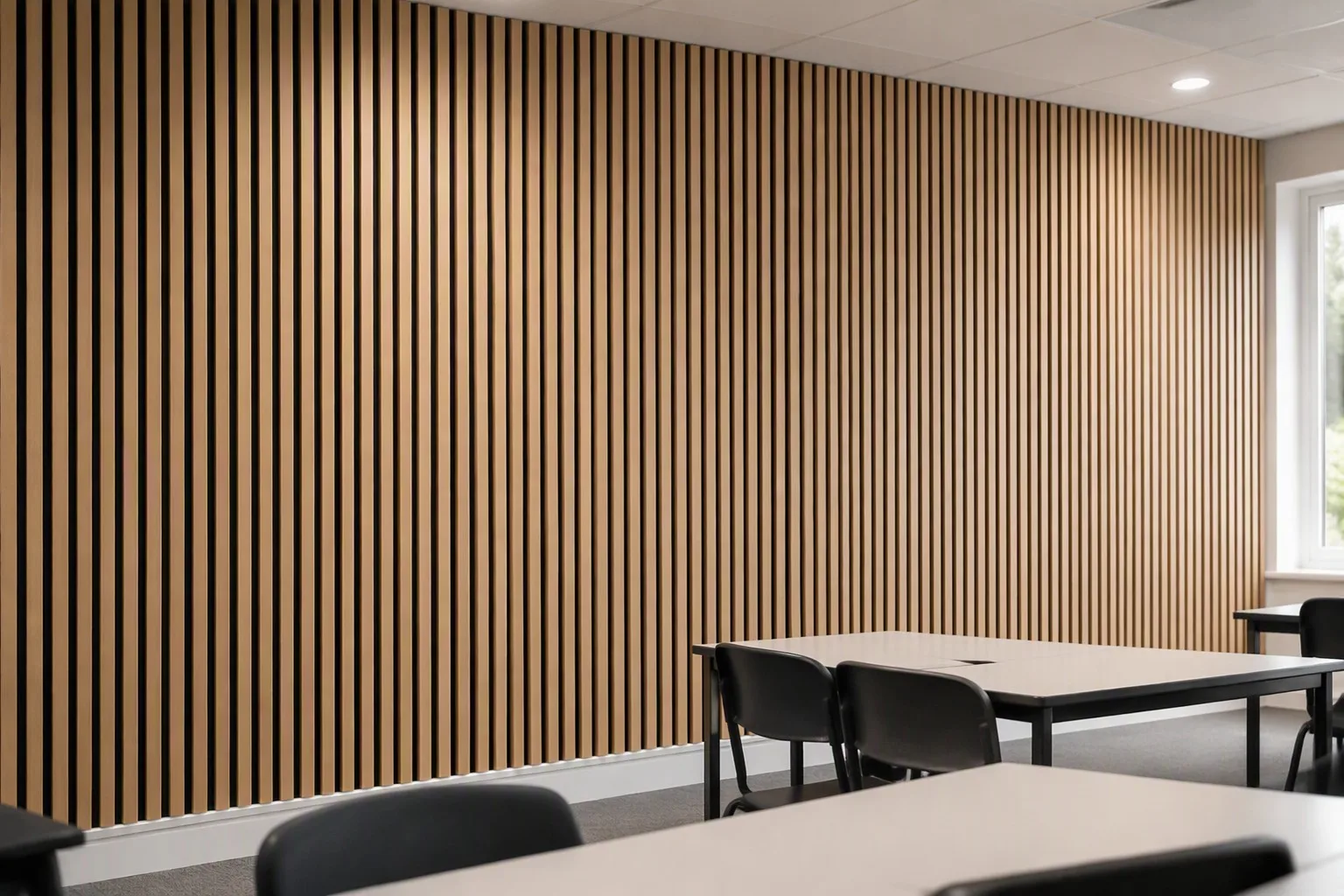
I have supported school-project specification, sample, and delivery discussions with architects and interior designers. Those conversations have shown me that the most useful question is rarely, “Which panel has the highest rating?” A better question is, “Which documented product construction fits this room, jurisdiction, maintenance plan, and installation?”
How Should I Evaluate the Safety of Acoustic Panels for Schools and Classrooms?
Safety documentation can look reassuring while leaving important gaps. A certificate may refer to a different thickness, substrate, finish, or mounting system than the product being specified. If I accept the document without checking its scope, I may create a compliance risk that becomes expensive to correct later.
I treat safety as a pass-or-fail threshold. I first identify the requirements set by the project jurisdiction, school authority, designer, and specification. I then compare those requirements with the exact tested panel construction, referenced standard, classification, laboratory report, mounting method, and stated limitations. I reject unsupported substitutions before comparing aesthetics or absorption ratings.
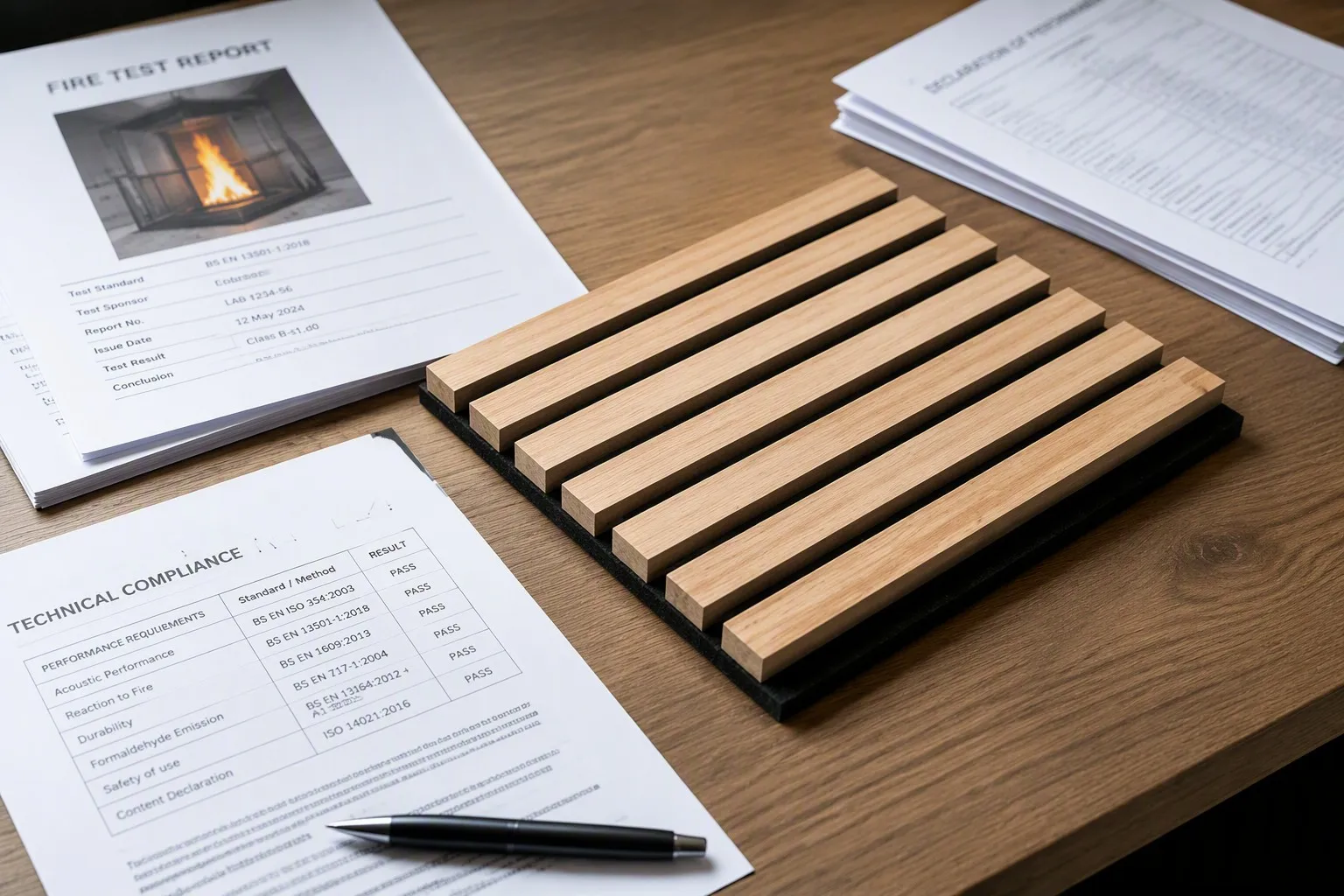
I Check the Exact Tested Construction
A test result applies to the specimen described in the report.1 It does not automatically extend to every product in a supplier’s catalog.
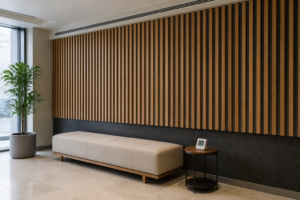
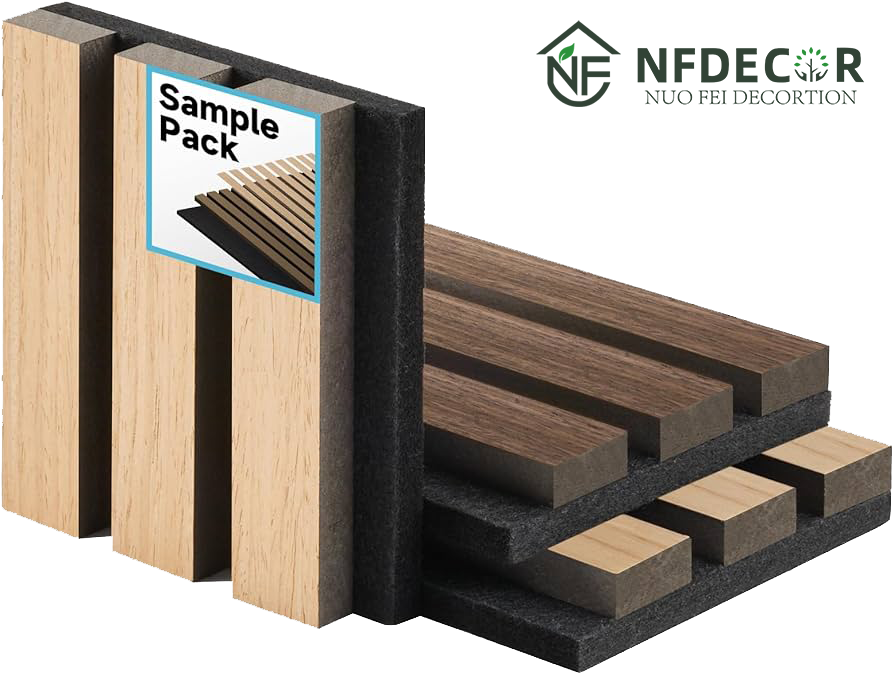
For example, wooden slat acoustic panels can combine several components:
- A decorative veneer, laminate, paint, or melamine surface
- An MDF, plywood, solid-wood, or other slat core
- A polyester felt or similar acoustic backing
- Adhesives used between layers
- Optional insulation or cavity materials behind the panel
- Mechanical fixings, battens, or direct adhesive installation
A change in one component can affect the relevance of a report.2 A thicker felt layer, different core density, alternative veneer, new adhesive, or modified mounting arrangement may represent a different construction. I therefore ask the supplier to connect each document to the offered SKU, thickness, finish, and installation method.
I Review the Standard and Report Scope
Common documents may refer to fire behavior, chemical emissions, material sourcing, or manufacturing systems. These documents address different issues, so I do not treat them as interchangeable.
| Document or test area | What I review | What I do not assume |
|---|---|---|
| Fire classification | Standard, class, specimen, mounting, substrate, report date, and limitations | I do not assume that one fire class is accepted in every jurisdiction |
| VOC or emissions testing | Tested product, chamber method, thresholds, and applicable program | I do not assume that a material certificate covers the finished panel |
| FSC documentation | Chain-of-custody scope and certified product claim | I do not treat FSC as a fire or indoor-air certificate3 |
| ISO management certification | Certificate scope, site, issuer, and validity | I do not treat a management-system certificate as product approval4 |
| CE or other market documentation | Applicable product basis, declared characteristics, and supporting records | I do not assume that the mark establishes school suitability worldwide |
Standards such as ASTM E84 and EN 13501-1 can describe different fire-test and classification frameworks. They are not simple one-to-one substitutes. The project team should confirm which standard and classification apply locally.
I view a certificate as evidence to investigate, not as a universal statement that a panel is safe for every school.
I Ask for Traceable Records
I usually request the full report rather than a cropped certificate image. A useful document package should let the buyer check:
- The manufacturer and production location
- The tested product name and model
- The panel dimensions and thickness
- The material layers and surface finish
- The test method and classification
- The mounting or substrate condition
- The laboratory and report number
- The issue date, validity, and stated exclusions
NF Decor holds documents including CE, SGS, ISO, and FSC-related certifications. However, I still recommend verifying the scope and relevance of each document against the offered product and project. A qualified code professional, fire consultant, architect, or local authority should determine application-specific compliance.
How Can I Assess the Durability of Classroom Acoustic Panels?
Classrooms expose wall finishes to frequent contact, cleaning, bags, chairs, displays, and accidental impacts.5 A face that feels hard during a quick review may still hide weak edges, inconsistent adhesive coverage, or a finish that marks easily. I reduce that risk by reviewing physical samples at product level.
I assess classroom acoustic panels by checking their material construction, surface finish, edge quality, color consistency, backing, bonding, cleanability, and expected position in the room. I also consider replacement access and likely contact. I do not infer long-term durability from hardness, thickness, product photographs, or a supplier’s general description alone.
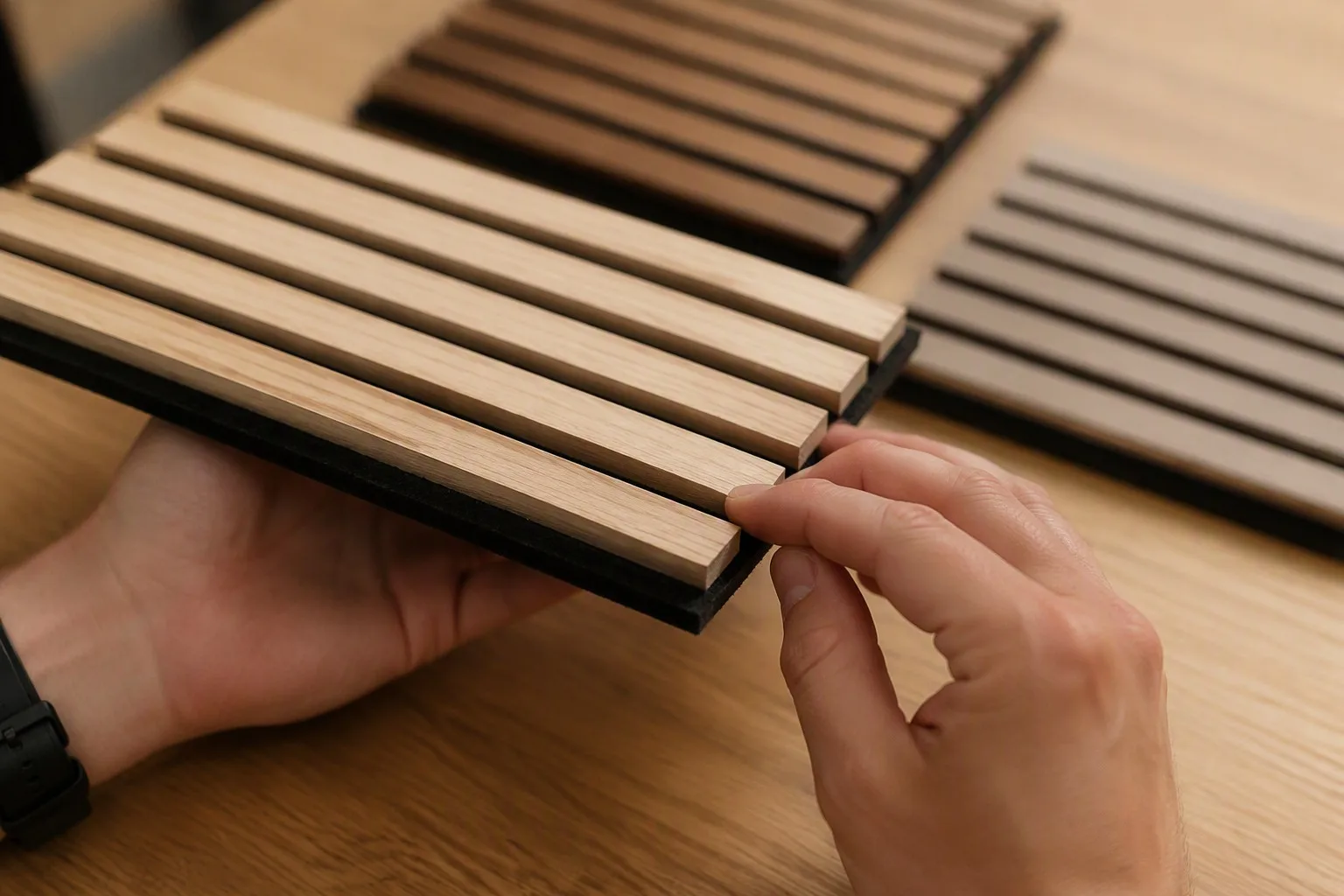
I Use a Structured Sample Review
When I discuss samples with architects and designers, I often see attention move quickly toward color. Color matters, but I believe the physical inspection should start before the aesthetic decision.
I recommend reviewing the following sample characteristics:
- Layer construction: I check whether the actual material matches the datasheet.
- Surface adhesion: I inspect veneer, laminate, paint, fabric, or suede-like finishes for lifting.
- Edge condition: I look for chipping, exposed core material, fraying, or uneven trimming.
- Slat alignment: I compare spacing, straightness, and dimensional consistency.
- Felt quality: I check density, color, cut accuracy, and visible contamination.
- Color consistency: I compare several pieces under the project’s intended lighting.
- Surface sensitivity: I test an inconspicuous area using an approved cleaning method.
- Odor and packaging condition: I note unusual odors, trapped moisture, or transit damage.
- Fixing compatibility: I confirm that the proposed fastener or adhesive suits the substrate.
I once prepared for a sample discussion in which the finish received most of the early attention. A closer review of the edges and backing produced more useful procurement questions than the initial color comparison. That experience reinforced my preference for a written inspection checklist.
I Match Durability to Panel Location
Not every wall area faces the same exposure. I consider location before I decide whether a construction is practical.
| Classroom location | Likely exposure | Questions I ask |
|---|---|---|
| Lower wall zone | Shoes, bags, furniture, and direct contact | Can the surface tolerate contact, and can damaged units be replaced? |
| Upper wall zone | Less frequent contact but harder maintenance access | Can the installer secure the panel safely and maintain alignment? |
| Rear teaching wall | Displays, movement, and changing room layouts | Will displays or fixings interfere with the panel? |
| Ceiling or high-level area | Limited direct contact | Does the fixing system suit the substrate and overhead application? |
| Corridor or shared area | Higher traffic and more frequent impact | Does the specification require added impact resistance or protection? |
A softer felt panel may be useful in one position but vulnerable in another. A wooden slat panel may provide a more protected face, but its edges and finish still need inspection. I avoid labeling either option as universally durable.
I Define Quality-Control Expectations Before Ordering
A production sample becomes more valuable when the purchase documents define what it represents. I recommend agreeing on:
- Approved color and finish references
- Permitted dimensional tolerances
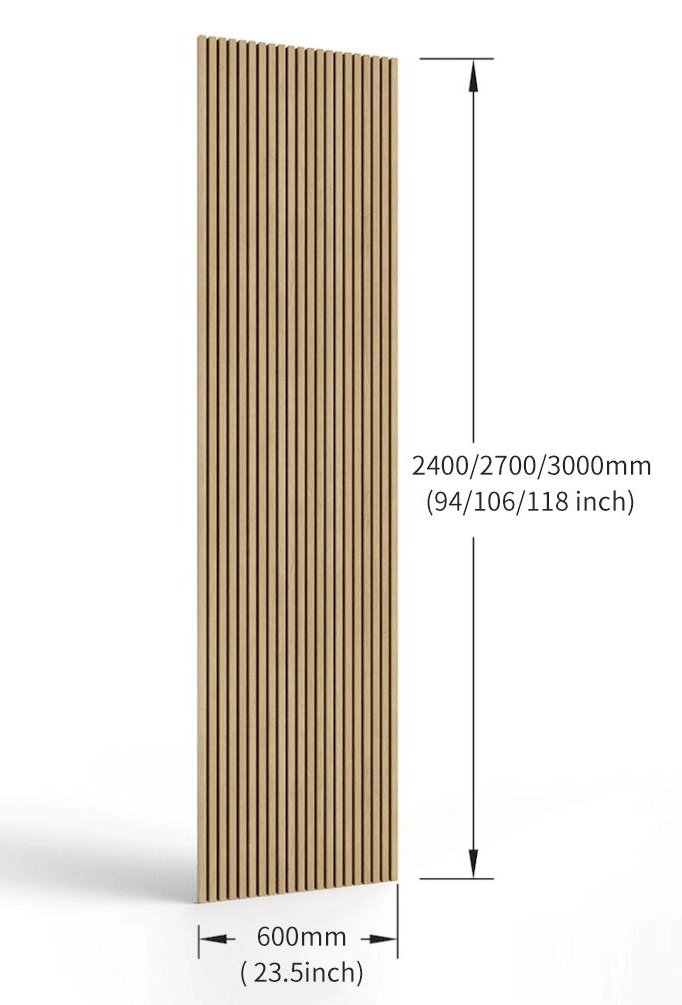
- Slat width and spacing
- Panel thickness and backing specification
- Edge treatment
- Packaging and corner protection
- Batch identification
- Inspection method and acceptance criteria
- Spare quantity or replacement strategy
NF Decor operates five production lines with reported monthly capacity exceeding 50,000 m². Capacity can support large-volume procurement, but I advise buyers to evaluate capacity together with production scheduling, quality controls, approved samples, and delivery planning. A factory’s output figure alone does not establish consistent project quality.
What Do Sound Ratings Mean for Acoustic Panels for Schools and Classrooms?
Acoustic ratings often become the center of a specification because they are easy to compare. However, a single number can hide the frequency range, test method, specimen size, mounting depth, and air cavity. If I ignore those details, I may compare products that were tested under materially different conditions.
I interpret an absorption rating as a laboratory description of a tested assembly under stated conditions. The rating can support comparison, but it cannot guarantee results in a specific classroom.6 I review the test standard, frequency data, mounting arrangement, panel construction, coverage, placement, room geometry, background noise, and intended teaching activity.
I Separate Sound Absorption from Soundproofing
Sound absorption and sound insulation solve different problems.7
Sound absorption reduces reflections inside a room. It can help control reverberant buildup and improve acoustic comfort when the design is appropriate.
Sound insulation, often called soundproofing in informal language, limits sound transmission between spaces. Wall mass, airtightness, junctions, doors, glazing, penetrations, and structural paths strongly influence transmission.8
An absorptive wall panel does not automatically prevent sound from passing into the next classroom. I therefore avoid claims that a decorative acoustic panel makes a room “completely soundproof.”
I Read Beyond the Headline Coefficient
Buyers may encounter ratings such as NRC or αw. These metrics come from defined methods, but they summarize performance differently.
NRC is commonly associated with ASTM C423 testing and is derived from absorption values at selected octave-band frequencies, typically 250, 500, 1,000, and 2,000 Hz, with defined rounding rules.9 The weighted absorption coefficient, αw, is associated with ISO 11654 and uses a reference-curve procedure.10
I treat both as useful summaries. However, I also request the underlying frequency-dependent results because classrooms contain speech, movement, mechanical noise, and other sounds across a broad range.
| Item to compare | Why I review it |
|---|---|
| Test standard | The standard defines the measurement and calculation procedure |
| Full specimen construction | Different layers can change absorption |
| Mounting classification | Direct mounting and cavity mounting may produce different results |
| Air gap or insulation | A cavity can affect lower-frequency absorption |
| Frequency table or graph | A single rating can hide weak frequency bands |
| Test laboratory | Laboratory identity supports document traceability |
| Report date and model | These details help connect the result to the offered product |
I Connect the Data to Classroom Use
A music room, language classroom, lecture space, laboratory, and early-learning room do not have identical acoustic needs. Room volume, ceiling height, occupancy, teaching style, existing finishes, mechanical systems, and furniture all influence the design.
Panel coverage also matters. A highly absorptive product installed over a very small area may have limited influence.11 A moderate product used over an appropriately designed area may contribute more total absorption. Placement matters because ceiling clouds, upper-wall panels, rear-wall treatment, and distributed surfaces interact differently with room geometry.
I recommend that a qualified acoustician define project targets, evaluate reverberation and speech needs, and determine suitable treatment area and placement. My manufacturing experience helps me explain panel construction and documentation, but it does not replace laboratory testing or project-specific acoustic design.
How Do I Compare Suppliers of Acoustic Panels for Schools and Classrooms?
Supplier comparison becomes difficult when quotations use different materials, thicknesses, test documents, and commercial terms. The cheapest square-metre price can hide incomplete test coverage, inconsistent finishes, unsuitable packaging, or unconfirmed lead times. I use a gated process so that price does not override basic project requirements.
I compare suppliers in four gates. I first reject products that lack relevant safety evidence. I then evaluate samples for construction, durability, and maintainability. Next, I compare documented acoustic performance under relevant test conditions. Finally, I review customization, quality control, capacity, packaging, delivery, and total procurement cost.

Gate 1: I Verify Safety and Compliance Evidence
I start with mandatory requirements because a visually attractive panel has no practical value if the project team cannot approve it.
I ask each supplier for:
- Full and legible reports
- A clear connection between reports and quoted products
- Material declarations where required
- Finish-specific or construction-specific evidence
- Installation limitations
- Current certificate details
- Written confirmation of the manufacturing site
I then refer unresolved questions to the project’s qualified compliance professionals. I do not ask the supplier to act as the local code authority.
Gate 2: I Compare Physical Quality and Maintainability
I request samples from the intended construction, not merely the nearest available finish. If an exact sample cannot be supplied, I document every difference.
I score the samples against consistent criteria:
| Evaluation area | Example weighting |
|---|---|
| Material and construction accuracy | 20% |
| Surface and edge quality | 20% |
| Cleanability and maintainability | 15% |
| Color and visual consistency | 15% |
| Fixing and installation suitability | 15% |
| Packaging and replacement strategy | 15% |
These percentages are only an example. Each project team should adjust them to reflect its risks.
Gate 3: I Assess Acoustic Evidence
I compare reports only after I understand the test conditions. I avoid ranking products by one coefficient when their mounting arrangements differ.
I ask three practical questions:
- Does the report cover the quoted product construction?
- Does the test mounting resemble the planned installation closely enough for a meaningful comparison?
- Does the frequency performance support the acoustic consultant’s design intent?
If the answer remains unclear, I request clarification or additional testing rather than filling the gap with an assumption.
Gate 4: I Review Commercial and Supply-Chain Fit
The final gate covers the supplier’s ability to execute the order. I review:
- Minimum order quantity
- Custom sizes, finishes, and colors
- Sample approval workflow
- Production lead time
- Inspection points
- Batch consistency controls
- Packaging design
- Container loading plan
- Shipping terms
- Replacement procedure
- Spare-panel availability
- Change-control process
NF Decor has manufactured acoustic and decorative wall panels since 1995 from facilities in Hebei and Shandong, China. We supply wooden slat, felt, suede acoustic wood, tambour, hexagon, and artistic 3D wall panels. We also export to more than 30 countries. I present those facts as supplier context, while I still encourage each buyer to conduct document review, sample approval, factory evaluation, and project-specific professional checks.
Frequently Asked Questions
Do classroom acoustic panels soundproof a room?
No. I use classroom acoustic panels mainly to absorb reflections within a room. Soundproofing requires a broader assembly strategy that addresses walls, ceilings, floors, doors, windows, penetrations, airtightness, and flanking paths. A qualified acoustic consultant should assess sound transmission between classrooms.
Is the highest NRC always best for a classroom?
No. I do not select a panel from NRC alone. I also review the test method, mounting condition, frequency data, total treatment area, placement, classroom use, durability, and safety requirements. A high laboratory rating cannot guarantee suitable results after installation.
Which fire certificate should a school acoustic panel have?
The required document depends on the project jurisdiction, building classification, installation, and local specification. I recommend that the project team identify the applicable standard first. The buyer should then verify that the report covers the exact panel construction and mounting condition being offered.
Are felt panels durable enough for schools?
Some felt panels may suit selected school locations, but I do not assume universal suitability. I inspect density, surface quality, edges, color, cleanability, fixing, and likely contact. High-traffic lower walls may require added protection, a different construction, or a planned replacement approach.
Should I request a sample before specifying acoustic panels?
Yes. I recommend reviewing a representative sample before final approval. The sample allows the team to inspect materials, finish, edge quality, color, backing, bonding, and fixing compatibility. The purchase agreement should identify whether that sample becomes the approved production reference.
Conclusion
Acoustic panels for schools and classrooms should pass a structured evaluation rather than a competition for the highest absorption rating. I recommend eliminating project-specific safety risks first, reviewing durability and maintainability second, and interpreting acoustic evidence within its test and installation context third. Architects should also verify samples, reports, mounting details, quality controls, and supplier capacity before approval. Contact NF Decor to discuss panel samples, customization, supporting documents, production planning, and a project-specific quotation, while your qualified consultants confirm local compliance and acoustic design requirements.
Related technical guides
- What Are the Best Acoustic Panels for Offices? A Specifier's Complete Guide
- NRC vs STC: Which Rating Does Your Project Actually Need?
- What Is NRC Rating? A Plain-English Guide for B2B Acoustic Panel Buyers
"How to Understand Your Lab Results: MedlinePlus Medical Test", https://medlineplus.gov/lab-tests/how-to-understand-your-lab-results/. Laboratory test reports are evidence for the specimen and test conditions described in the report; changes in product construction, materials, or installation may require separate assessment of applicability. Evidence role: general_support; source type: institution. Supports: That test reports identify the tested specimen and conditions, and that changes to the specimen can affect the applicability of the result.. ↩
"Fire classification of construction products and building elements—", https://images.chemycal.com/Media/Files/TBT/19_2190_00_e.pdf. Product-performance classifications are tied to the tested construction and stated conditions of use, so alterations to component materials or mounting may affect whether a report applies. Evidence role: mechanism; source type: institution. Supports: That fire-performance classifications and other test results depend on the tested product construction and specified end-use or mounting conditions.. ↩
"Improving Indoor Air Quality During Wildfires - Berkeley Lab News Center", https://newscenter.lbl.gov/2019/10/25/improving-indoor-air-quality-during-wildfires/. FSC chain-of-custody certification addresses the traceability of forest-based materials in the supply chain and is not, by itself, a test of fire behavior or indoor-air emissions. Evidence role: definition; source type: institution. Supports: That FSC chain-of-custody certification concerns the traceability of forest-based materials through supply chains.. ↩
"ISO - Certification", https://www.iso.org/certification.html. Management-system certification assesses whether an organization operates a management system meeting a stated standard; it does not constitute approval or performance certification of every product made by that organization. Evidence role: definition; source type: institution. Supports: That management-system certification evaluates an organization's management system rather than certifying individual products.. ↩
"School Design Standards", https://www.aps.edu/facilities-design-and-construction/documents/design-standards-and-guidelines/HS_Standards.pdf. Educational-facility design guidance commonly treats durability, cleanability, and resistance to expected wear as material-selection considerations for frequently used school interiors. Evidence role: general_support; source type: government. Supports: That educational facilities require interior finishes selected for durability, maintainability, cleaning, and anticipated wear.. Scope note: Such guidance supports the general selection principle rather than proving the durability of any particular acoustic-panel product. ↩
"Lab #6 – Room Acoustics", https://astro.pas.rochester.edu/~aquillen/phy103/Labs/RoomLab.pdf. A laboratory absorption coefficient characterizes a tested assembly under controlled conditions; classroom acoustic outcomes also depend on room volume, existing surfaces, treatment area, placement, occupancy, and installation details. Evidence role: general_support; source type: research. Supports: That room acoustic outcomes depend on room geometry, total absorption, surface distribution, installation conditions, and other room-specific factors in addition to a material's laboratory coefficient.. Scope note: The source supports the limits of extrapolating laboratory data but does not predict the performance of a specific classroom without room-specific analysis. ↩
"Classroom Acoustics for Architects", https://acousticalsociety.org/wp-content/uploads/2022/01/Classroom_Acoustics_for_Architects_4_18_15.pdf. Sound absorption reduces reflected acoustic energy within a room, whereas sound insulation concerns limiting airborne or structure-borne sound transmission between adjoining spaces. Evidence role: definition; source type: education. Supports: That sound absorption reduces reflected sound within an enclosure, while sound insulation reduces transmission between spaces.. ↩
"Acoustical and thermal performance of exterior residential ...", https://www.govinfo.gov/content/pkg/GOVPUB-C13-d95f552291f2e2f8b266486c656ef991/pdf/GOVPUB-C13-d95f552291f2e2f8b266486c656ef991.pdf. Inter-room sound insulation depends on the complete assembly: mass and airtightness are important, while doors, penetrations, junctions, and flanking paths can substantially reduce measured isolation. Evidence role: mechanism; source type: research. Supports: That sound insulation performance depends on the complete building assembly, including leakage paths, junctions, openings, and flanking transmission.. ↩
"Noise reduction coefficient", https://en.wikipedia.org/wiki/Noise_reduction_coefficient. Under ASTM C423, the Noise Reduction Coefficient is calculated from measured absorption coefficients at 250, 500, 1,000, and 2,000 Hz using the standard's prescribed averaging and rounding convention. Evidence role: definition; source type: institution. Supports: That ASTM C423 defines NRC from absorption coefficients at 250, 500, 1,000, and 2,000 Hz with a specified calculation and rounding procedure.. ↩
"ISO 11654:1997(en), Acoustics - Rating of sound absorption", https://www.iso.org/obp/ui/#iso:std:iso:11654:ed-1:v1:en. ISO 11654 specifies a reference-curve method for deriving the weighted sound absorption coefficient, αw, from frequency-dependent absorption data. Evidence role: definition; source type: institution. Supports: That ISO 11654 specifies a reference-curve procedure for determining the weighted sound absorption coefficient αw.. ↩
"Modeling Reverberation Time", http://hyperphysics.phy-astr.gsu.edu/hbase/Acoustic/revmod.html. Room-acoustics theory relates reverberation time to a room's total equivalent absorption, meaning that both the absorption properties and the amount of installed treatment influence the likely acoustic effect. Evidence role: mechanism; source type: education. Supports: That reverberation time is related to total equivalent absorption in a room and therefore depends on the area and absorption of installed treatment.. Scope note: A total-absorption model is a design approximation and does not by itself account for every effect of treatment location, scattering, or room geometry. ↩