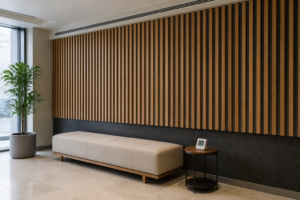
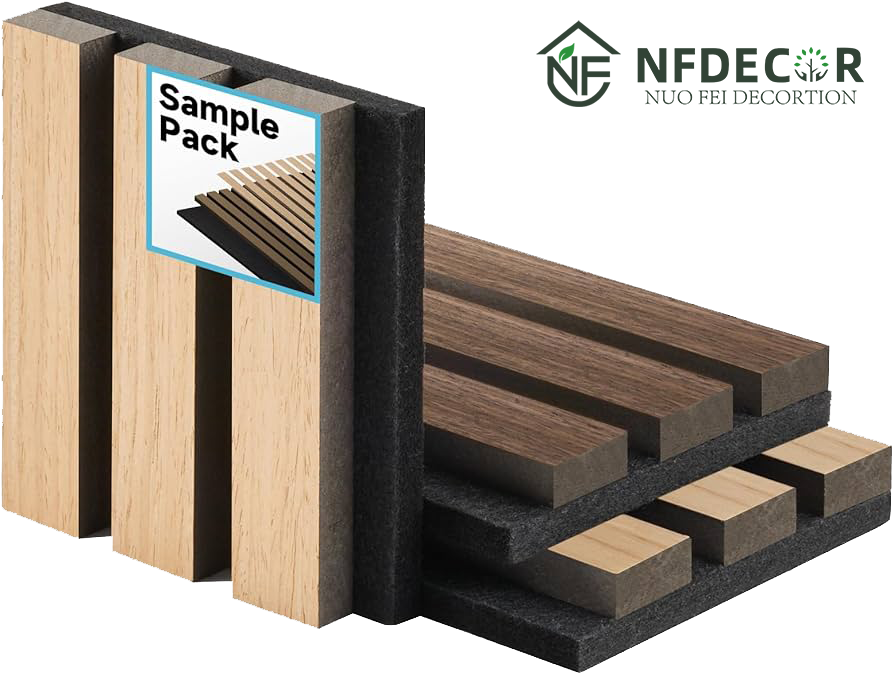
Wood slat panels and acoustic foam solve different problems, so a price-per-square-metre comparison usually leads buyers to the wrong product. Wood slat panels combine a decorative wood finish with a sound-absorbing felt backing, while foam acts as a functional treatment that is normally hidden. Choose wood slat panels when the finish stays visible and reverberation control is the goal; choose foam when only the acoustic function matters. Neither choice should rely on an unsupported NRC claim. Always compare model-specific test reports, fire documentation, installation assembly and installed cost. For a related material decision, see PET felt vs wood slat acoustic panels.
Wood slat panels and acoustic foam are not interchangeable. Wood slat panels combine a decorative surface with sound-absorbing components, while acoustic foam usually serves as a functional treatment. The right choice depends on whether the goal is reducing reverberation or blocking transmission, whether the product remains visible, and how the complete installed assembly performs.
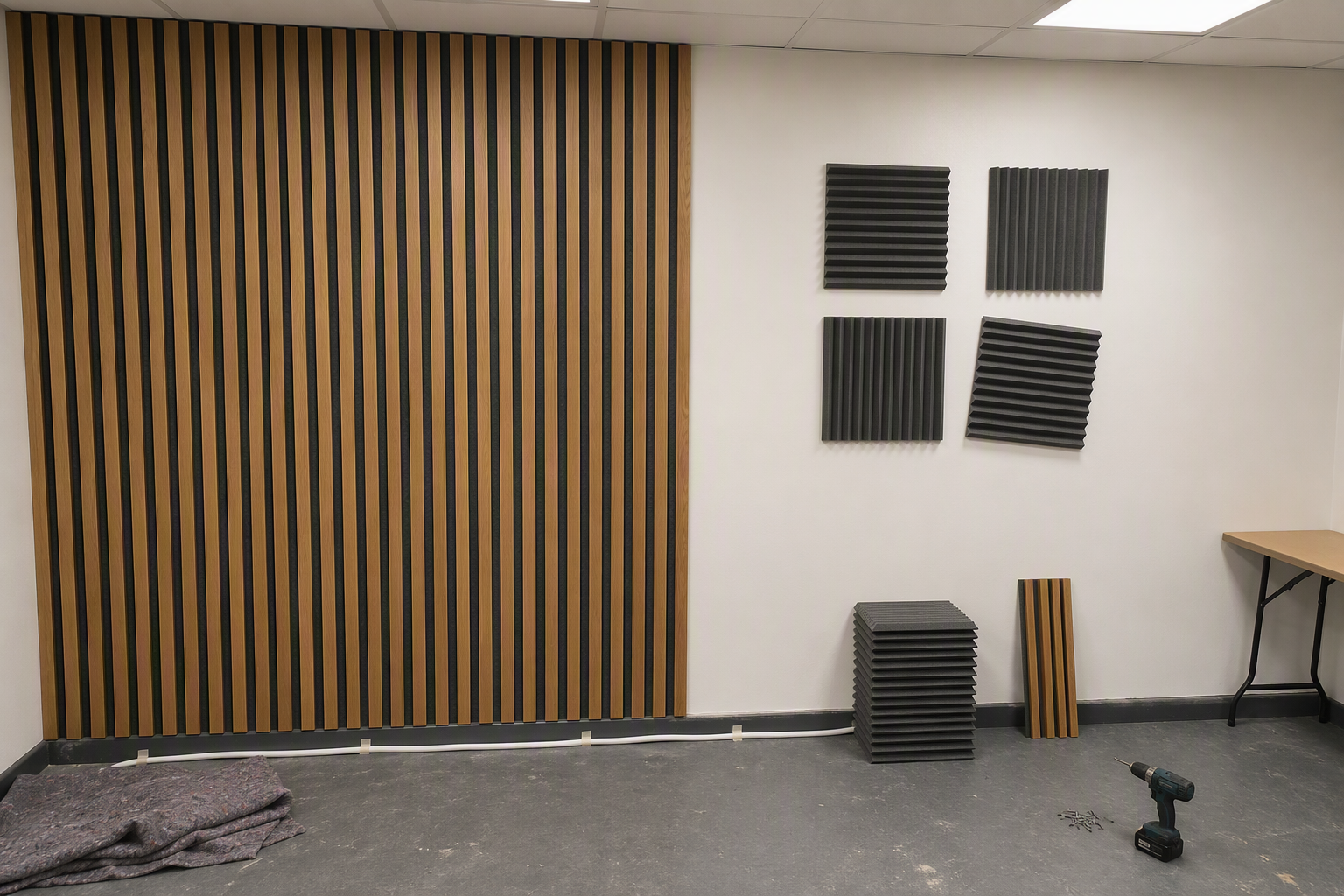
I manufacture wood slat acoustic panels, so my direct experience covers production, finishes, specifications, customization, and distributor inquiries. I have not conducted controlled side-by-side laboratory testing against acoustic foam. I therefore use this comparison as a procurement framework rather than as a substitute for qualified acoustic engineering or product-specific test reports.
What Should Buyers Ask Before Comparing Wood Slat Panels vs Acoustic Foam?
Buyers often begin by requesting an NRC value or comparing unit prices. That shortcut can hide the most important difference: the products may be intended for different construction and design roles. I start each inquiry by clarifying what the buyer actually wants the product to accomplish.
The first two questions should be: Is the goal to reduce reverberation or stop sound transmission, and will the material remain visible or sit inside a construction system? These answers determine whether buyers should evaluate a decorative acoustic finish, an exposed functional absorber, or a more complete wall and ceiling assembly.
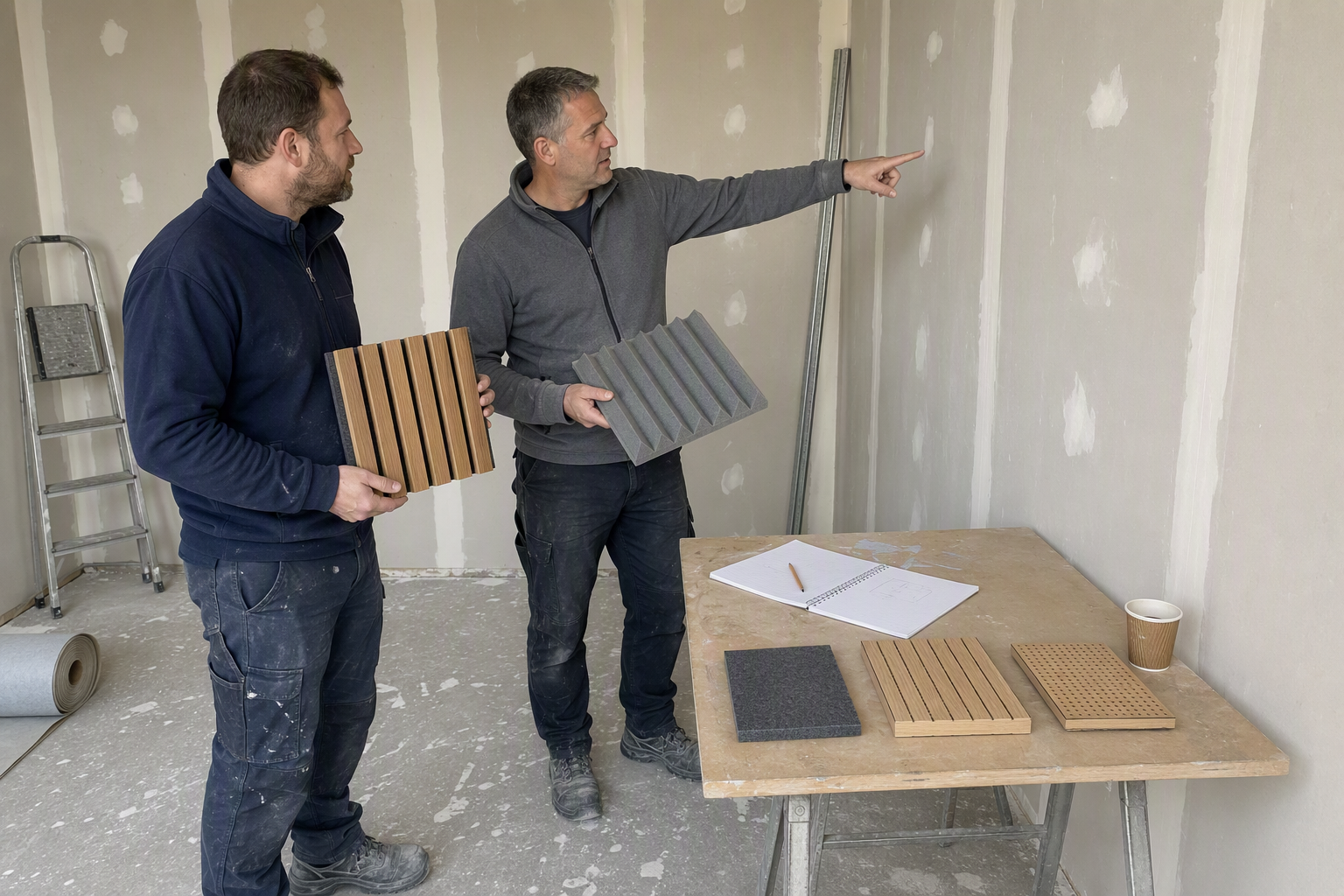
Reverberation control is not sound isolation
I regularly see the terms “soundproofing” and “sound absorption” used as if they mean the same thing. They do not.
Sound-absorbing products can help manage reflected sound inside a room. They may reduce echo, shorten reverberation time, and improve speech conditions when the product and coverage area suit the space.1 Sound isolation addresses sound passing from one room or building area into another. Isolation normally depends on the complete construction system2, including:
- Wall or ceiling mass
- Cavity depth
- Insulation
- Mechanical decoupling
- Airtightness
- Doors, glazing, and penetrations
- Flanking transmission paths
Neither a decorative wood slat panel nor a layer of lightweight acoustic foam should automatically be presented as a replacement for an engineered sound-isolation assembly.3
Visible finish or concealed treatment?
I recommend treating visibility as the second qualifying question. Wood slat acoustic panels are generally selected as an integrated decorative-and-acoustic wall or ceiling finish. Their value can include veneer appearance, slat geometry, felt color, visual rhythm, and compatibility with the wider interior concept.
Acoustic foam often has another role. Depending on its design and certification, it may be installed as an exposed functional treatment in recording, broadcasting, industrial, rehearsal, or specialist rooms. Some foam products may also form part of another assembly. Buyers should confirm the intended use with the manufacturer.
| Qualifying issue | Wood slat acoustic panels | Acoustic foam |
|---|---|---|
| Typical role | Decorative finish with acoustic contribution | Functional sound-absorbing treatment |
| Common visibility | Usually visible | Visible or integrated into another system |
| Design priority | Finish, geometry, repeatability, and acoustics | Absorption profile, thickness, shape, and compliance |
| Sound isolation | Not a complete isolation system | Not a complete isolation system |
| Typical commercial positioning | Interior finishes and architectural materials | Acoustic treatment and specialist room products |
In my supplier conversations, these two initial questions often save more time than an early price comparison. They reveal whether the distributor is serving architects and interior contractors, specialist audio customers, or price-sensitive online retail buyers. Each channel requires a different product story and a different level of technical support.
How Should NRC Be Used in a Wood Slat Panels vs Acoustic Foam Comparison?
A high published NRC number can appear to settle the decision. However, a number without its test conditions can create a misleading comparison. I advise buyers to request the full report because thickness, mounting method, backing, air cavity, substrate, and specimen configuration can materially affect measured absorption.
NRC is a single-number rating derived from sound absorption measurements at specified frequencies.4 Buyers should compare NRC values only when they understand the relevant test standard and tested assembly. They should verify product thickness, backing material, air gap, mounting method, substrate, specimen size, and whether the supplied product matches the tested construction.

What does NRC tell a buyer?
In markets that use ASTM methods, manufacturers may report results based on testing such as ASTM C423. Other markets may reference tests conducted under standards such as ISO 354, with related ratings calculated under the applicable classification method. Buyers should confirm which standard the report uses and whether that standard is accepted for their project.
NRC is useful as a summary indicator, but I would not use it as the only design value. A single number cannot show how a material behaves across every frequency band. Two products can have similar summary ratings while showing different absorption patterns at low, middle, and high frequencies.5
I recommend checking the following:
- Test method: Which standard and laboratory procedure were used?
- Product identity: Does the report identify the exact model, thickness, density, and construction?
- Mounting condition: Was the sample installed directly against a rigid surface or over an air cavity?
- Backing: Did the tested panel include PET felt, mineral wool, another absorber, or no additional backing?
- Air gap: What cavity depth was present behind the sample?
- Frequency data: Does the report provide absorption coefficients by frequency?
- Laboratory status: Is the test laboratory appropriately accredited for the stated method?
- Report validity: Does the document match the current production specification?
Why assembly details matter
A wood slat acoustic panel is not acoustically defined by the decorative slats alone. Its performance may depend on the slat spacing, felt backing, panel thickness, mounting method, cavity, and any additional absorptive material behind it.6 Likewise, acoustic foam performance depends on factors such as foam type, density, profile, thickness, mounting area, and installation surface.7
For example, a thin material installed directly against a rigid wall should not be assumed to perform like a thicker product installed over a cavity. A product’s published result may also represent a specific tested configuration that differs from the distributor’s proposed installation.
I never recommend converting a laboratory rating into a project promise without checking whether the proposed installation matches the test report.
I can explain how our wood slat products are made and provide available specification and test documents for buyer review. However, an acoustician or other qualified professional should determine coverage, placement, reverberation targets, and application-specific suitability.
How Do Wood Slat Panels vs Acoustic Foam Differ as Commercial Products?
A distributor can make a poor choice even when both products absorb sound. The risk appears when the distributor places them in one undifferentiated category. I prefer to compare their complete commercial roles, including appearance, durability expectations, customization, handling, installation, compliance documents, and end-customer positioning.
Wood slat panels typically function as architectural finishes with an acoustic component, while acoustic foam is usually positioned as a dedicated treatment material. Buyers should compare the complete customer proposition rather than absorption alone. That proposition includes visual quality, finish consistency, installation labor, maintenance, fire documentation, replacement needs, and target-market expectations.
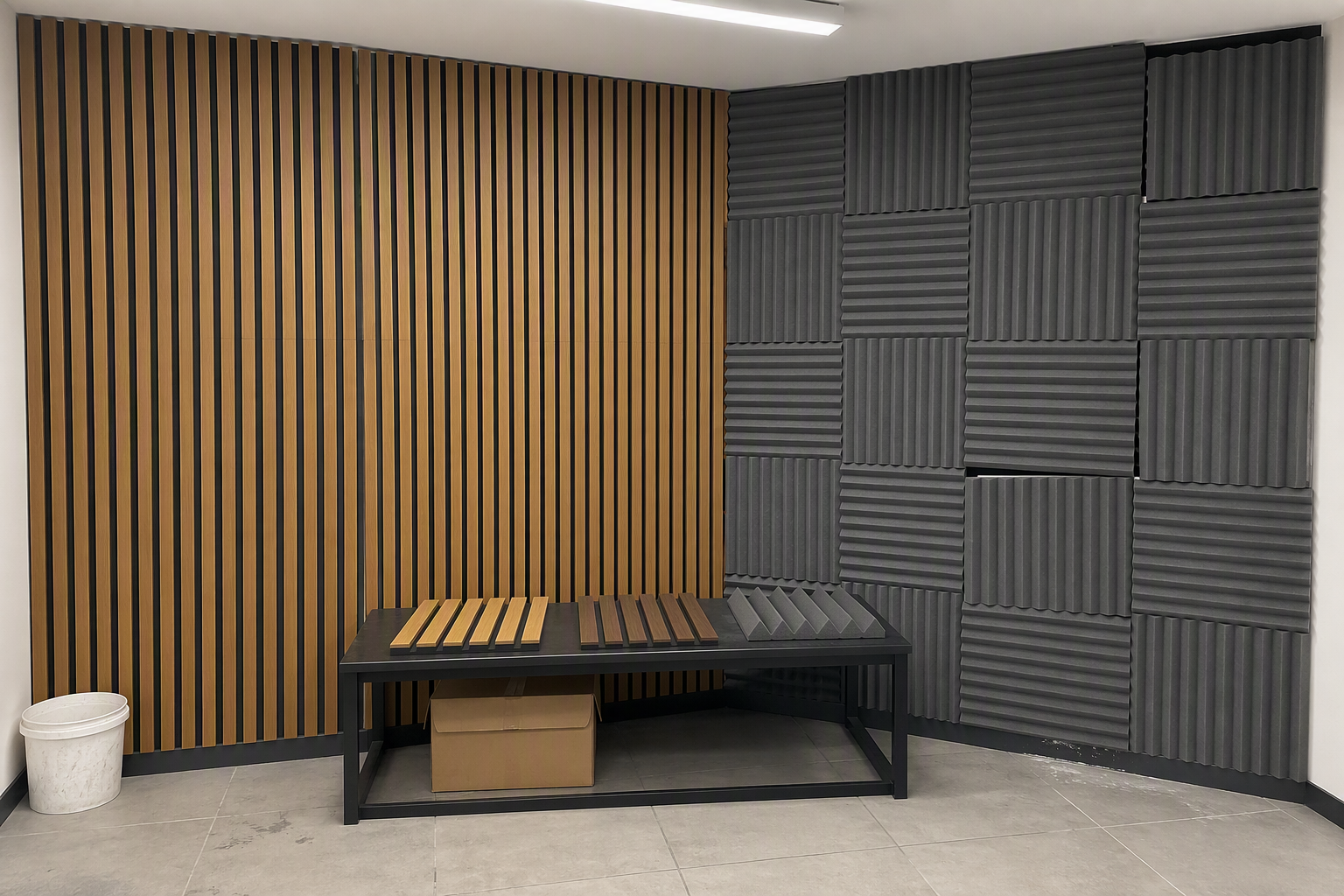
Design and finish expectations
Wood slat acoustic panels are often specified where the wall or ceiling contributes to the interior identity. Commercial buyers may need to evaluate:
- Slat width and spacing
- Panel dimensions and thickness
- Felt color
- Edge and joint appearance
- Natural veneer grading
- Engineered veneer consistency
- PVC film color and texture
- Batch-to-batch color control
- Replacement and replenishment procedures
- OEM branding and packaging
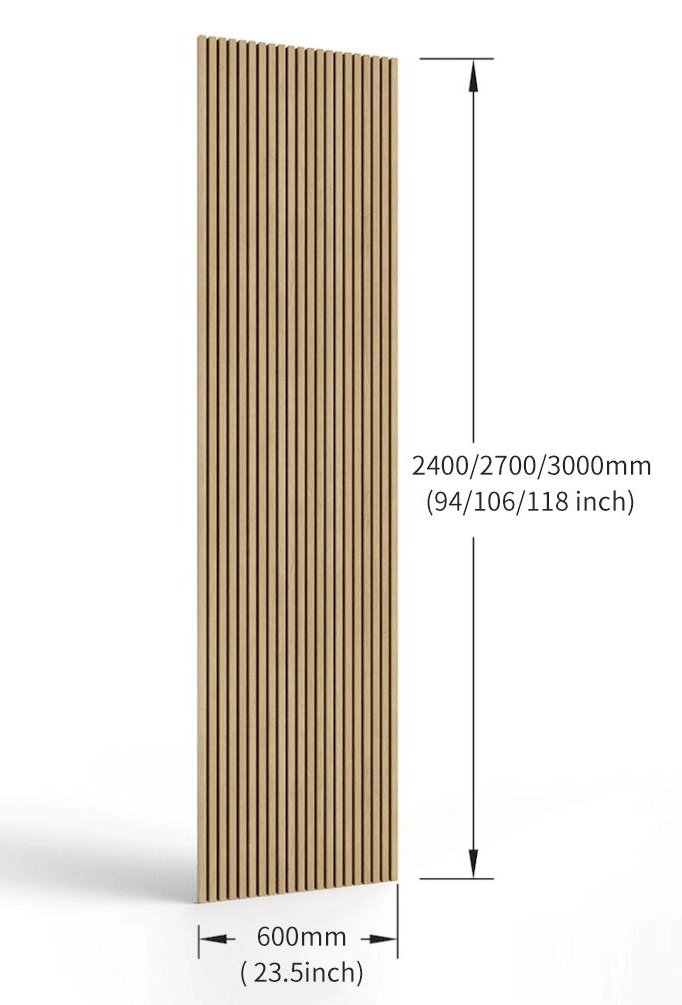
At NF Decor, our standard wood slat acoustic panels include lamella strips with acoustic felt backing. Common sizes include widths and lengths such as 600 mm × 2400 mm, 2700 mm, or 3000 mm, with 21 mm standard and 18 mm slim constructions available within our range. Buyers still need to confirm the exact specification for each order because dimensions and assemblies affect handling, installation, cost, and available documentation.
Our finish families include natural wood veneer, engineered or reconstituted veneer, and PVC film. I often recommend engineered veneer when a distributor prioritizes visual repeatability across a large batch or later replenishment. Natural veneer offers authentic variation, but buyers should define acceptable shade and grain variation before production.
Acoustic foam is usually evaluated differently. Buyers may focus on:
- Foam chemistry and intended application
- Density and thickness
- Flat, wedge, pyramid, or other surface profiles
- Color availability
- Cut dimensions
- Odor or emissions documentation
- Aging behavior
- Cleaning limitations
- Fire-test evidence
- Adhesive compatibility
These criteria do not make either option universally better. They show why wood slat panels vs acoustic foam should not be reduced to one absorption rating.
Durability and maintenance require application-specific review
I advise distributors to ask how customers will touch, clean, repair, and replace the installed product. A hotel corridor, office reception area, recording booth, retail store, and industrial enclosure create different exposure conditions.
A wood slat surface may fit projects that require a rigid, furniture-like appearance. However, the buyer should still review veneer care, impact risk, moisture limits, substrate quality, and cleaning instructions. Acoustic foam can suit specialist treatment areas, but buyers should verify resistance to damage, dust accumulation, discoloration, and cleaning methods for the exact foam formulation.
No generic material label proves durability. Product samples, technical data, installation trials, and supplier documentation provide a more reliable basis for procurement.
Which Fire, Compliance, and Installation Factors Should Buyers Verify?
Commercial projects can reject a product that looks suitable and has a promising acoustic rating if its documentation does not meet local requirements. I have seen buyers focus on color and price before checking fire documentation. That sequence can waste sampling time and delay quotations.
Buyers should verify fire classification, test scope, emissions documentation, material composition, installation instructions, and local code acceptance before specifying either product. A fire report applies to the tested product and assembly, not automatically to every thickness, finish, adhesive, backing, substrate, or installation method offered under the same product name.8
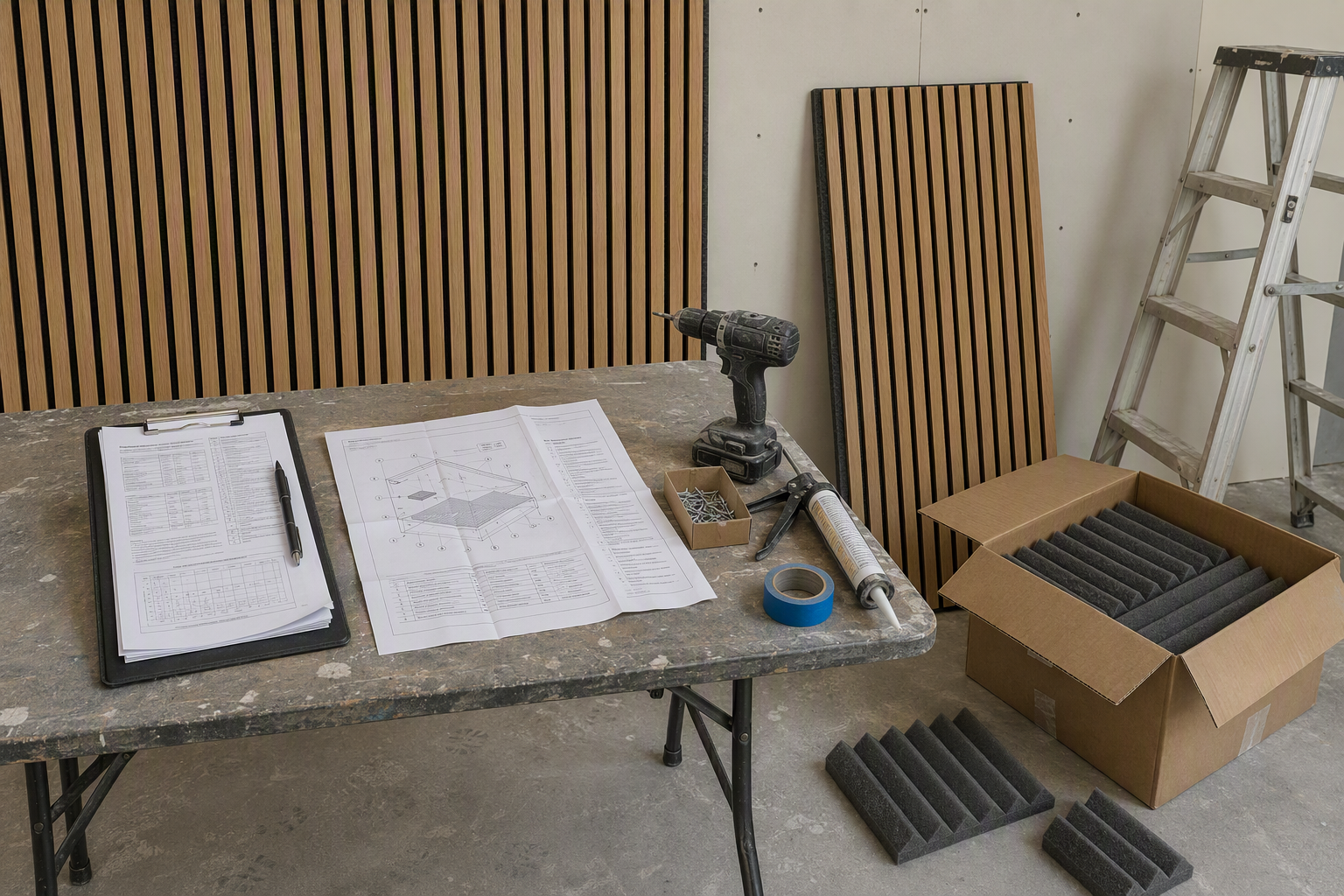
Fire classifications are not universal
Different markets use different fire-test systems. European projects may request documentation under EN 13501-1, while North American buyers may ask for results related to ASTM E84 or another applicable method. Some markets and buyers also use classifications such as B1 under a relevant national test framework.
I recommend checking these details rather than accepting a classification in isolation:
- Full name of the test standard
- Product description in the report
- Tested thickness and construction
- Surface finish and backing
- Mounting and substrate
- Adhesive or mechanical fastening method
- Classification field of application
- Report date and issuing laboratory
- Local approval requirements
I also advise buyers not to assume that “fire retardant” is equivalent to a specific code classification. The wording can describe an ingredient, formulation, treatment, or marketing category without proving acceptance for a particular commercial interior.
NF Decor supplies ISO- and FSC-related documentation within our business scope, but buyers should verify the exact certificate, issuing body, validity period, covered entity, product scope, and chain-of-custody relevance. An organizational certificate does not replace product-specific acoustic or fire testing.
Installation cost is more than material price
Low unit cost can become less attractive after the buyer calculates the complete installed system. I recommend comparing costs on a defined wall or ceiling area rather than by package, sheet, or individual panel.
| Cost factor | Questions for the buyer |
|---|---|
| Material coverage | How many square meters does each unit cover after waste? |
| Substrate preparation | Does the wall require leveling, framing, or sealing? |
| Fixings and adhesive | Which approved accessories are required? |
| Labor | How much cutting, alignment, and edge finishing is needed? |
| Perimeter details | Are trims, corners, sockets, and transitions included? |
| Freight | How do product volume, weight, and packaging affect landed cost? |
| Damage allowance | What waste percentage is realistic for the project? |
| Maintenance | Can damaged areas be cleaned or replaced easily? |
| Compliance | Will additional testing or consultant review be required? |
Wood slat panels may require careful alignment because their linear pattern makes joint quality visible. Acoustic foam may appear simpler to place, but a professional installation can still require layout planning, substrate preparation, compatible adhesive, clean cutting, and attention to fire requirements.
The fairest comparison is therefore installed cost for an approved application, not the lowest online price per piece.
How Should Distributors Position Wood Slat Panels vs Acoustic Foam?
A distributor can create risk by promising that two materials solve the same customer problem. When a sales team labels every absorber as “soundproofing,” customers may expect privacy or noise containment that the installed material cannot provide. I recommend building separate product categories, qualification questions, and claim libraries.
Distributors should position wood slat panels for customers seeking an architectural surface with an acoustic function, while they should position acoustic foam according to its verified specialist treatment role. Sales teams should use report-supported language, avoid soundproofing claims, and refer complex projects to a qualified acoustic consultant or relevant design professional.
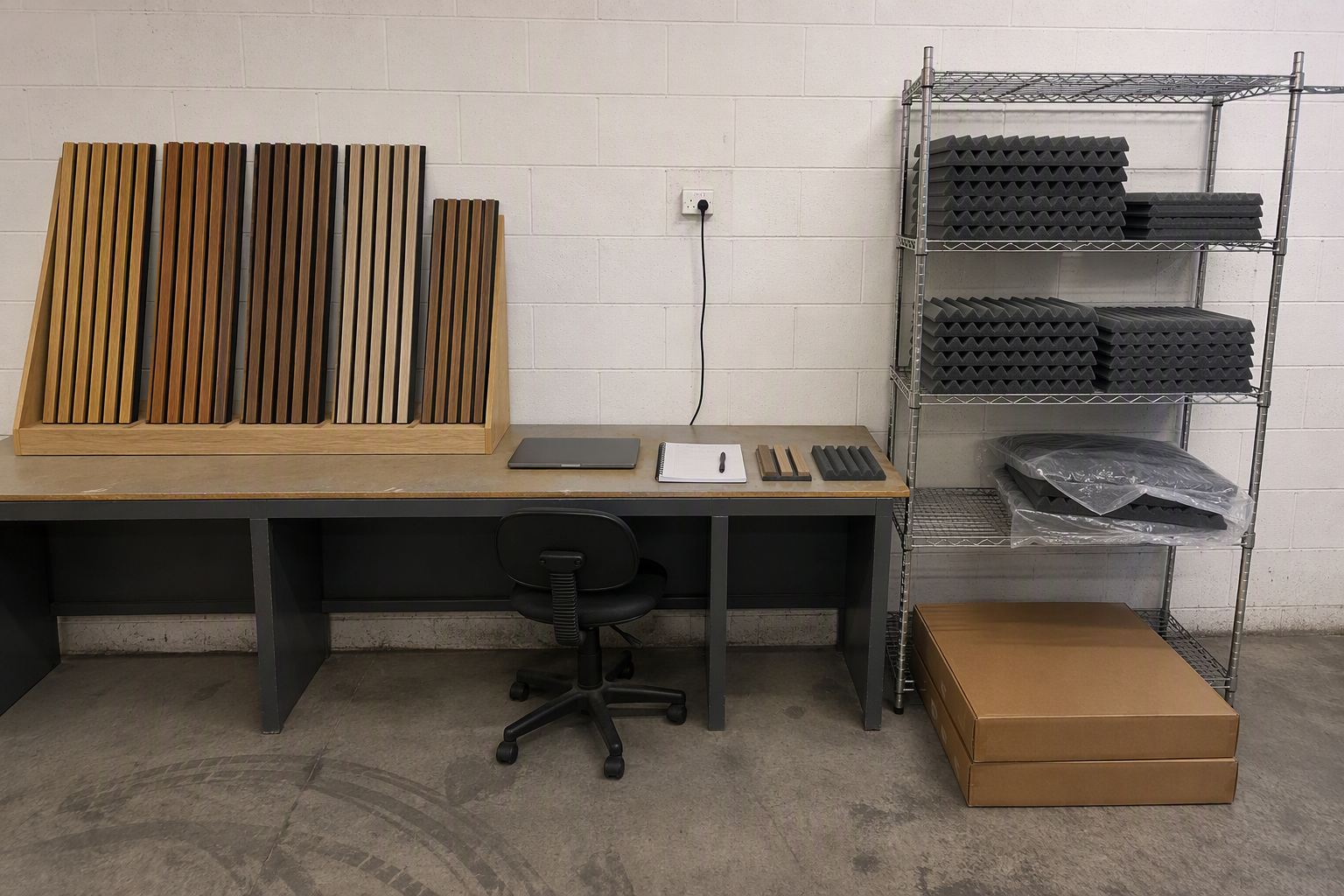
Match the product to the sales channel
From my experience handling distributor inquiries, finish questions usually appear early when the customer serves architects, interior designers, hospitality contractors, office fit-out companies, and building-material showrooms. These buyers often want acoustic improvement, but they also care about visual coordination and project consistency.
Wood slat acoustic panels may fit channels such as:
- Architectural wall and ceiling finishes
- Commercial interior products
- Hospitality and office fit-out materials
- Decorative acoustic collections
- Building-material distribution
- Private-label interior panel ranges
Acoustic foam may fit channels such as:
- Studio and broadcast equipment
- Rehearsal-room products
- Content-creator accessories
- Specialist acoustic treatment
- Selected industrial or technical applications
- Direct-to-consumer treatment kits
These categories can overlap, but the buyer should not assume that they have the same customer, specification process, price structure, or compliance burden.
Build a responsible sales-claim framework
I recommend giving sales teams approved language for each model. The framework should distinguish between verified facts, qualified statements, and prohibited claims.
Verified facts may include:
- Product dimensions and composition
- Available finish families
- Test method and reported result
- Installation conditions used during testing
- Manufacturing lead time
- Packaging and loading information
Qualified statements may include:
- “Designed to contribute to room sound absorption”
- “Performance depends on the installed assembly”
- “Available test documents can be supplied for review”
- “Final suitability should be confirmed by the project professional”
Unsupported statements to avoid may include:
- “This product soundproofs any room”
- “This NRC guarantees the same result in every installation”
- “This product meets all commercial fire codes”
- “Foam and slat panels are acoustically identical”
- “More panels always solve the noise problem”
I once received an inquiry that asked for the “best soundproof panel” before the buyer had identified the room type, wall construction, or source of noise. That kind of inquiry is common. I now treat it as a qualification opportunity rather than a product-selection question.
A responsible distributor can reduce risk by requesting project drawings, room dimensions, finish references, required documentation, expected quantities, and installation details before making a firm recommendation.
Frequently Asked Questions
Is thin, inexpensive acoustic foam with a high NRC as good?
A high NRC does not establish overall equivalence. I would verify the test standard, foam thickness, mounting condition, frequency data, fire documentation, durability, and intended application. A thin foam product may serve a useful treatment role, but it should not automatically be treated as equal to a decorative panel or another tested assembly.
How good are egg boxes for soundproofing?
Egg boxes are not a responsible substitute for tested acoustic or sound-isolation products. Their irregular shape may scatter a limited amount of high-frequency sound, but they do not create an effective sound barrier.9 They can also introduce fire, hygiene, and durability concerns. I recommend purpose-designed materials with verifiable documentation.
Do wood slat acoustic panels block sound between rooms?
Wood slat acoustic panels primarily contribute to room finishes and sound absorption, depending on their construction and installation. I do not present them as complete sound-isolation systems. Sound transmission between rooms requires evaluation of the entire wall or ceiling, including mass, cavities, junctions, doors, glazing, and penetrations.
Are thicker acoustic products always better?
Greater thickness can improve absorption at certain frequencies, but thickness alone does not determine suitability.10 I recommend reviewing frequency-specific test data, density, backing, air gaps, mounting, room needs, and surface coverage. A qualified acoustician can determine whether added thickness addresses the project’s actual reverberation or noise-control problem.
Can buyers compare fire ratings from different countries directly?
Buyers should not assume that classifications from different standards are directly equivalent. Each test uses its own procedure, specimen construction, mounting conditions, and classification rules.11 I advise importers to confirm the locally required standard and have the complete report reviewed by the relevant project professional or code authority.
Conclusion
Wood slat panels vs acoustic foam is not a contest with one universal winner. I recommend starting with the acoustic task, deciding whether the material is a visible finish or specialist treatment, and then verifying the tested assembly, fire documentation, durability, installation cost, and channel fit. NRC can support a decision, but it cannot replace a full technical review.
If you are sourcing a decorative acoustic collection, contact NF Decor to discuss specifications, veneer or PVC finishes, OEM options, samples, documentation, production requirements, and container-order planning for your market.
Related technical guides
- Wooden Slat Acoustic Panels: What Every Specifier and Designer Must Know
- How to Choose the Best Wood Acoustic Panels for Your Project?
"Prior listening in rooms improves speech intelligibility - PMC - NIH", https://pmc.ncbi.nlm.nih.gov/articles/PMC2921430/. Room-acoustics references explain that sound-absorbing surfaces reduce reflected acoustic energy and can lower reverberation time; resulting speech benefits depend on the room, source levels, listener positions, and treatment design. Evidence role: mechanism; source type: education. Supports: That absorptive surfaces reduce reflected acoustic energy and can reduce reverberation time; improved speech conditions depend on room design and coverage.. Scope note: This evidence describes general room-acoustic principles rather than the performance of a particular panel or foam product. ↩
"[PDF] new construction acoustical design guide - City of High Point", https://www.highpointnc.gov/DocumentCenter/View/1103/Wyle-New-Construction-Acoustical-Design-Guide-April-2003-PDF?bidId=. Building-acoustics guidance identifies mass, cavity construction, structural connections, airtightness, penetrations, and flanking transmission as determinants of airborne sound isolation in a completed assembly. Evidence role: mechanism; source type: government. Supports: That airborne sound isolation depends on assembly properties such as mass, cavities, connections, sealing, and flanking paths.. Scope note: Assembly performance must still be assessed for the specific wall, ceiling, junctions, and installation conditions. ↩
"A Study on the Sound Absorption Properties of Mycelium-Based ...", https://pmc.ncbi.nlm.nih.gov/articles/PMC9394424/. Acoustics literature distinguishes porous sound absorbers, which principally reduce reflected sound within a space, from sound-isolation systems, which require assembly-level control of transmission paths. Evidence role: general_support; source type: research. Supports: That porous absorbers primarily treat reflected sound and do not by themselves provide the assembly-level properties required for substantial sound isolation.. Scope note: The degree of isolation achievable by any product depends on its full tested assembly and cannot be inferred solely from its material category. ↩
"Noise reduction coefficient", https://en.wikipedia.org/wiki/Noise_reduction_coefficient. The Noise Reduction Coefficient (NRC) is a single-number sound-absorption rating derived from measured absorption coefficients at specified frequency bands under the applicable test method. Evidence role: definition; source type: institution. Supports: The definition and calculation basis of the Noise Reduction Coefficient as a single-number sound-absorption rating.. Scope note: The precise calculation, rounding convention, and applicable test conditions should be confirmed against the cited edition of the relevant standard. ↩
"Introduction to Acoustics", https://pages.uoregon.edu/ftepfer/SchlFacilities/AcousticsIntro.html. Acoustic measurement literature treats absorption as frequency dependent and notes that single-number indices such as NRC summarize, rather than fully represent, the absorption spectrum of a material or assembly. Evidence role: mechanism; source type: paper. Supports: That sound absorption is frequency dependent and that single-number ratings do not replace band-by-band absorption data.. Scope note: Frequency-band data must be interpreted with the tested mounting condition and the acoustic requirements of the intended room. ↩
"Sound absorption of slat structures for practical applications", https://www.academia.edu/124568053/Sound_absorption_of_slat_structures_for_practical_applications. Studies of slatted and perforated absorbers show that opening geometry, porous backing, absorber depth, and air-cavity conditions influence frequency-dependent sound absorption. Evidence role: mechanism; source type: paper. Supports: That the acoustic response of slatted or perforated absorbers is influenced by opening geometry, backing material, panel depth, and air-cavity configuration.. Scope note: Published findings for a given slatted construction do not establish the performance of a different proprietary panel without product-specific testing. ↩
"Sound Absorption Characteristics of Polyurethane and Polystyrene ...", https://www.academia.edu/123461450/Sound_Absorption_Characteristics_of_Polyurethane_and_Polystyrene_Foams_as_Inexpensive_Acoustic_Treatments. Research on porous acoustic absorbers reports that absorption is affected by material structure, thickness, density or flow resistance, surface geometry, and mounting conditions including any air space behind the material. Evidence role: mechanism; source type: paper. Supports: That porous foam absorption depends on material structure and density, thickness, surface geometry, and mounting or air-gap conditions.. Scope note: Foam chemistry and test configuration vary substantially, so generalized findings cannot substitute for an exact product test report. ↩
"[PDF] Fire Resistance of Structural Members and Assemblies", https://tsapps.nist.gov/publication/get_pdf.cfm?pub_id=932140. Fire-classification documentation is based on the product specimen and mounting conditions evaluated under the stated test procedure and is valid only within any declared field of application. Evidence role: definition; source type: institution. Supports: That reaction-to-fire classifications are tied to the tested specimen, test conditions, and any stated field of application.. Scope note: Local code acceptance may impose additional requirements beyond the laboratory classification or report. ↩
"(PDF) Experimental Analysis of Sound Absorption Coefficient of the ...", https://www.academia.edu/35228612/Experimental_Analysis_of_Sound_Absorption_Coefficient_of_the_Combined_Mechanism_of_Enhanced_Egg_Carton_Gypsum_Board_and_Sound_Diffuser. Basic building-acoustics principles indicate that lightweight, non-airtight egg-carton materials lack the mass and sealed assembly required to function as an effective sound barrier. Evidence role: general_support; source type: education. Supports: That lightweight egg-carton materials do not provide the mass and airtight construction required for meaningful sound isolation.. Scope note: The extent to which an irregular surface scatters high-frequency sound depends on its geometry and room conditions and does not demonstrate useful absorption or isolation. ↩
"(DOC) A preliminary study of effect of air gap on sound absorption of ...", https://www.academia.edu/1559344/A_preliminary_study_of_effect_of_air_gap_on_sound_absorption_of_natural_coir_fiber. Research on porous absorbers shows that thickness and mounting depth influence frequency-dependent absorption, with thicker or spaced absorbers often providing greater absorption at lower frequencies than thin, flush-mounted materials. Evidence role: mechanism; source type: research. Supports: That absorber thickness and air-gap conditions affect frequency-dependent absorption, particularly for porous materials.. Scope note: Suitability also depends on material properties, room geometry, source spectrum, coverage, and the target acoustic outcome. ↩
"[PDF] TECHNICAL DATA SHEET - Portland.gov", https://www.portlandoregon.gov/bds/appeals/index.cfm?action=getfile&appeal_id=23976&file_id=29926. Fire-safety authorities and standards guidance caution that reaction-to-fire results from different test systems reflect different procedures, specimen configurations, and classification criteria and should not be treated as directly equivalent without competent review. Evidence role: expert_consensus; source type: government. Supports: That differing fire-test standards use distinct test methods, specimen conditions, and classification systems, limiting direct comparison.. Scope note: The locally applicable building code and the authority having jurisdiction determine whether a particular report is acceptable for a project. ↩