What Are Acoustic Panels Made Of? A Materials Guide for Importers and Distributors
Acoustic panels are made from combinations of decorative finishes, structural substrates, sound-absorbing backings, and bonding materials. However, material labels alone can hide major quality differences. Importers who compare products only as “wood” or “polyester” risk inconsistent batches, unsuitable documentation, and costly market complaints. A construction-based evaluation offers a safer purchasing approach.
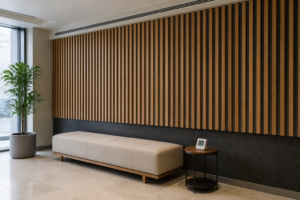
Acoustic panels can be made from solid wood, wood veneer, MDF, plywood, polyester fiber, felt, fabric, foam, or mineral-based materials. Many commercial panels combine several of these materials. The finish creates the appearance, the substrate provides stability, the backing supports acoustic absorption, and adhesives or mechanical fasteners hold the construction together.
I have learned through manufacturing that two panels with the same product name can behave very differently during production, transport, installation, and resale. Importers therefore need to look beyond the visible surface and examine the complete bill of materials, relevant test documents, and controls used for bulk production.
What Structural Layers Make Up Acoustic Panels?
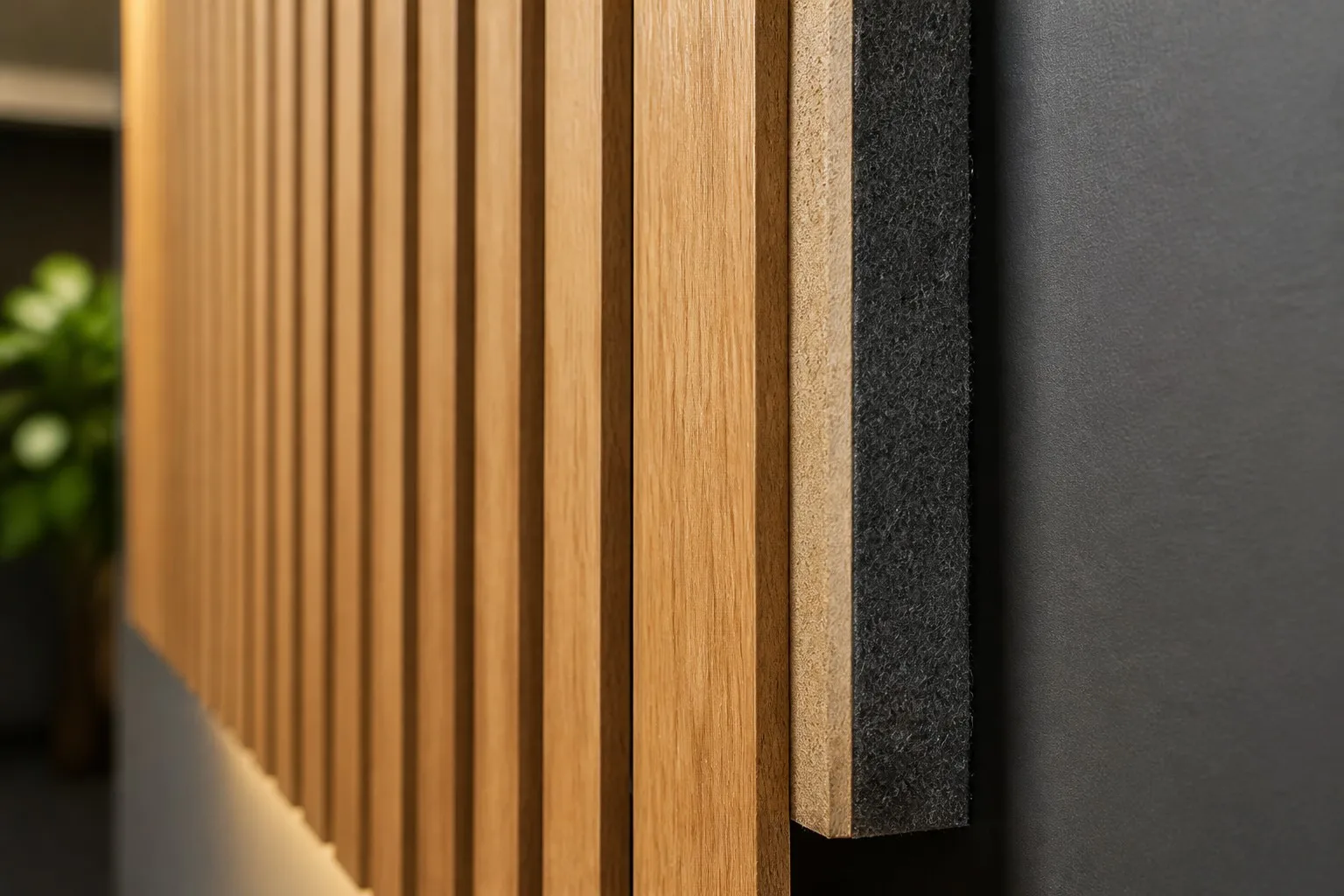
A panel can look simple in a showroom sample but contain several functional layers. When buyers focus only on the visible finish, they may miss the substrate, backing, and bonding choices that affect dimensional stability and batch consistency. I recommend treating every panel as an assembled system rather than a single material.
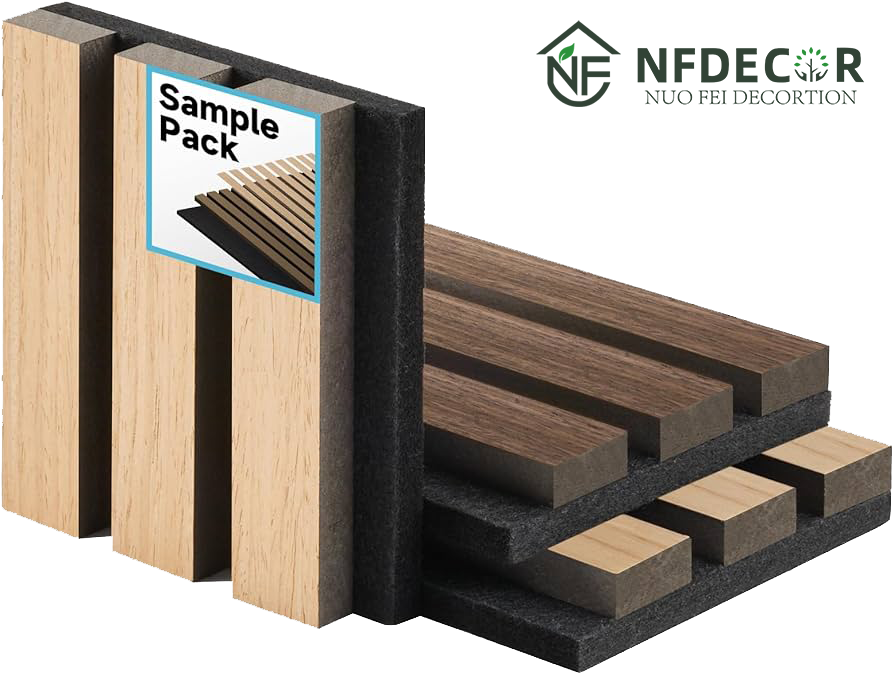
Most acoustic panels contain four construction elements: a decorative finish, a structural substrate, an acoustic backing or core, and a bonding or fastening system. Each element has a different role. Buyers should specify all four because changes to any layer can alter appearance, weight, handling, documentation, and potential performance.
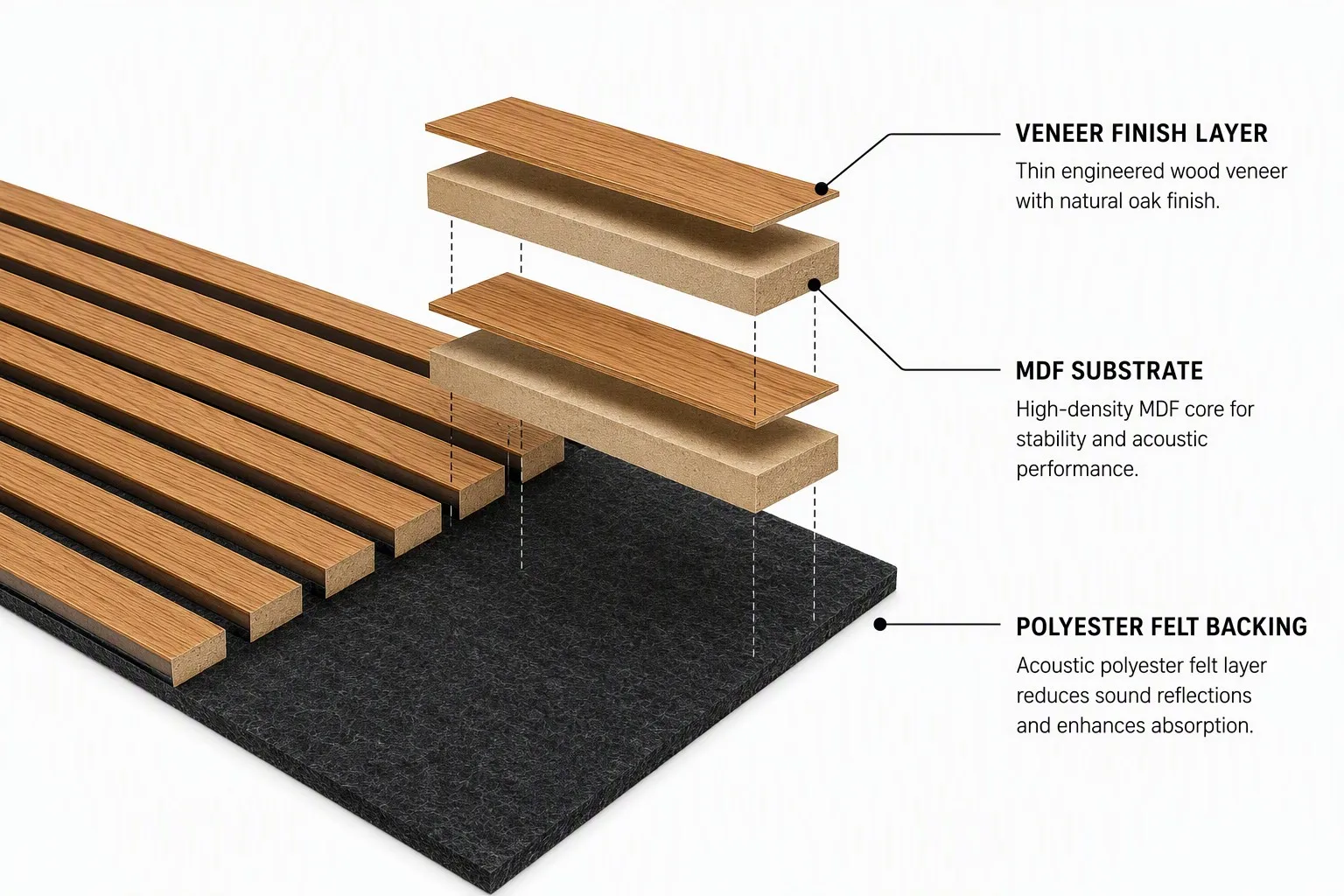
1. The decorative finish controls appearance
The finish is the surface that customers see after installation. Common options include:
- Natural wood veneer
- Melamine paper
- Decorative laminate
- Painted or stained wood
- Printed surfaces
- Fabric
- Suede-style textile
- Colored polyester felt
I usually ask importers to approve more than a color name. Terms such as “oak,” “walnut,” or “light grey” can describe a broad visual category rather than a controlled specification. A stronger purchase specification can include a physical reference sample, finish code, gloss expectation, grain direction, and an agreed method for evaluating normal variation.
Natural veneer requires special attention because wood grain and tone naturally vary.1 Decorative paper or laminate can provide greater visual uniformity, although batch-to-batch differences can still occur when suppliers change printing, coating, or raw material lots.
2. The substrate gives the panel form
The substrate supports the visible surface and helps the product retain its shape. Manufacturers commonly use MDF, plywood, solid wood, rigid polyester fiber, or another engineered board.
Each choice creates trade-offs. For example, MDF can support consistent machining and surface finishing, while plywood has a different layered construction and edge appearance.2 Solid wood can provide a premium material story, but natural moisture and grain variation require careful control. Buyers should not assume that one substrate is universally superior.
The specification should identify at least:
- Substrate type
- Nominal thickness
- Density or grade, where relevant
- Moisture-related requirements
- Edge treatment
- Machining pattern
- Applicable restricted-substance requirements
3. The backing supports acoustic function
Many slatted products use polyester felt behind decorative wood or wood-based slats. Fabric-wrapped products may use polyester fiber, foam, mineral wool, fiberglass, or another porous core. The backing can absorb some incident sound energy, while slots or gaps can expose more absorbing surface.3
However, the material name does not establish a verified acoustic rating. Thickness, density, air space, mounting method, and complete panel construction can all influence a tested result.4 Importers should request a report for the relevant product specification and test method rather than relying on a general statement about felt or fiber.
4. The bonding method maintains construction integrity
Manufacturers can use adhesive, staples, screws, clips, or combined methods. Adhesive selection affects production efficiency, bond integrity, odor, and the documents a buyer may need for a particular market.
From my production perspective, bonding is often overlooked during quotation comparisons. A low quotation may reflect a change that is invisible in product photos, such as lower adhesive coverage or a different fastening pattern. The buyer should therefore define the assembly method and inspect bond consistency during pre-shipment quality control.
Which Materials Are Commonly Used in Acoustic Panels?
Importers can choose from many material families, but the options are not directly interchangeable. Each material affects cost, appearance, machining, packaging, and market positioning. I find that the right question is not “Which material is best?” but “Which complete construction fits the intended application and sales channel?”
Common acoustic panel materials include wood and wood-based boards, polyester fiber felt, textiles, foam, mineral wool, fiberglass, metal, and perforated gypsum. Decorative wall panels often combine wood veneer or laminate, an MDF or plywood substrate, and polyester felt. The correct combination depends on design, documentation, installation, and budget requirements.
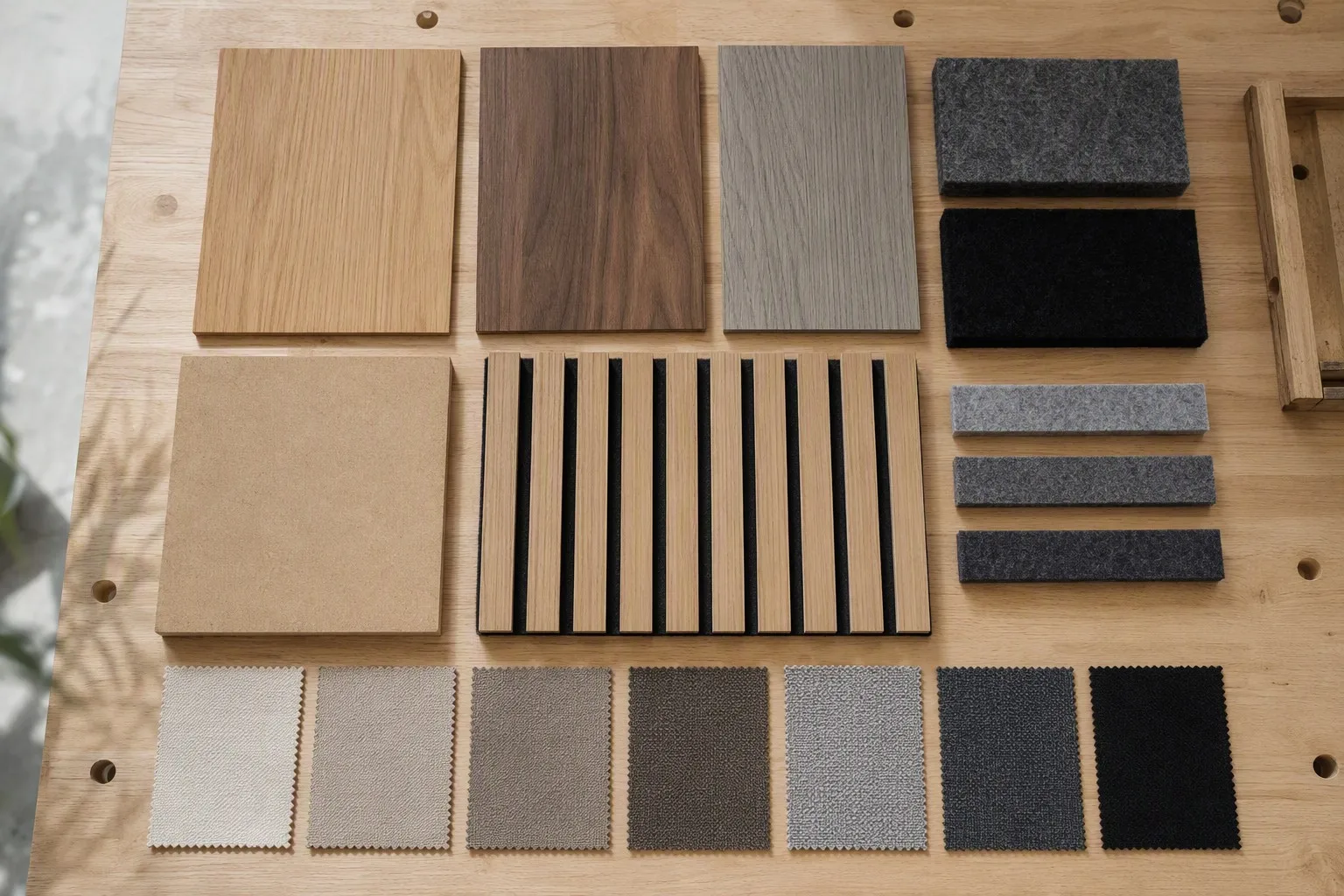
Wood and wood-based materials
Wooden slat acoustic panels commonly use narrow slats fixed over a felt backing. However, the word “wooden” can refer to several constructions:
| Market description | Possible underlying construction | Main buyer checks |
|---|---|---|
| Wood veneer panel | Natural veneer over MDF or plywood | Veneer species, grade, thickness, finish, substrate |
| Laminate wood-look panel | Decorative laminate over engineered board | Pattern consistency, wear resistance, substrate |
| Melamine-finished panel | Printed decorative paper on MDF | Paper quality, color match, edge finish |
| Solid wood slat panel | Machined natural timber slats | Species, moisture, knots, warping risk |
| Plywood slat panel | Plywood with clear or decorative finish | Ply structure, face grade, edge appearance |
I advise buyers to ask suppliers to state the construction in plain language. A specification such as “oak acoustic panel” remains incomplete. A more useful description could identify an oak veneer face, the substrate type, the slat dimensions, the felt specification, and the fastening method.
Polyester fiber and felt
Polyester fiber can appear as a backing layer, a rigid decorative panel, a shaped tile, or a freestanding acoustic product. Felt wall panels and hexagonal tiles often use compressed polyester fiber throughout the visible product.
Relevant purchasing variables include:
- Fiber composition
- Panel thickness
- Nominal density
- Surface texture
- Color consistency
- Edge quality
- Odor expectations
- Recycled-content evidence, if claimed
- Fire and emissions documentation, if required
A polyester label does not prove recycled content, low emissions, or fire performance. Buyers should verify each claim with supplier declarations and applicable third-party documents. They should also confirm that the tested sample matches the material density, thickness, finish, and construction being ordered.
Fabric, suede, and other textile finishes
Textile-covered panels give designers more freedom over color and texture. A suede acoustic wood panel, for example, can combine a soft decorative surface with a wood-based substrate and an acoustic backing.
The textile adds another supply-chain variable. Importers should check colorfastness expectations, fabric lot variation, surface defects, cleaning guidance, and adhesive compatibility. A replacement batch can look different if the textile comes from another dye lot.
Foam and fibrous cores
Some fabric-wrapped products use acoustic foam, mineral wool, or fiberglass. These products can serve different commercial applications, but buyers must evaluate handling, fiber containment, installation, local regulations, and required documentation.
I recommend qualified acoustic, fire-safety, and building professionals for application-specific decisions. A supplier’s material description cannot replace an assessment of the actual room, installation system, occupancy type, or local code.
Why Can Acoustic Panels With the Same Label Differ?
Material labels help buyers create a shortlist, but they rarely provide enough detail for a purchase order. Two suppliers may both quote “oak wood acoustic panels” while offering different veneers, substrates, felt densities, adhesives, and finishes. These hidden differences can create sample-to-bulk variation and uneven distributor inventory.
Acoustic panels with the same label can differ because material names do not define grade, density, thickness, source, finish, dimensions, backing, or assembly. Buyers should compare controlled specifications and approved samples. They should also verify whether test documents apply to the exact construction, not merely to one component or an older product version.
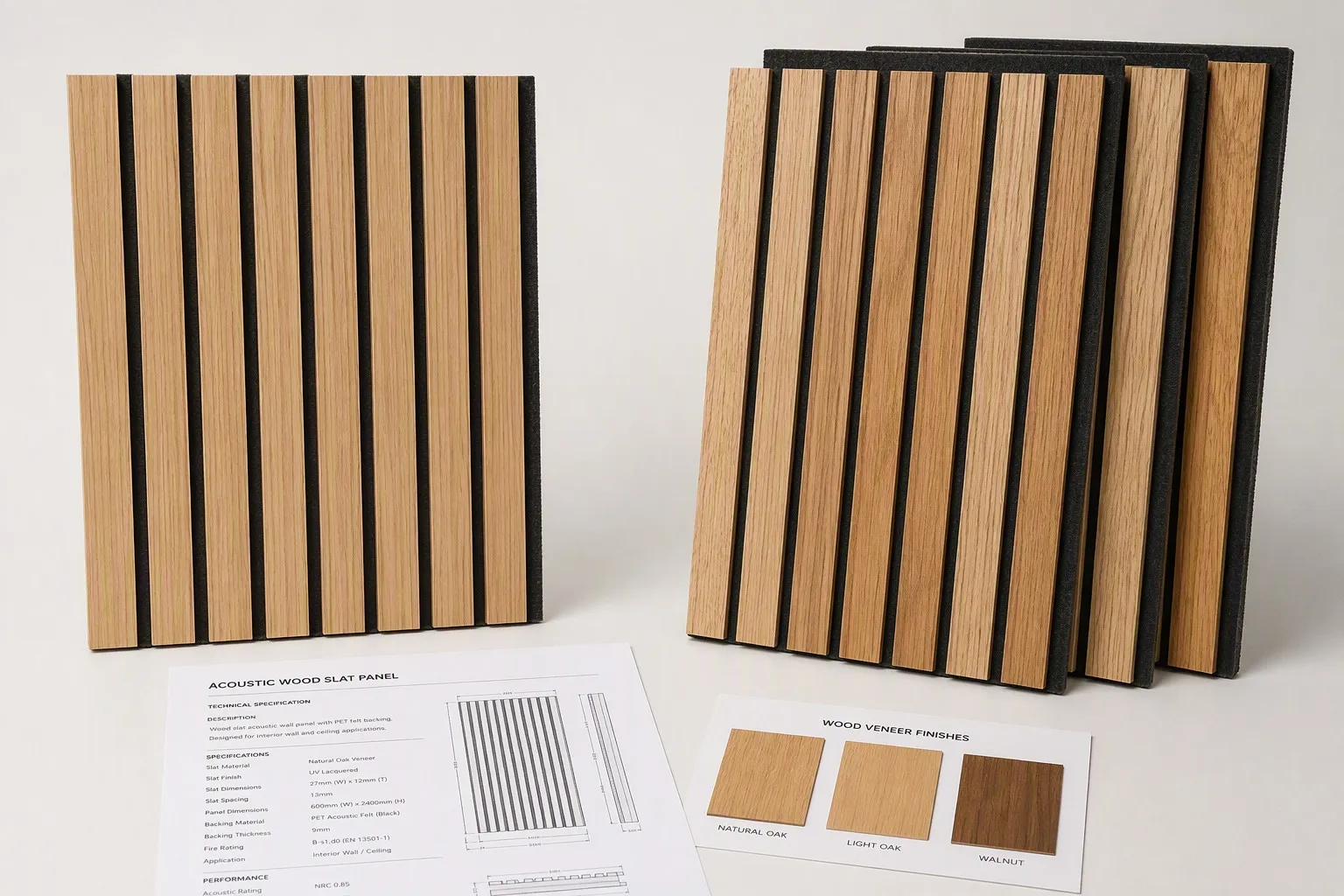
Nominally identical materials can conceal meaningful differences
I have seen material substitutions create visible or practical changes even when a commercial product name stayed the same. For example, two MDF boards with the same nominal thickness may machine differently because their density profiles or surface quality differ.5 Two black polyester backings may have different stiffness, fiber texture, or actual thickness.
The buyer should define measurable or verifiable characteristics wherever possible. A useful specification package may contain:
- A construction drawing with overall dimensions and layer arrangement.
- A bill of materials that identifies finish, substrate, backing, and bonding method.
- An approved reference sample signed or sealed by both parties.
- Color references for felt, textiles, coatings, and laminates.
- Packaging instructions for retail or project distribution.
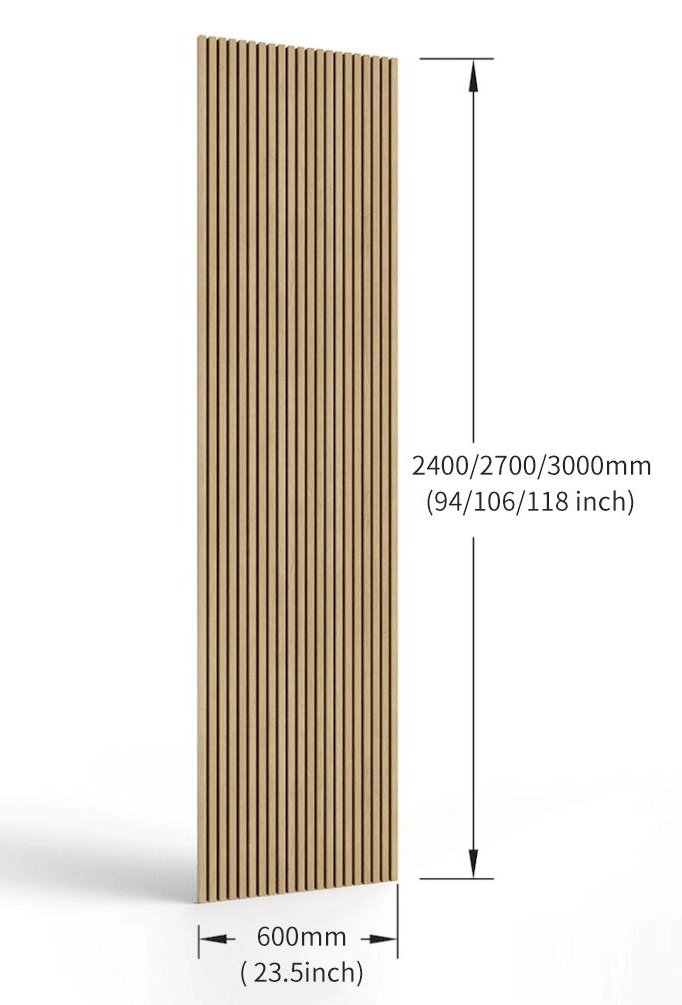
- Inspection criteria for dimensions, appearance, assembly, and quantity.
- Document requirements linked to the exact ordered model.
Small specification changes can affect several outcomes
A supplier may change a component to manage cost or availability. However, a change to one layer can affect more than one purchasing criterion.
| Specification change | Possible procurement effect | Recommended control |
|---|---|---|
| Different veneer batch | Grain or color variation | Approve a range or master sample |
| Different MDF source | Machining or edge variation | Lock grade and approved source where practical |
| Lower felt thickness | Different weight or construction | State thickness and inspection method |
| New adhesive | Bond or odor concerns | Require change approval and relevant documents |
| Altered slat spacing | Different appearance and tested construction | Use a controlled drawing |
| Different carton design | Higher transit damage risk | Approve packaging and conduct drop testing if needed |
These effects do not automatically mean that the revised product is defective. They mean that the buyer must decide whether the change remains acceptable for the target market.
The approved sample needs supporting records
A sample provides a physical reference, but it does not control production by itself. The factory must connect the sample to the material codes, drawings, process instructions, and inspection records used for bulk production.
At NF Decor, we use our manufacturing experience to evaluate how material selection interacts with production across our panel lines. We also understand that buyers should independently verify our claims and documentation. Our CE, SGS, ISO, and FSC-related documents should be checked for issuer, scope, validity, product coverage, and relevance to the ordered construction. A certification logo alone does not answer those questions.
I recommend requiring written approval before a supplier changes any material or structural specification that could affect appearance, documentation, installation, or tested construction.
How Should Importers Match Acoustic Panel Materials to Their Markets?
Many sourcing problems begin before the quotation stage. A buyer requests the cheapest wood or felt product without defining where it will be sold. The resulting construction may not fit the retailer, contractor, designer, or local documentation requirements. I start with the market and work backward toward the material specification.
Importers should choose acoustic panel materials by identifying the target country, customer type, installation environment, price band, design position, and required documentation. They can then compare complete constructions that meet those needs. This market-first method is more reliable than selecting a material name and trying to adapt it later.
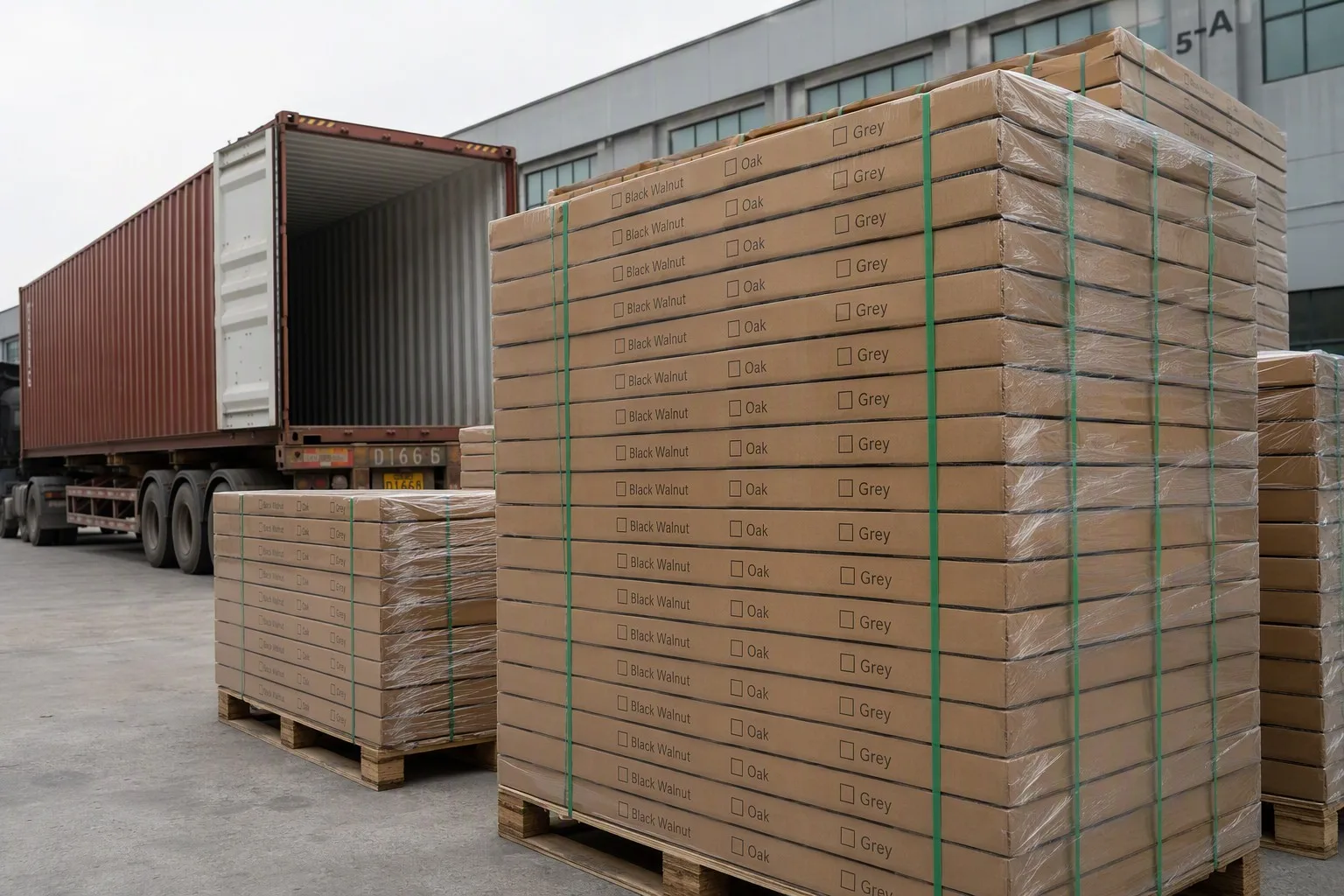
Start with five commercial questions
I recommend answering these questions before requesting final prices:
-
Where will the product be sold?
Countries and regions may have different documentation, labeling, chemical, fire, and building requirements. -
Who will buy or specify it?
A retail customer, interior designer, wholesaler, and commercial contractor may expect different packaging, finishes, and technical files. -
Where will the panel be used?
An office, hotel, conference room, showroom, home, or public building can present different design and compliance considerations. -
What price position must the product occupy?
Entry-level, mid-market, and premium ranges usually require different finish choices, packaging, and visual controls. -
Which claims will appear in sales materials?
Every acoustic, fire, environmental, recycled-content, and sourcing claim should have evidence that applies to the marketed product.
Match construction to channel priorities
| Sales channel | Common priorities | Material and construction focus |
|---|---|---|
| Building-material distributor | Repeatability, stock turnover, low complaint rate | Standard colors, stable specifications, durable packaging |
| Design studio | Appearance, finish range, customization | Veneer quality, textile options, color control |
| Commercial contractor | Documentation, lead time, installation | Controlled drawings, project submittals, fastening details |
| DIY retailer | Easy handling, clear instructions, shelf presentation | Panel size, carton design, labeling, installation accessories |
| Premium importer | Material story and finish detail | Selected veneer, refined edges, controlled visual grading |
No table can determine the final product automatically. The buyer still needs to consider project-specific requirements and local rules. However, this framework prevents the sourcing team from treating every panel as a commodity.
Consider installation as part of material selection
An acoustic report usually describes a particular specimen and mounting arrangement.6 An installed room may produce different results because room volume, existing surfaces, panel coverage, air gaps, furniture, and placement all matter.7
Importers should avoid converting one laboratory value into a universal promise. They should keep the original report available, present its scope accurately, and consult a qualified acoustician when a project must achieve a specific reverberation or sound-control target.
The same principle applies to fire-related information. A component report may not represent the complete assembled panel. Buyers should confirm whether evidence covers the finish, substrate, backing, adhesive, dimensions, and mounting conditions relevant to the offered product.
How Can Buyers Verify Acoustic Panel Materials and Batch Consistency?
A polished sample can support product selection, but it cannot prove that thousands of square meters will match. Importers face the greatest risk when the order lacks controlled specifications and inspection criteria. I recommend building quality controls into the purchase process rather than relying on a final visual check.
Buyers can verify acoustic panel materials through approved samples, bills of materials, controlled drawings, incoming-material records, in-process checks, pre-shipment inspections, and relevant third-party documents. Purchase orders should require approval for substitutions. Inspection criteria should cover appearance, dimensions, construction, packaging, labeling, and quantities.

Use a staged verification process
A practical procurement process can include the following stages:
Before sampling
The buyer should provide:
- Target application and country
- Preferred dimensions and finishes
- Expected order volume
- Price positioning
- Packaging requirements
- Required reports or declarations
- Installation method
- Intended marketing claims
During sample approval
The buyer should record:
- Overall panel dimensions
- Slat or pattern dimensions
- Surface material and color
- Substrate type
- Backing type, thickness, and color
- Edge treatment
- Panel weight, if relevant
- Bonding or fastening method
- Label and carton details
I also suggest photographing the approved sample under consistent lighting. Photographs cannot replace the physical reference, but they help teams communicate when purchasing, sales, and quality staff work in different countries.
During bulk production
The factory should control incoming materials and key process steps. Depending on the product, these checks can cover material identity, dimensions, color lots, surface defects, machining, adhesive application, alignment, and packaging.
NF Decor operates five production lines with stated monthly capacity above 50,000 m². However, capacity figures should not replace order-specific planning. Buyers should confirm the production schedule, approved specification, inspection arrangement, and delivery terms for each purchase order.
Before shipment
A pre-shipment inspection can use a recognized sampling plan agreed by the parties. The inspection should match the risks of the product and order rather than relying on a generic checklist.
Useful inspection points include:
- Quantity and model mix
- Panel and carton dimensions
- Finish and color consistency
- Slat alignment or tile geometry
- Surface scratches, stains, or chips
- Bond integrity
- Edge quality
- Label accuracy
- Carton strength and internal protection
- Loading and pallet requirements
Verify documents, not just logos
Importers should review each report or certificate critically. They can ask:
- Who issued the document?
- Is the issuer appropriately recognized for the stated work?
- Is the document still valid?
- Which company and factory does it identify?
- Which product construction does it cover?
- Which standard or test method was used?
- Does the tested thickness and density match the order?
- Does the report cover the complete panel or only one component?
- Can the buyer use the claim legally in the target market?
I recommend professional review when a regulation, public tender, or building approval depends on a document. A manufacturer can provide production information and available files, but the importer remains responsible for confirming market access and claim suitability with qualified local advisers.
Frequently Asked Questions
Are wooden acoustic panels made entirely from solid wood?
Many wooden acoustic panels are not entirely solid wood. A common construction uses natural veneer, melamine, or laminate over MDF or plywood slats, which are then fixed to polyester felt. Buyers should request a layer-by-layer specification because the phrase “wood panel” does not identify the complete construction.
Is polyester felt enough to prove acoustic performance?
No. Polyester felt alone does not prove a specific acoustic rating. Thickness, density, panel geometry, air space, installation, and the full tested assembly can affect results. Buyers should review an applicable test report and confirm that its specimen matches the product they plan to import.
Which acoustic panel material is best for commercial interiors?
No single material is best for every commercial interior. The suitable choice depends on visual design, installation conditions, maintenance, budget, documentation, and acoustic objectives. I recommend comparing complete panel systems and seeking qualified acoustic or building advice when a project has defined performance requirements.
What documents should an acoustic panel importer request?
An importer may request product specifications, controlled drawings, material declarations, installation instructions, quality records, and relevant acoustic, fire, environmental, or sourcing documents. The required list depends on the target country and application. Buyers should verify each document’s scope, validity, issuer, and connection to the ordered construction.
How can distributors reduce sample-to-bulk differences?
Distributors can approve a physical sample, lock the bill of materials, specify acceptable visual variation, require written approval for substitutions, and arrange production or pre-shipment inspections. They should also control color references, packaging, labels, dimensions, and component sources when those factors are commercially important.
Conclusion
Acoustic panels are rarely defined by one material. Their finish, substrate, backing, and bonding method work together as a complete construction. Importers should begin with the target market, application, price band, sales channel, and documentation needs. They should then control the approved specification and verify any performance claims against applicable evidence.
NF Decor draws on more than 30 years of panel manufacturing experience to support B2B sourcing, customization, production, and quality control. Contact our team to discuss your required construction, finish, order volume, documentation, and sample approval process.
Related technical guides
- NRC vs STC: Which Rating Does Your Project Actually Need?
- What Is NRC Rating? A Plain-English Guide for B2B Acoustic Panel Buyers
"VENEER SPECIES THAT GROW IN THE UNITED STATES", https://www.fpl.fs.usda.gov/documnts/fplrp/fplrp167.pdf. Wood-science references attribute natural variation in grain and color to differences in anatomy, growth conditions, and position within the tree. Evidence role: mechanism; source type: government. Supports: Wood-science evidence that anatomical growth patterns, species, and environmental conditions produce natural differences in wood grain and color.. Scope note: Such references establish the general source of variation but do not define acceptable visual tolerances for a particular veneer order. ↩
"Wood-Based Composite Materials-Panel Products", https://www.fpl.fs.usda.gov/documnts/fplgtr/fplgtr190/chapter_11.pdf. Wood-products references describe MDF as a comparatively homogeneous fiber panel suitable for machining and finishing, while plywood is formed from bonded veneer plies whose layered structure remains visible at cut edges. Evidence role: mechanism; source type: government. Supports: Authoritative descriptions of MDF as a relatively homogeneous fiber-based panel and plywood as cross-laminated veneer layers.. Scope note: Actual machining and finishing quality also depends on panel grade, tooling, moisture, and manufacturing quality. ↩
"Acoustic properties of multilayer sound absorbers with a ...", https://www.academia.edu/81206444/Acoustic_properties_of_multilayer_sound_absorbers_with_a_3D_printed_micro_perforated_panel. Research on porous absorbers explains that acoustic energy is dissipated through viscous and thermal losses within interconnected pores, while an open or perforated facing permits sound to reach the absorptive layer. Evidence role: mechanism; source type: paper. Supports: The physical mechanism by which viscous and thermal losses in porous materials dissipate acoustic energy and openings permit incident sound to interact with the absorber.. Scope note: This mechanism does not establish the absorption rating of any specific panel geometry. ↩
"Acoustic Absorption in Porous Materials", https://ntrs.nasa.gov/api/citations/20110011143/downloads/20110011143.pdf. Standardized reverberation-room methods report sound absorption for a defined specimen and mounting arrangement, and published studies show that thickness, flow-related material properties, and backing air space can alter measured absorption. Evidence role: expert_consensus; source type: institution. Supports: Acoustic test standards and studies showing that specimen construction and mounting conditions are part of the reported absorption result.. ↩
"Surface roughness and processing time of a medium density ...", https://bioresources.cnr.ncsu.edu/resources/surface-roughness-and-processing-time-of-a-medium-density-fiberboard-cabinet-door-processed-via-cnc-router-and-the-energy-consumption-of-the-cnc-router/. Studies of medium-density fiberboard report that through-thickness density profiles and surface-layer properties can influence cutting behavior and machined-edge quality even when nominal panel thickness is unchanged. Evidence role: mechanism; source type: paper. Supports: Empirical evidence that MDF density distribution and surface-layer properties influence cutting forces, edge quality, or machinability.. Scope note: Machining outcomes are also affected by tool geometry, wear, feed speed, and moisture content. ↩
"Examination of the Measurement of Absorption Using the ...", https://ntrs.nasa.gov/api/citations/20150023091/downloads/20150023091.pdf. Reverberation-room standards define absorption results for the specimen and mounting condition used in the test and require those conditions to be documented in the report. Evidence role: definition; source type: institution. Supports: Standards defining sound-absorption measurements in relation to an identified specimen, test area, and mounting condition.. ↩
"Lab #6 – Room Acoustics", https://astro.pas.rochester.edu/~aquillen/phy103/Labs/RoomLab.pdf. Room-acoustics research shows that reverberation depends on room volume, boundary absorption, furnishings, and the amount and distribution of absorptive treatment, so a laboratory material value does not by itself predict a unique installed-room outcome. Evidence role: mechanism; source type: paper. Supports: Room-acoustics evidence that reverberation depends on room volume, total and spatially distributed absorption, geometry, and contents.. Scope note: The relative importance of each factor is project-specific and normally requires measurement or acoustic modeling. ↩