I’ve walked into offices that looked like they belonged in a design magazine — and sounded like a high school cafeteria. Beautiful space, terrible acoustics. The problem isn’t the design. It’s that nobody thought about sound until the first team meeting when half the room couldn’t hear the presenter over the HVAC hum and keyboard clatter from three desks away.
Office acoustics isn’t a luxury add-on. It directly impacts productivity, focus, and — for the people making purchasing decisions — employee retention. Study after study shows that poor acoustic comfort is the number one complaint in open plan offices, ahead of temperature and lighting.
So if you’re specifying materials for an office project — whether you’re an architect, interior designer, or procurement manager — choosing the right acoustic panels isn’t just about noise reduction. It’s about creating a space where people can actually work.
Featured Snippet: The best acoustic panels for offices depend on your specific needs: wood slat panels offer the highest NRC (0.75–0.95) with premium aesthetics for feature walls and meeting rooms; PET felt panels provide lightweight, budget-friendly absorption for ceiling baffles and desk dividers; fabric-wrapped panels deliver maximum sound control for conference rooms and call booths. For most commercial office projects, a combination of wood slat panels on visible walls and PET felt on ceilings gives the best balance of performance, aesthetics, and cost.
The right panel for your project depends on three things: how much sound you need to absorb, where you’re installing it, and what the space needs to look like. Let me walk you through each option based on what I’ve seen work — and fail — on real commercial projects.
Why Open Plan Offices Need Acoustic Treatment — The Problem You Can’t Ignore

Here’s what happens in an untreated open plan office: sound bounces. Hard surfaces — glass walls, concrete floors, exposed ceilings — reflect noise instead of absorbing it. One phone call at desk 12 becomes background noise for everyone within a 10-meter radius. Multiply that by 40 people, and you’ve got a cognitive nightmare.
The technical term is reverberation time (RT60) — how long it takes for sound to decay by 60 decibels. In an office, you want RT60 below 0.6 seconds. An untreated open plan with hard surfaces can easily hit 1.2 to 1.8 seconds. That’s the difference between "I can focus" and "I can hear Karen’s sales call from across the floor."
I’ve specified wood slat acoustic panels for dozens of office projects, and the pattern is always the same: the spaces that invest in proper acoustic treatment see fewer noise complaints, higher employee satisfaction scores, and — interestingly — lower turnover in departments that require deep focus work like engineering and design.
| Acoustic Metric | Untreated Office | Treated Office (Wood Slat Panels) |
|---|---|---|
| RT60 (Reverberation Time) | 1.2 – 1.8 seconds | 0.4 – 0.6 seconds |
| Speech Intelligibility | Poor (> 10m radius) | Good (≤ 4m radius) |
| Employee Noise Complaints | High | Low |
| Perceived Privacy | None | Moderate |
The key takeaway: you don’t need to cover every surface. Strategic placement — a feature wall behind the open plan area, ceiling baffles above collaborative zones, panels flanking meeting room walls — can transform the acoustic experience of an entire floor.
Wood Slat vs. PET Felt vs. Fabric-Wrapped — Which Acoustic Panel Type Suits Your Office?
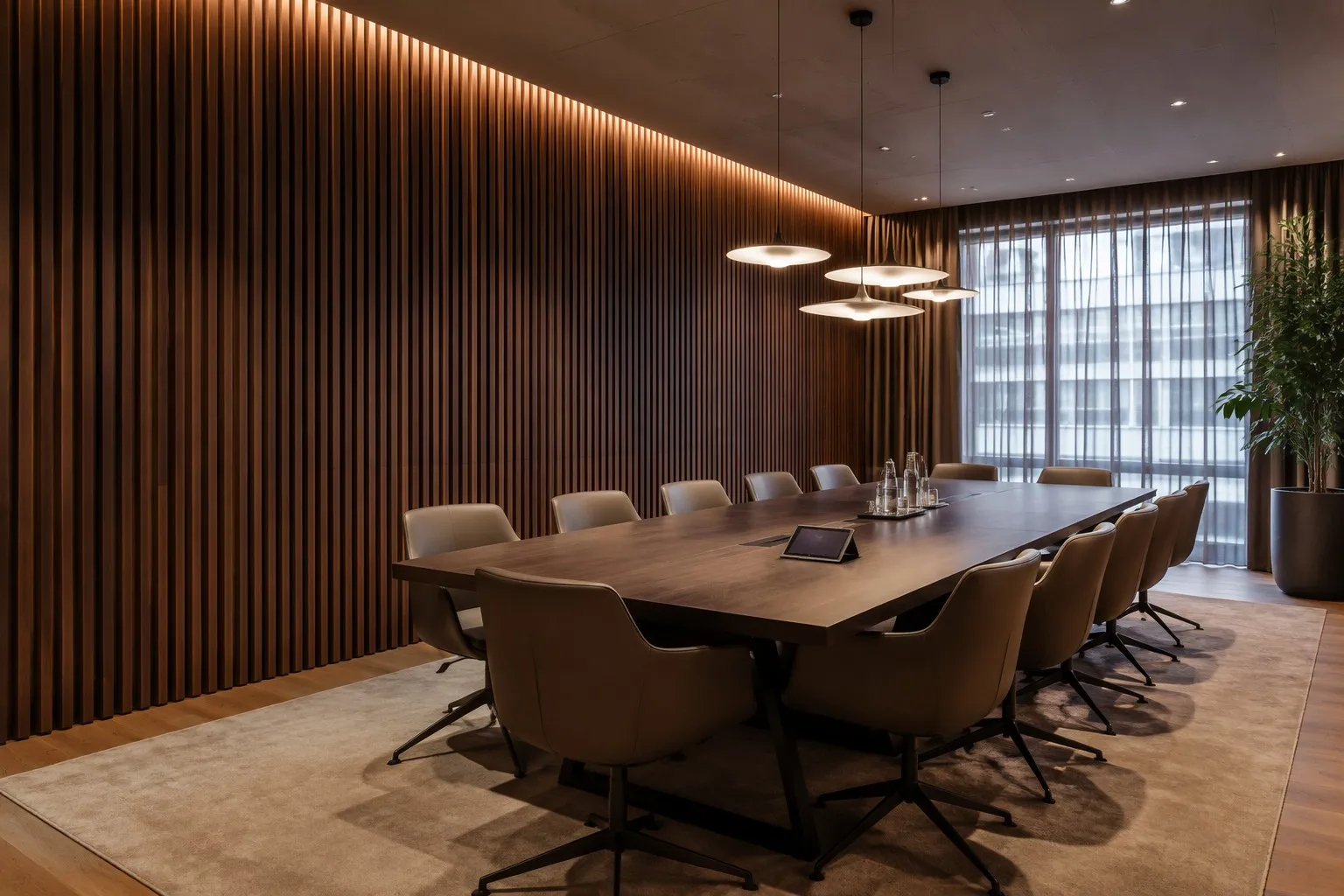
I get asked this question at least three times a week. The answer depends on what you’re optimizing for: aesthetics, acoustic performance, budget, or fire safety. Here’s the honest breakdown from years of working with all three.
Wood Slat Acoustic Panels
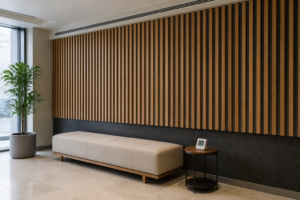
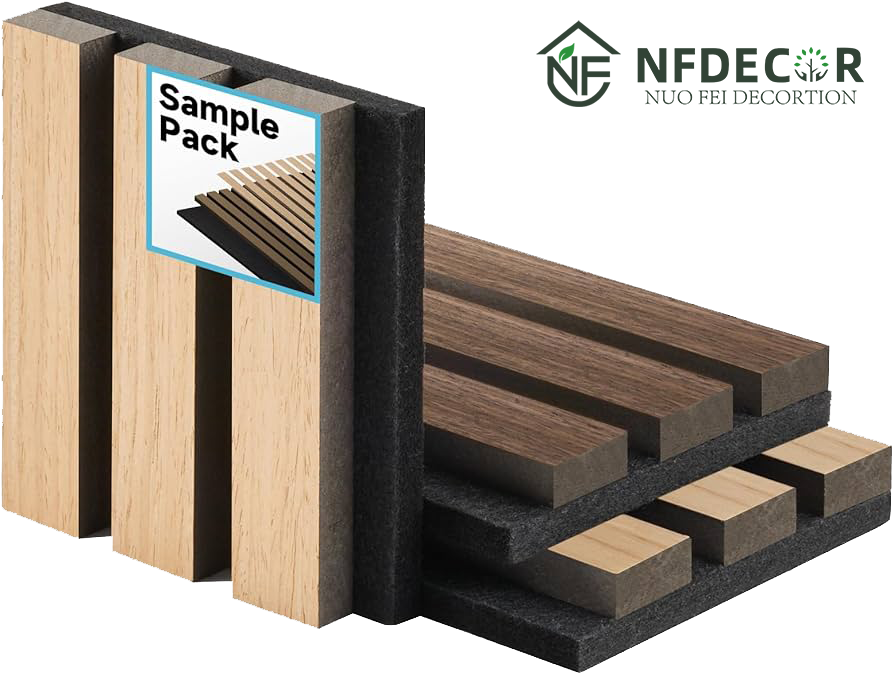
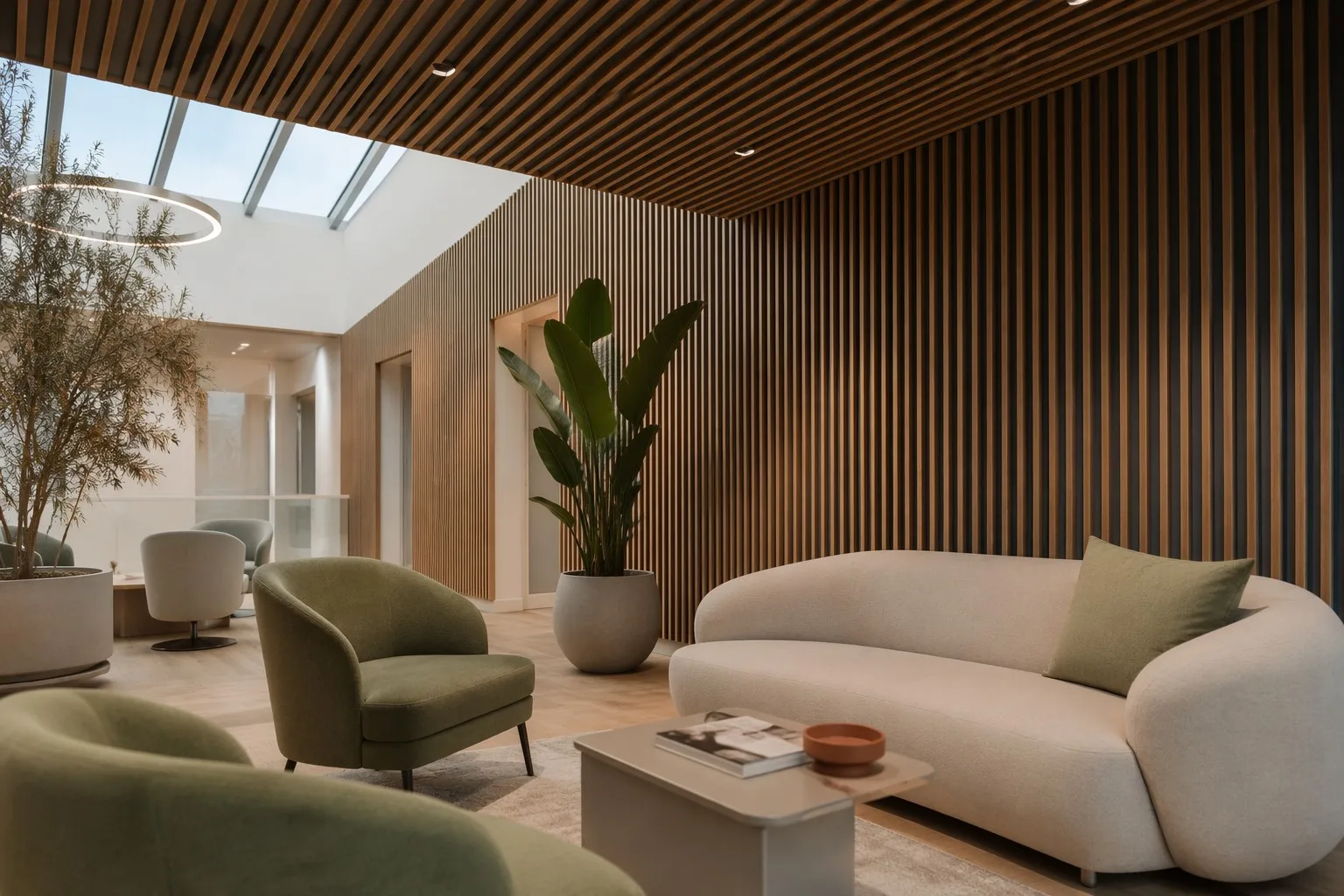
These are the panels I specify most often for visible walls in office projects. They combine real wood veneer slats — oak, walnut, teak, rosewood — with a high-density acoustic felt backing. The felt absorbs sound, the slats diffuse it, and the result is both functional and genuinely beautiful.
NRC ratings range from 0.75 to 0.95 depending on slat spacing and felt density. For an office feature wall or meeting room, they’re hard to beat. The aesthetic is warm, professional, and aligns with the biophilic design trends that corporate clients increasingly demand.
One thing I always tell specifiers: look for panels with real wood veneer, not printed MDF. The difference is visible from across the room — and it matters when your client is a Fortune 500 company whose brand reputation lives in the details.
PET Felt Panels
If you need ceiling baffles, desk dividers, or large-area coverage on a tighter budget, PET felt panels are your best option. Made from recycled polyester fibers, they’re lightweight, easy to cut on-site, and available in 20+ colors.
NRC is typically 0.55 to 0.75 — lower than wood slat systems, but excellent for the price point. I use them most often as suspended ceiling clouds in open plan areas and as pin-able wall panels in breakout spaces where teams need both acoustic comfort and a surface they can use.
Fabric-Wrapped Panels
For conference rooms, executive offices, and call booths where maximum absorption is the priority, fabric-wrapped panels deliver NRC ratings up to 1.0. They’re the most utilitarian option — not the prettiest, but when sound control is the only metric that matters, they win.
| Panel Type | NRC Range | Best For | Relative Cost | Fire Rating |
|---|---|---|---|---|
| Wood Slat Acoustic | 0.75 – 0.95 | Feature walls, meeting rooms, lobbies | $$$ | B1 available |
| PET Felt | 0.55 – 0.75 | Ceilings, desk dividers, large areas | $$ | B1 |
| Fabric-Wrapped | 0.85 – 1.00 | Conference rooms, call booths | $$ | Class A |
My recommendation for most office projects: wood slat panels on the walls people see, PET felt on the surfaces they don’t. It’s the combination that gives you premium aesthetics where it counts and cost-effective coverage everywhere else.
Specifying Acoustic Panels for Commercial Office Projects — What to Look For
If you’re writing a spec sheet for an office project, here are the five things I check before approving any acoustic panel product.
1. Fire Rating
This is non-negotiable for commercial projects. Most building codes in North America, Europe, and the Middle East require Class B1 or Class A fire rating for wall and ceiling materials in commercial spaces. I’ve seen projects held up for weeks because the specified panels didn’t have the right certification. Always ask for the test report, not just the claim. NF Decor’s panels come with B1 fire-rated certification — don’t spec a panel without it.
2. NRC Certification
Not all NRC claims are created equal. Look for panels tested to ASTM C423 or ISO 354 standards. If a supplier can’t produce a lab test report, assume the number is marketing.
3. Installation System
The best acoustic panel in the world is worthless if your contractor can’t install it efficiently. Wood slat systems should support both screw-fix and adhesive mounting. For large commercial projects — 500 square meters or more — the installation method can swing the labor cost by 30-40%.
4. Customization
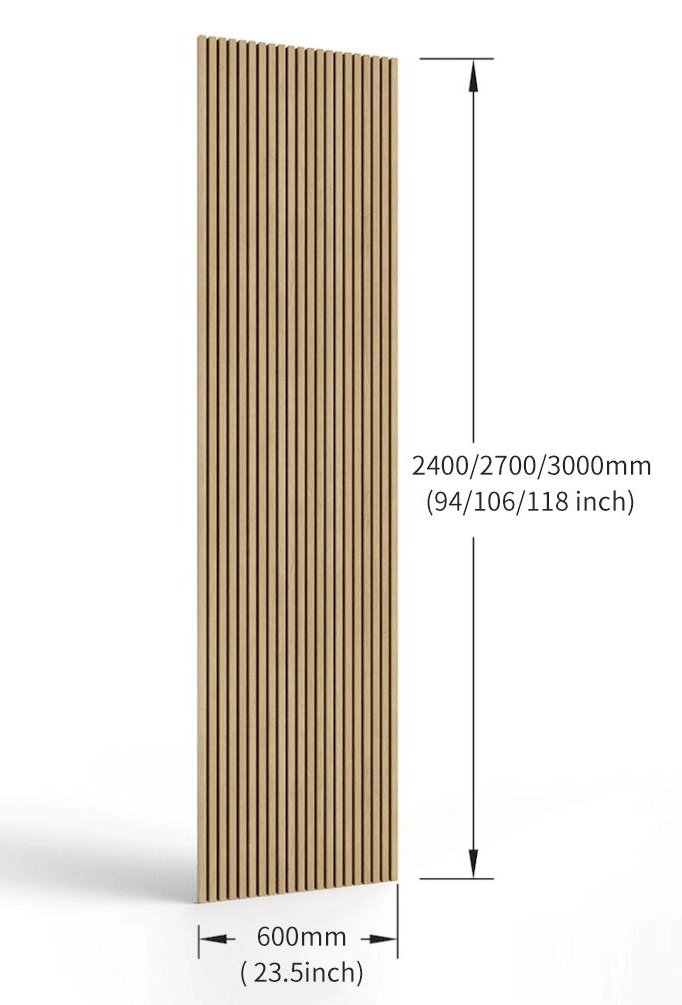
Standard sizes (600mm × 2400mm / 2700mm / 3000mm) work for most applications, but office projects often need custom dimensions — especially for feature walls with integrated lighting, screens, or irregular ceiling heights. I always recommend working with a manufacturer that offers OEM and custom sizing rather than trying to make standard panels fit an unusual space.
5. Sustainability Credentials
This matters more every year. Major corporate clients — especially in Europe and North America — now require FSC certification and environmental product declarations. If you’re sourcing directly from a factory, confirm their certifications before you spec their products. NF Decor holds both ISO and FSC certifications, which has saved me more than once when a client’s compliance team asked for documentation.
| Specification Factor | Minimum Standard | Recommended |
|---|---|---|
| Fire Rating | Class B1 / ASTM E84 Class A | Class B1 with test report |
| NRC | ≥ 0.55 | ≥ 0.75 for feature walls |
| Installation | Screw-fix only | Screw-fix + adhesive compatible |
| Certification | — | ISO, FSC, fire test report |
| Custom Sizing | Standard only | Custom dimensions + OEM available |
I’ve spent over a decade in this industry, and the one thing I’ve learned is that good office acoustics isn’t about buying the most expensive panels. It’s about putting the right product in the right place — and working with suppliers who understand commercial project timelines, compliance requirements, and the fact that your reputation is on the line with every specification you write.
FAQ
Q1: What NRC rating do I need for an office?
For open plan offices, aim for NRC 0.70 or higher on wall panels. For conference rooms and call booths, NRC 0.85+ is recommended. Ceiling treatments can use NRC 0.55–0.75 PET felt panels, as they cover larger surface areas and the cumulative absorption compensates for the lower per-panel rating.
Q2: Can wood slat acoustic panels meet commercial fire codes?
Yes. Wood slat acoustic panels with Class B1 fire-rated acoustic felt backing meet the fire safety requirements for commercial interiors in most markets, including North America, Europe, and the Middle East. Always request the fire test certificate from your supplier before specifying.
Q3: How long does installation take for a typical office project?
For 200–300 square meters of wood slat panels, a professional crew of two can complete installation in 2–3 days using the screw-fix method. PET felt panels install faster — the same area can be done in 1–2 days with adhesive mounting. Custom-cut panels around windows, outlets, and irregular corners add time.
CTA
If you’re specifying acoustic panels for an upcoming office project, I recommend starting with physical samples. You need to see the wood grain, feel the felt density, and check the color under your project’s lighting — catalog photos only get you so far. Get in touch with NF Decor for a free sample set and full product catalog, or discuss custom sizing and OEM requirements directly with the team.