I’ve seen it happen more than once. A distributor places a large order for acoustic wall panels, ships them to a hotel project in Europe, and then gets a call from the contractor. The panels fail the building inspection. The fire rating certificate is wrong. The whole shipment gets rejected.
Class B1 fire rated acoustic panels meet the flame-retardant standard required by most commercial building codes in Europe and Asia. They are tested under EN 13501-1 and must self-extinguish within seconds of flame removal. For hotels, schools, hospitals, and offices, Class B1 is the minimum legal requirement in most jurisdictions.

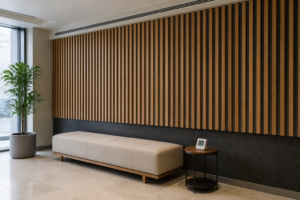
fire rated acoustic panels Class B1 commercial building
Fire ratings are not just a checkbox. They are the difference between a project that passes inspection and one that gets shut down. In this guide, I’ll break down what the fire rating classes actually mean, which spaces legally require Class B1, and how to verify that your supplier’s certificates are real before you place your next bulk order.
What Do Fire Rating Classes Mean for Acoustic Wall Panels? (A vs. B1 vs. B2 Explained)
Most buyers I talk to know they need "fire rated" panels. But very few can tell me the difference between Class A, Class B1, and Class B2. That gap in knowledge has cost some of them real money on rejected shipments and failed inspections.
Fire rating classes for acoustic wall panels are defined under the European standard EN 13501-1. Class A panels are non-combustible and do not contribute to fire at all. Class B1 panels are flame retardant and self-extinguish quickly. Class B2 panels are normally flammable and are not suitable for most commercial applications.

acoustic panel fire rating Class A B1 B2 comparison
Understanding these three classes is the foundation of compliant acoustic panel sourcing. Here is how they compare in detail.
Class A vs. Class B1 vs. Class B2: A Full Comparison
| Fire Rating | EN 13501-1 Class | Combustibility | Self-Extinguishing | Smoke Production | Typical Material | Best For |
|---|---|---|---|---|---|---|
| Class A | A1 / A2 | Non-combustible | Yes (does not ignite) | Very low | Mineral wool, steel, glass | High-risk zones: escape routes, atriums |
| Class B1 | B / C | Flame retardant | Yes (within seconds) | Low to medium | Treated MDF + PET felt | Hotels, offices, schools, hospitals |
| Class B2 | D / E | Normally flammable | No | High | Untreated wood, standard fabric | Residential only |
Why Class B1 Is the Most Common Choice for B2B Buyers
Class A panels are the safest option, but they are also the most expensive and the hardest to customize. Most commercial projects do not require Class A unless the panels are installed in escape routes or areas with very high occupancy density.
Class B1 is the practical sweet spot for most B2B buyers. It meets the legal requirement for the majority of commercial spaces, it can be achieved with standard MDF cores treated with flame-retardant chemicals, and it still allows full customization in terms of veneer finish, size, and felt color.
Class B2 panels should never be specified for commercial projects. They may be cheaper, but they will fail any building inspection in Europe, the UK, Australia, or most of Asia. If a supplier is offering you panels without a fire rating certificate, assume they are Class B2 or lower.
How the EN 13501-1 Test Works
The EN 13501-1 standard tests four things: ignitability, flame spread, heat release, and smoke production. A panel earns its Class B1 rating by passing all four tests in a certified laboratory. The test report must include the specific product name, dimensions, and substrate. A certificate issued for one product cannot be applied to a different product — even from the same factory.
At NF Decor, all our wooden slat acoustic panels are tested under EN 13501-1 and carry genuine Class B1 certificates issued by SGS. You can verify every certificate number directly on the SGS certified client directory.
Which Commercial Spaces Require Class B1 Fire Rated Acoustic Panels by Law?
I get this question from project managers and architects almost every week. The answer depends on the country and the type of building. But in most markets where our distributors operate, the rule is simple: if the public can access the space, Class B1 is the minimum.
Class B1 fire rated acoustic panels are legally required in hotels, schools, hospitals, offices, shopping centers, and any public assembly space in most European, UK, Australian, and Asian markets. The specific regulation varies by country, but the underlying standard is almost always EN 13501-1 or an equivalent national standard.

Class B1 fire rated acoustic panels hotel school hospital office
Here is a breakdown of the most common commercial spaces and their fire rating requirements.
Fire Rating Requirements by Commercial Space Type
| Space Type | Minimum Fire Rating Required | Key Regulation | Notes |
|---|---|---|---|
| Hotel guest rooms & corridors | Class B1 | EN 13501-1 / BS 476 | Corridors and escape routes may require Class A |
| School classrooms | Class B1 | EN 13501-1 | Applies to all wall and ceiling materials |
| Hospital wards & waiting rooms | Class B1 | EN 13501-1 / HTM 05-02 (UK) | Strict enforcement in UK and EU markets |
| Open-plan offices | Class B1 | EN 13501-1 | Required for panels over 1m² in most EU countries |
| Shopping centers | Class B1 or A | EN 13501-1 | Atrium and common areas often require Class A |
| Conference centers | Class B1 | EN 13501-1 | High occupancy density triggers stricter rules |
| Restaurants | Class B1 | EN 13501-1 | Kitchen proximity may require Class A locally |
The Cost of Getting It Wrong
I’ve spoken with distributors who tried to save money by sourcing untested panels for a hotel project. The panels passed visual inspection but failed the fire test during the building approval process. The entire order had to be replaced. The cost of the replacement, plus the project delay, was three times what they would have saved on the original order.
The lesson is straightforward. Fire rating compliance is not optional in commercial projects. It is a legal requirement, and the liability sits with the buyer if the panels fail inspection.
What About Markets Outside Europe?
In the US, the equivalent standard is ASTM E84, which uses a Class A / B / C classification. Class A under ASTM E84 is roughly equivalent to Class B1 under EN 13501-1. In China, the national standard is GB 8624, which uses Class A1, A2, B1, and B2 — directly aligned with the European system.
If you are sourcing panels for multiple markets, ask your supplier to provide both EN 13501-1 and GB 8624 certificates. At NF Decor, we supply both as standard for our custom acoustic wall panels and felt wall panels.
How to Verify That Your Acoustic Panel Supplier’s Fire Rating Certificates Are Genuine?
This is the part most buyers skip. They see a certificate, they assume it is real, and they move on. I understand why — verifying certificates takes time. But fake fire rating certificates are more common than most people think, especially in the lower-price segment of the Chinese acoustic panel market.
To verify that an acoustic panel supplier’s fire rating certificate is genuine, check that the certificate number is searchable on the issuing body’s official website, confirm the tested product matches the product you are ordering, and request the full test report — not just the certificate cover page.

NF Decor official certification documents: SGS Test Report, CE Conformity, FSC Chain of Custody
Here is the five-step verification checklist I recommend to every distributor who sources acoustic panels from China.
The 5-Step Fire Certificate Verification Checklist
Step 1: Search the Certificate Number on the Issuing Body’s Website
Every legitimate fire test certificate has a unique certificate number. If the certificate was issued by SGS, TÜV, Intertek, or Bureau Veritas, you can search that number on their official website and confirm it is valid. If the number does not appear, the certificate is fake.
Step 2: Confirm the Tested Product Matches Your Order
The certificate must name the exact product you are buying. Check the product name, substrate material (e.g., MDF, PET felt), thickness, and surface finish. A certificate issued for a 15mm MDF panel with white oak veneer does not cover a 12mm panel with walnut veneer — even if they come from the same factory.
Step 3: Request the Full Test Report, Not Just the Cover Page
A full EN 13501-1 test report is typically 10–30 pages long. It includes the test conditions, the sample dimensions, the flame spread measurements, and the laboratory technician’s signature. If a supplier only sends you a one-page certificate, ask for the full report. Legitimate suppliers will always provide it.
Step 4: Check the Test Date and Validity Period
Fire rating certificates are typically valid for three to five years from the test date. If the certificate is expired, the supplier should have a renewal on file. An expired certificate is not compliant, even if the product itself has not changed.
Step 5: Ask for a Product-Specific Certificate, Not a Factory Certificate
Some suppliers show a factory-level fire safety certificate rather than a product-specific test report. These are not the same thing. A factory certificate confirms that the factory has a fire safety management system. It does not confirm that the specific product you are buying has passed the EN 13501-1 test.
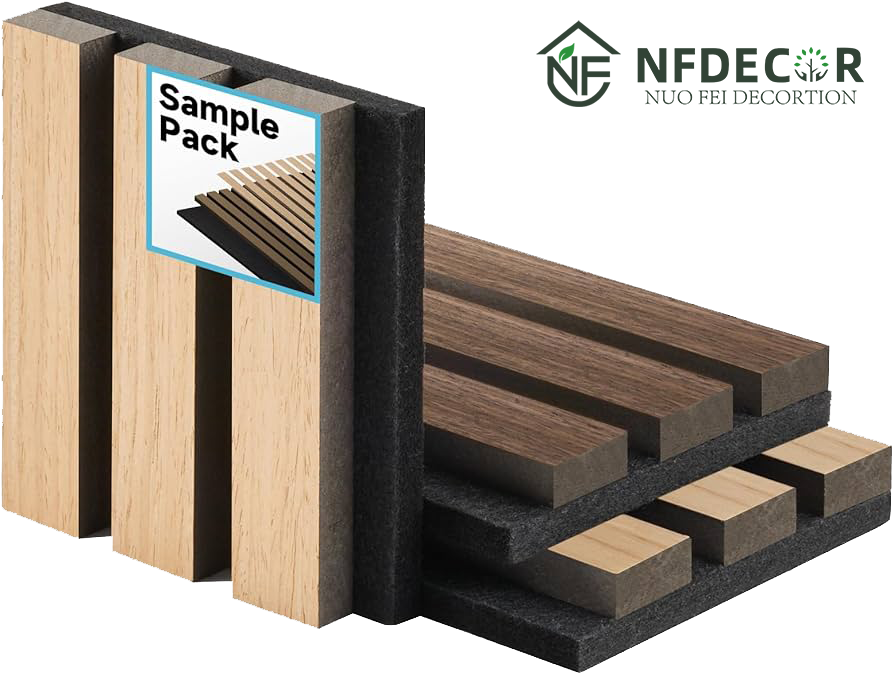
At NF Decor, we provide full test reports for all our hexagon acoustic panels, 3D wall panels, and wooden slat panels. Every certificate is product-specific, searchable on the SGS website, and updated within its validity period. We send the full report — not just the cover page — as a standard part of our sample package.
Conclusion
Fire ratings are not a formality. Class B1 is the legal minimum for most commercial spaces, and a fake or mismatched certificate can cost you an entire project. Verify before you order.
Ready to source Class B1 certified acoustic panels for your next commercial project? Contact NF Decor for a free sample and full fire test documentation.