The packaging clause is the part of a purchase order nobody negotiates. Price gets three rounds of emails. Packaging gets one line: “export packing, suitable for sea freight.” That line then travels into a factory with its own packing habits, a carton supplier with its own stock, and a yard full of pallets of unknown history. It cannot be measured at goods-in, so it cannot be enforced after the container is opened.
So I stopped writing packaging as an adjective and started writing it as an annex with four testable layers, each one assigned to a named party, each one checkable by a warehouse clerk with a phone.
Direct answer: Write packaging into the purchase order as a numbered annex with four layers: face and edge protection, unitising, moisture control, and identity. Name the material that touches each surface, the pallet and banding arrangement, the barrier and desiccant, and the marks and batch code that trace a carton back to a production run. State how each line will be checked at goods-in. Keep carrier actions — booking, equipment, stuffing, terminal handling — in the shipping instruction, where the forwarder owns them. The annex defines what the supplier must deliver; the booking defines what the carrier must do.
1. Which Packaging Clauses Belong in the Purchase Order, and Which Belong to the Carrier?
Problem. My first packaging note went to the factory and my loading note went to the forwarder, and both mentioned stretch film. When a pallet arrived with two crushed corners, the factory pointed at the forwarder, the forwarder pointed at the factory, and my file contained nothing that had assigned corner protection to anyone.
Agitation / Answer: Packaging is a product requirement: the condition of the goods at the factory gate. Carrier operations begin when the packed unit is handed over. Put the first in a numbered annex to the purchase order and the second in the booking, give each document one owner, and a crushed corner stops being a three-way conversation.
Solution. Two documents get confused in most packaging disputes. A packaging specification describes the goods at the moment the supplier hands them over: what touches the finished face, what holds the boards together, what protects the pallet, what identifies the carton. A carrier instruction describes what happens after handover: booking, equipment, stuffing, terminal, delivery appointment. The first can be rejected at goods-in; the second is a service clause.
So Annex A of my purchase order carries the packaging: numbered, dated, with a revision letter, and the order body says “Packaging per Annex A, revision C, attached and signed.” Anything not in the annex is not a requirement, and protection cannot be added by email after the deposit is paid. One signed page replaces a year of assumptions about what “export packing” was supposed to mean.
I write the annex in the supplier’s language of control. Not “strong cartons” but “cartons sized to the unit, no product edge protruding.” Not “waterproof packing” but “barrier liner in the carton, desiccant quantity on the packing list.” Every line names a material, a position, and an observation a receiving clerk can make in ten seconds without a laboratory.
Carrier matters stay out. If the unit needs two straps for road transit and four for the vessel, that is a packing requirement and belongs in the annex. If the container needs lashing, that belongs to the forwarder, and I want photographs at stuffing rather than a promise. You cannot hold a forwarder to a clause you never sent. The Incoterm decides where risk passes; it does not decide who packs well. The rest of the commercial frame sits in my notes on choosing wood slat acoustic panels for bulk orders.
| Clause | Where it is written | Who is accountable | What makes it checkable |
|---|---|---|---|
| Face film and interleaving | PO Annex A, item 1 | Supplier, at packing | Film intact and closed; no tape, marker or print on the face |
| Corner and edge protection | PO Annex A, item 2 | Supplier, at packing | Protector at all four corners of every layer, under every strap |
| Pallet and unitising | PO Annex A, item 3 | Supplier, at packing | Pallet condition, footprint and strap positions photographed pre-shipment |
| Moisture barrier and desiccant | PO Annex A, item 4 | Supplier, at packing | Barrier unbroken; desiccant quantity recorded on the packing list |
| Marks and batch code | PO Annex A, item 5 | Supplier, at packing | Carton and pallet marks match the packing list; batch code legible |
| Equipment, stuffing, lashing | Shipping instruction and booking | Forwarder, per the agreed Incoterm | Stuffing photographs and a loading report |
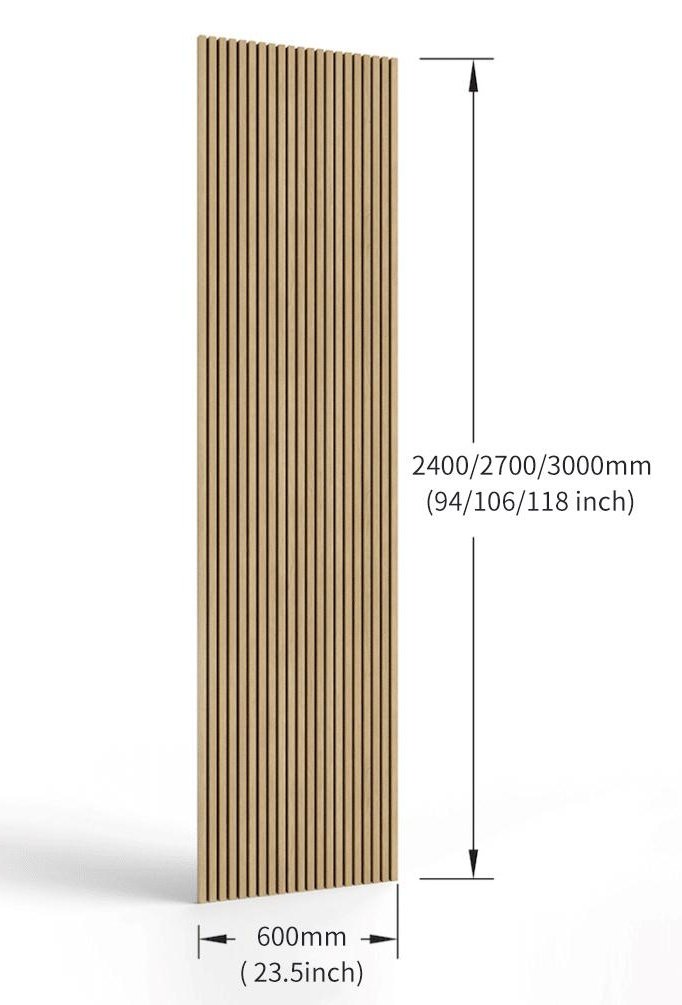
2. How Do I Specify Inner Liner and Face Protection for a 0.6 × 2.6 m Board I Cannot Test?
Problem. The quotation said “PE film and foam protection.” I had no idea which surface the foam touched, whether the film was the factory film or a second wrap, or what separated two finished faces pressed together by a strap for six weeks.
Agitation / Answer: A requirement I cannot check at goods-in is not a requirement. So I specify function instead of material: what touches the finished face, what separates board from board, what faces the felt, and how the film is closed. Then I attach one sample and one photograph.
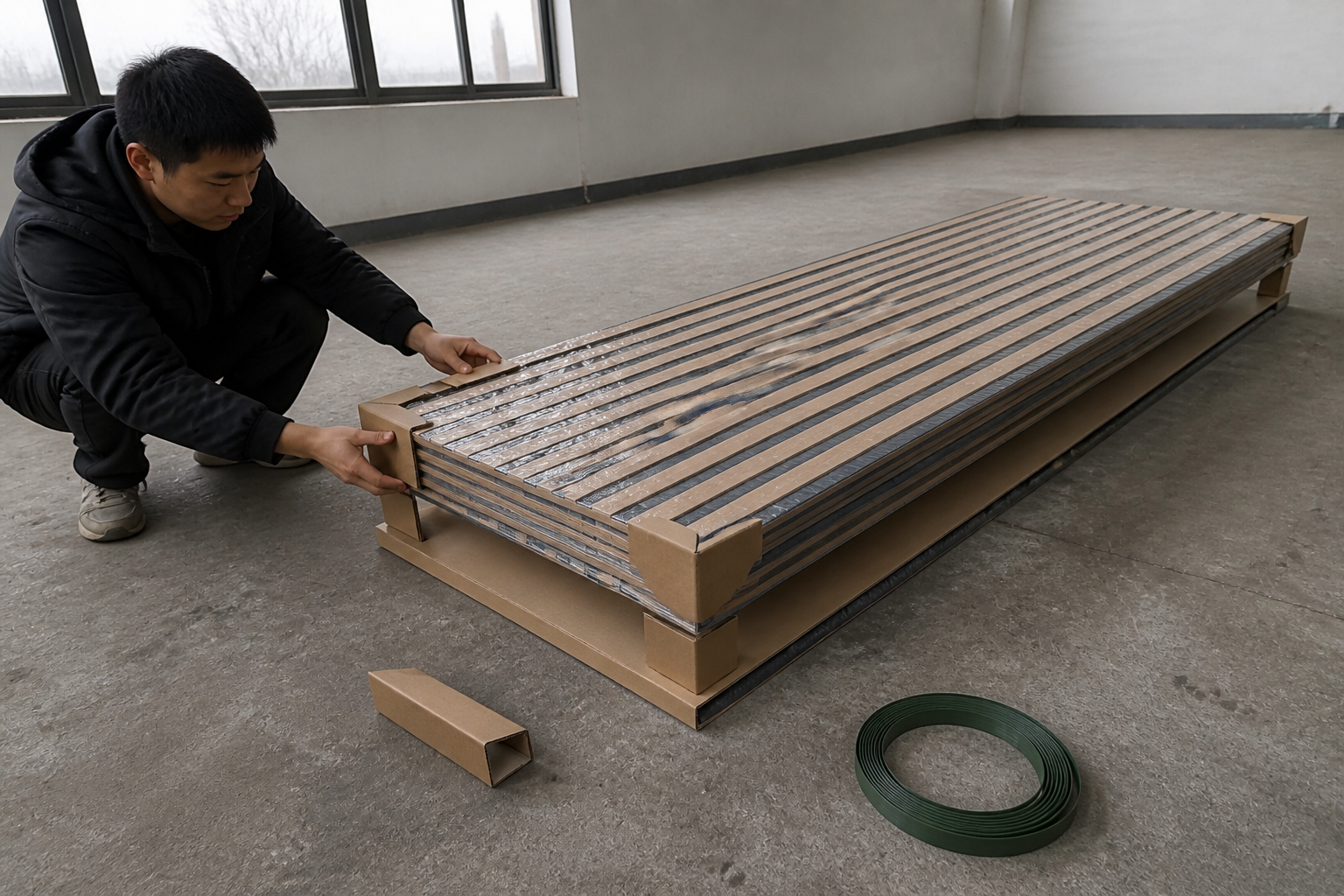
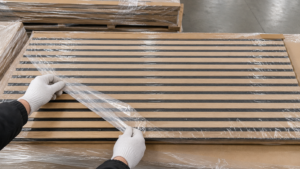
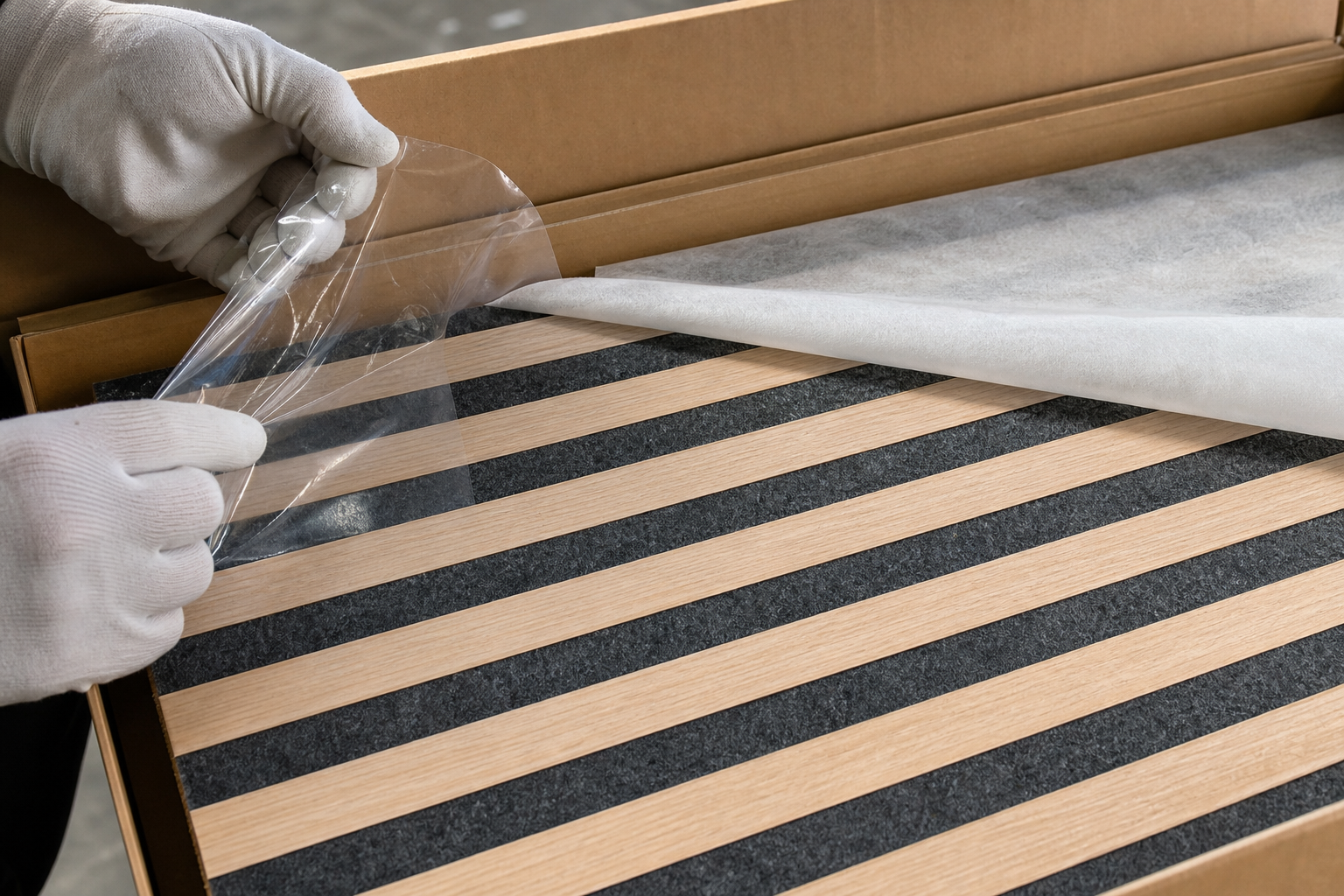
Solution. Face protection has one job: nothing hard, printed or adhesive touches the finished surface between the factory and the wall. The board leaves the line with a transparent film on the face; I want it left in place, closed at the ends, and free of writing, marker, tape or labels. Tape residue is a surface defect waiting for an installer.
Between boards I require an interleaving liner, facing the same way in every layer. Slat face against slat face is an abrasion pair: two finished surfaces sliding under strap tension. Felt against felt is acceptable while the felt is dry; felt against a slat face is not, because the felt edge picks up grit. The liner goes between every board, is at least as wide as the face, and carries no print on the facing side.
I do not specify a film thickness, a foam density or a micron count unless I will measure it on arrival, because a number I cannot check becomes a number the factory can interpret. Instead I specify function plus evidence: a declared material grade on a supplier data sheet, a retained liner sample signed by both sides, and a pre-shipment photograph of one opened carton showing the layer sequence.
Long edges get their own line: a 2.6 m board loses material along its length before it loses it at a corner. Protection is continuous along the full edge, not patches near the ends. The film protects nothing structurally, so a wrinkled film is not a defect in the board. My notes on what acoustic panels are made of explain why the felt face and the slat face behave differently once moisture is involved, and the questions I use for verifying a wood panel supplier apply to whoever packs the cartons.
3. Where Do Corner Protectors, Edge Boards and Straps Belong, and What Do They Actually Hold?
Problem. The straps arrived tight over bare slat edges and the corner protectors were loose on top of the stack, doing nothing. Two boards had a visible depression along the edge where the band had bitten in, and the unit had shifted out of square on the pallet.
Agitation / Answer: A strap holds nothing by itself. It transfers force through whatever sits between the band and the product, so the protector, its length, and its position under the band are the actual specification. The strap is only the tension path, and tension is the one thing I cannot verify at goods-in.
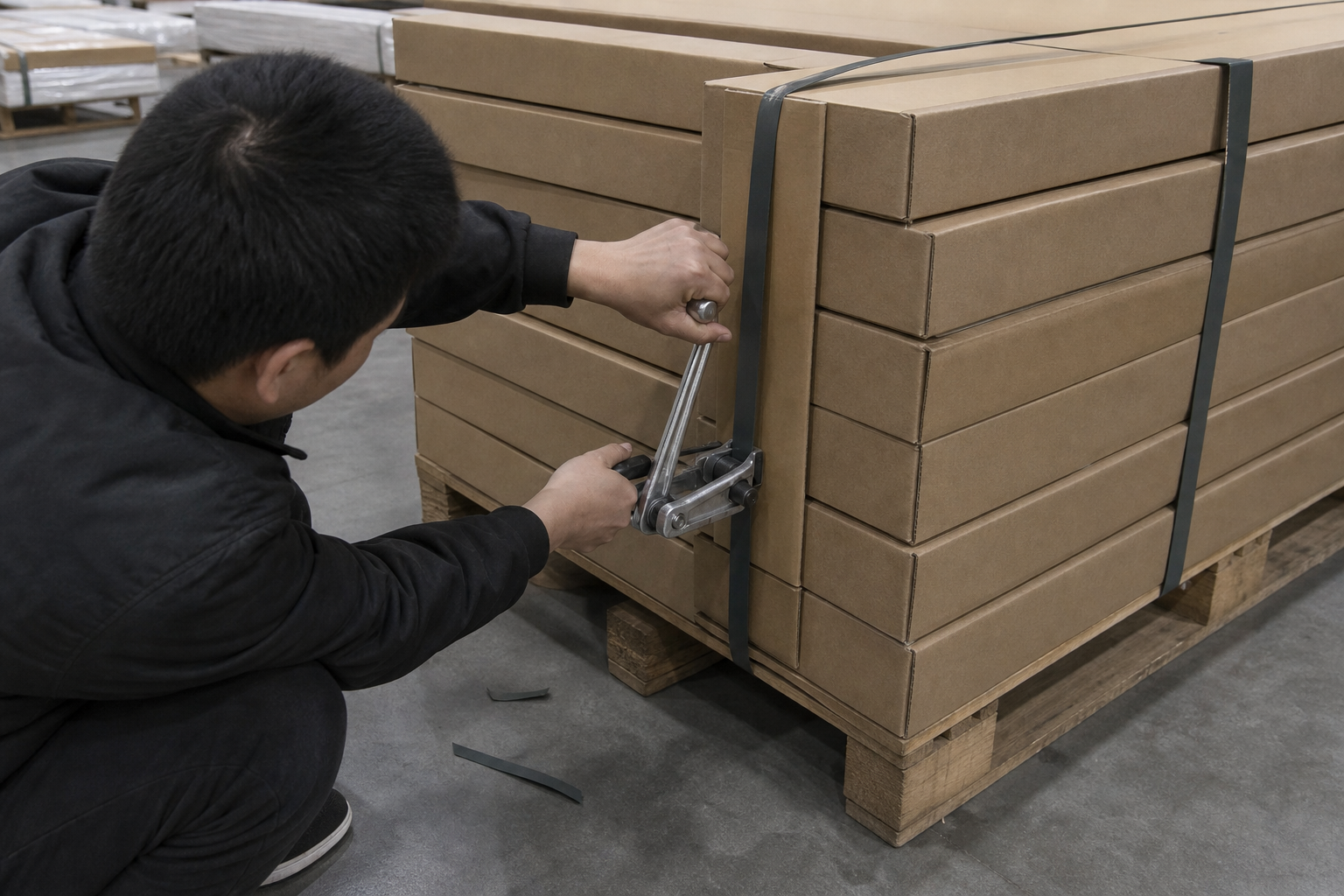
Solution. Strapping is the least inspected part of packing. A strap does two jobs: it holds the boards onto the pallet and holds the stack square. It does neither when it bears on a bare slat edge, which is what most pre-shipment photographs show, protectors loose at the top.
The annex therefore describes the stack, not the tension. Vertical corner boards at all four corners, covering the full stack height, fitted before the straps go on. Straps run over the protectors and never across the finished face, and a strap must not leave a visible depression in a slat edge. I cannot check tension with a gauge at goods-in; I can check whether the protector is crushed, whether the band has cut into timber, and whether the stack is still square against the pallet corner.
Horizontal banding goes around the pallet and the load together, so the unit lifts as one piece. A pallet that separates at the fork pockets is a handling hazard before it is a claim, and a shifted stack tells me the unit was re-handled between the packing bench and my door. For less-than-truckload consolidation I add a top cap and a second layer of corner boards, because the unit will be re-handled by people who did not pack it.
The pallet interface matters as much as the band. A rough deck with protruding fasteners marks the bottom board, and a damp deck moves moisture upward into the stack. I require a dry pallet, no protruding fasteners, and a slip sheet where the deck is rough. The carton is outer packaging, sized to the unit, with the product edges inside it. A carton that wraps the face like a frame will be read as a product frame in every photograph.
| Element | What it actually protects | How to write it | How goods-in checks it |
|---|---|---|---|
| Vertical corner board | Slat ends and board corners | Full stack height at four corners, fitted under the band | Present, uncrushed, and no band contact with timber |
| Horizontal strap | Unit stability on the pallet | Around pallet and load together, bearing on protectors | Band in place, protector uncut, no depressed slat edge |
| Interleaving liner | Finished face against finished face | Between every board, no print on the face side | Liner present throughout, no print transfer |
| Pallet deck and slip sheet | Bottom board against rough timber | Dry deck, no protruding fasteners, slip sheet if stated | No damp patches, no nail heads, no crushed base board |
| Carton | Outer handling, dust and abrasion | Packaging only, sized to the unit, no edge protruding | Carton intact, product fully inside, no frame-like wrap |
4. How Do I Specify the Pallet, the Moisture Barrier and the Marks So the Unit Can Be Checked?
Problem. The pallet was whatever stood in the yard that morning, the marks were made with a marker pen, and no one could tell me which production run the cartons came from. On arrival I could count cartons and weigh them, and that was the entire inspection.
Agitation / Answer: Three things travel with a pallet and none appear on an invoice: the wood it is made from, the moisture it has met, and the identity of what is inside. If the order names none of them, receiving can verify a quantity and nothing else. I name all three, and I ask for one photograph of each.
Solution. Wood first. Pallets, crates and dunnage made from raw wood are subject to phytosanitary measures under ISPM 15, which aims to reduce the risk of spreading quarantine pests associated with wood packaging material in international trade, and whose scope excludes wood packaging processed in a way that is free from pests, such as plywood.1 For my orders that becomes a clause: the mark must be visible on the pallet in the pre-shipment photographs, on more than one face, and it must belong to the pallet actually shipped. A certificate in a document pack says a treatment happened somewhere; the mark on the timber says it happened to this pallet.
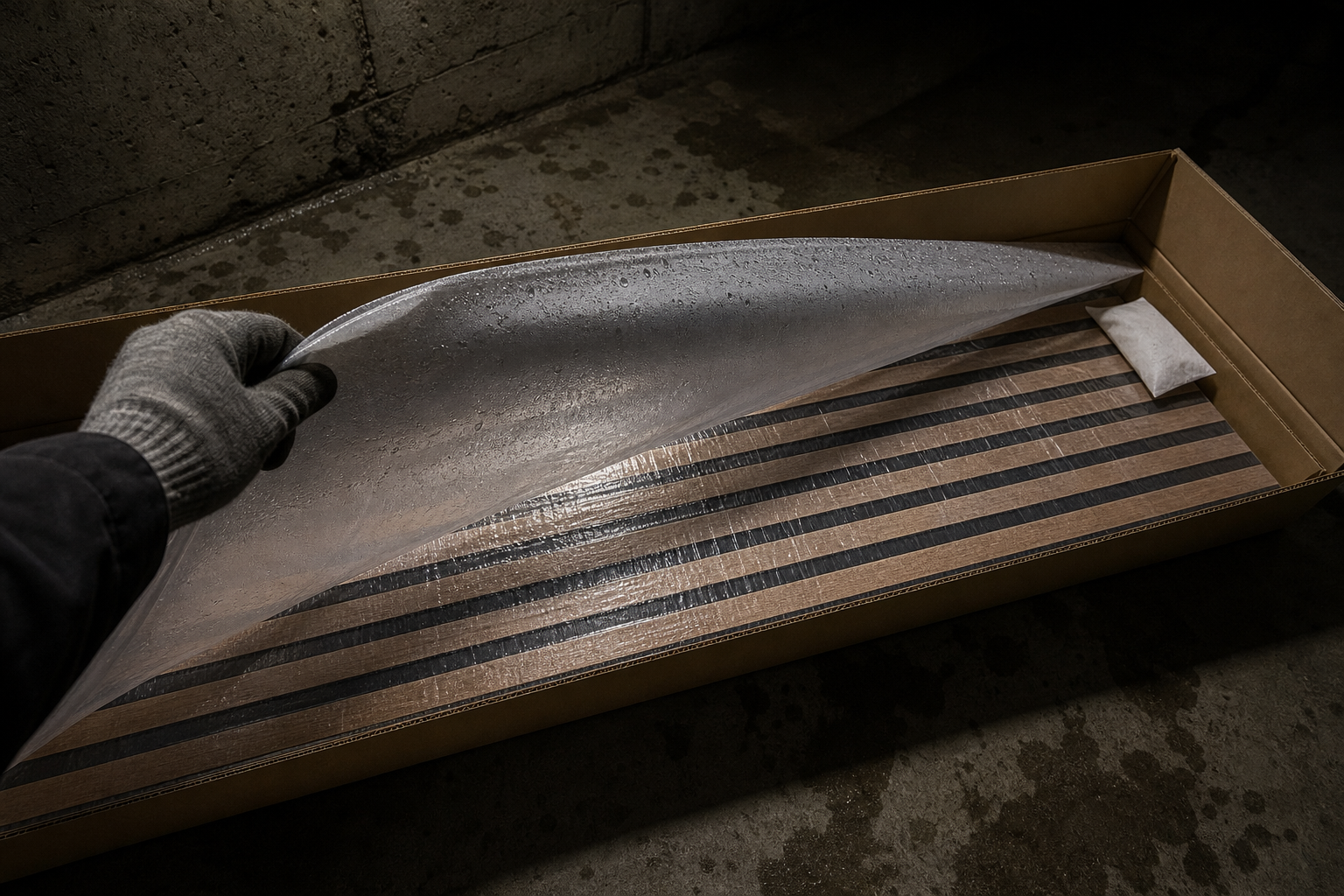
Moisture second. A barrier liner inside the carton, a desiccant sachet whose quantity is written on the packing list, and a closed unit rather than an open stack under film. Film alone is not a moisture barrier: it is perforated, it vents at the joints, and it traps condensation against the face as a container cycles hot and cold. Boards bound for humid destinations need this permanently, which is why my guidance on wood acoustic panels in humid interiors sits in the same file as the annex.
Identity third. Minimum marks per carton: product code, size, quantity, gross weight, batch or lot code, and a carton sequence within the pallet. Handling symbols follow ISO 780, which specifies graphical symbols for marking distribution packages with handling instructions, to be used only when necessary.2 I name the symbols I want rather than letting a printer choose arrows. The batch code earns its keep: it links a carton to a production run and a veneer lot, which is what you need when a shade question appears, as I describe in my notes on controlling veneer colour variation.
5. How Do I Turn the Annex Into an Acceptance Check My Warehouse Team Will Actually Run?
Problem. The specification existed. The check did not. By the time anyone looked, the forks had gone through the film, the corner boards were in a skip, and the cartons had been flattened for recycling. The evidence went out with the rubbish.
Agitation / Answer: Packaging acceptance is a sampling decision taken before unloading finishes, not an opinion formed afterwards. I fix a short photo sequence, score each pallet against the annex, keep the packing material until the claim closes, and convert every failure into a dated annex revision rather than an email.
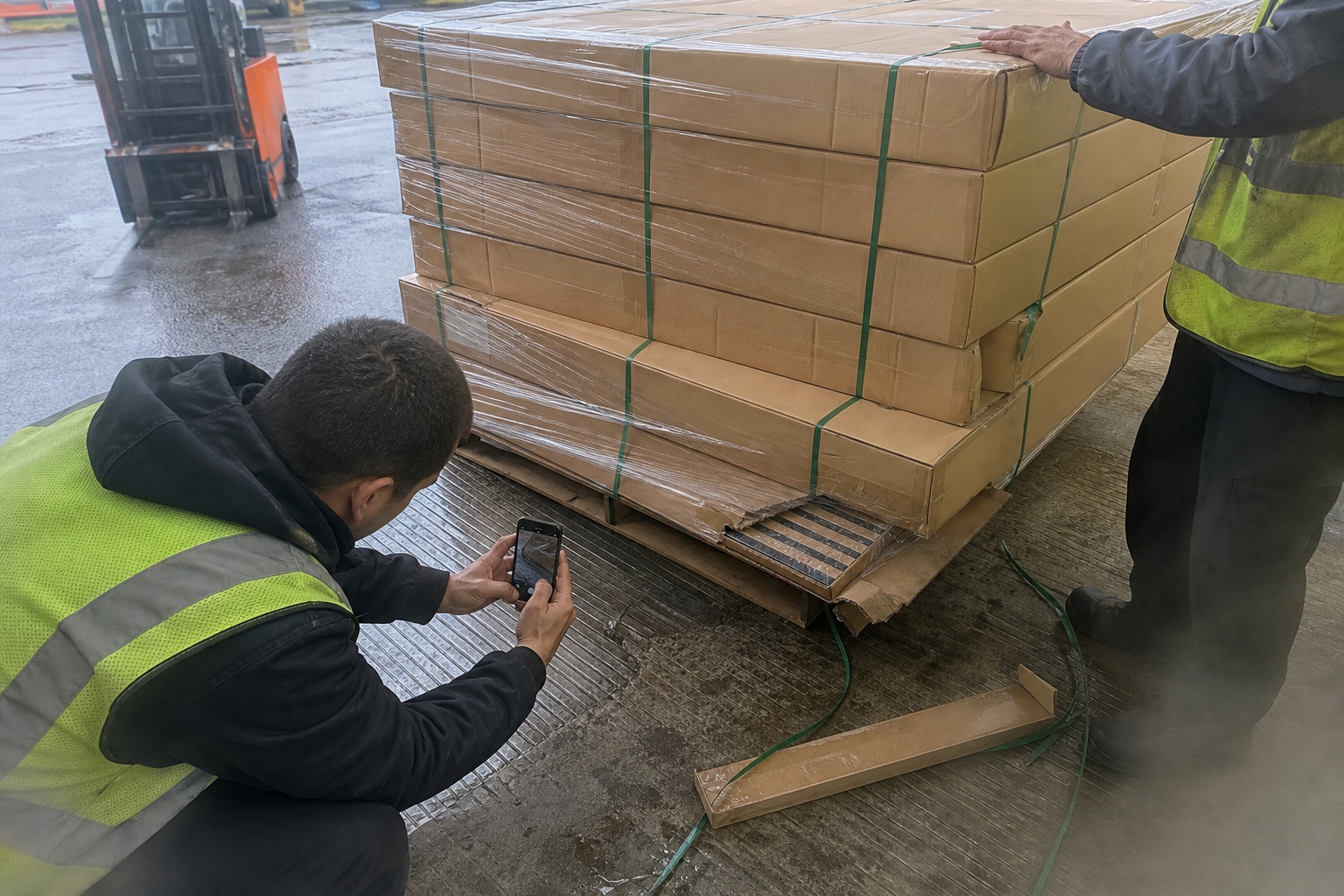
Solution. An annex is worthless if the first thing to touch the pallet is a forklift blade. The check must be sequenced around unloading and small enough to run: nine to twelve photographs, one page, ten minutes per pallet.
The sequence: photograph the unit inside the container before the forks touch it, each pallet face at the door, then one carton per pallet opened to show the layer sequence. Score one line per pallet: protectors present, straps on protectors, no crushed slat edge, liner between boards, barrier unbroken, desiccant recorded, marks matching the packing list, batch code present. Any “no” becomes a non-conformance with a photograph; nothing is thrown away until the claim closes.
Where a project needs performance evidence rather than a visual check, I ask for a pre-shipment test report and read how it was run. ASTM D4169 builds a test plan as a sequence of anticipated distribution hazards, keeps the tested units unopened until the sequence is complete, and bases its levels on the shipping and handling environment rather than one universal severity.3 ISTA separates screening tests from general simulation; its unitised-load procedures address palletised freight.4 Neither is a promise of zero damage: ISTA’s own unitised-load material notes that conditions such as moisture, pressure or unusual handling may not be covered.
Then the loop closes. The packaging check tells me whether the unit held the boards straight, so I run my flatness and bow inspection on the same visit against the same pallet label. Every failure becomes annex revision D, E or F, dated and reasoned; a supplier who re-signs a revised annex stops treating packing as an afterthought. When I audit the factory rather than the delivery, the same questions sit in my checklist for evaluating an acoustic panel manufacturer.
References
- Secretariat of the International Plant Protection Convention, ISPM 15: Regulation of wood packaging material in international trade. ↩
- International Organization for Standardization, ISO 780:2015 Packaging — Distribution packaging — Graphical symbols for handling and storage of packages. ↩
- ASTM International, ASTM D4169: Standard Practice for Performance Testing of Shipping Containers and Systems. ↩
- International Safe Transit Association, ISTA Test Procedures. ↩
Frequently Asked Questions
1. Who is responsible when packaging fails: the supplier or the carrier? Whoever owns the clause that failed. Face protection, corner boards, pallets, banding and marks are supplier obligations in the annex. Container condition, lashing and terminal handling sit with the forwarder under the booking. Your Incoterm tells you where risk passes and therefore who carries the loss, but it does not decide who packed badly.
2. Should I specify a pallet size for 2.6 m panels? Specify the footprint you can handle rather than a catalogue size. The pallet should support the full board length with the load inside the deck, the unit should lift as one piece at the fork pockets, and the cartons should not overhang the deck. If you need a standard footprint for racking or container planning, say so in the annex and let the supplier work to it.
3. Is every wooden pallet ISPM 15 marked? Not automatically. The standard applies to wood packaging material made from raw wood, and its scope excludes processed wood that is free from pests. What you can require is that the mark is visible on the pallet itself in pre-shipment photographs and that it matches the pallet shipped. Treat a certificate without a mark on the timber as unverified.
4. Can good packaging guarantee no damage? No, and I would not sign an order that promised it. Packaging reduces the probability and severity of damage from handling, stacking, vibration and moisture, but the distribution environment includes events no carton controls. What you can buy is a defined construction, a documented check, and a claim route with photographs taken at the right moment.
5. Should packaging sit in the purchase order or the shipping instruction? Both, in separate documents. Packaging is the condition of the goods at handover, so it belongs in a numbered annex to the purchase order that the supplier signs. Booking, equipment, stuffing and delivery appointments belong in the shipping instruction to the forwarder. When one email carries both, nobody can be held to either.
CTA
If you are preparing a bulk order, send me your panel quantity, destination port, handling equipment and the delivery date you are working to. I will return a one-page packaging annex you can attach to the purchase order — face and edge protection, unitising, moisture control, marks and batch codes, plus the goods-in checklist that matches it — and I will flag which lines belong with your forwarder instead of your supplier. Start from the wooden slat acoustic panel specification and we will build the packing terms around the board you are actually shipping.