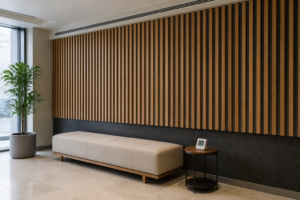
Most acoustic panels look like they belong in a recording studio, not a five-star hotel lobby. If you are sourcing acoustic solutions for high-end commercial projects, you already know that standard felt-backed wood panels just do not cut it anymore.
Suede acoustic wood panels solve this problem by combining a soft-leather microfiber surface with a half-round MDF slat core and a PET felt backing. The result is a panel that absorbs sound at a professional level while delivering a tactile, luxury finish that designers and end-clients actually want to specify. For B2B buyers, this means higher project win rates and stronger margins.

suede acoustic wood panels luxury commercial interior
I have been working with acoustic wall panels long enough to remember when "acoustic" and "beautiful" were two words that never appeared in the same sentence. That changed when suede-finish panels started showing up in hospitality and high-end office projects. In this guide, I will break down exactly what makes suede acoustic wood panels different, which commercial spaces are driving the demand, and how to source them directly from a manufacturer in China.
What Makes Suede Acoustic Wood Panels Different from Standard Felt-Backed Panels?
Walk into any commercial space fitted with standard acoustic panels and you will notice the same thing: flat wood slats, black felt gaps, functional but forgettable. Architects and interior designers are pushing back on this. They want acoustic performance without the industrial look.
Suede acoustic wood panels stand apart because the surface material is a soft microfiber leather, not a wood veneer or paint. The half-round slat profile creates a three-dimensional shadow line that changes with the light. Combined with the matte, velvety texture of the suede coating, the panel reads as a premium material — not an acoustic treatment.

suede acoustic panel vs standard felt acoustic panel comparison
I had a client ask me once: "Why would I pay more for suede when felt works just as well acoustically?" The answer is that suede does not just work as well — in several key areas, it works better. Let me show you the full picture.
Material Composition: Three Layers, One Premium Product
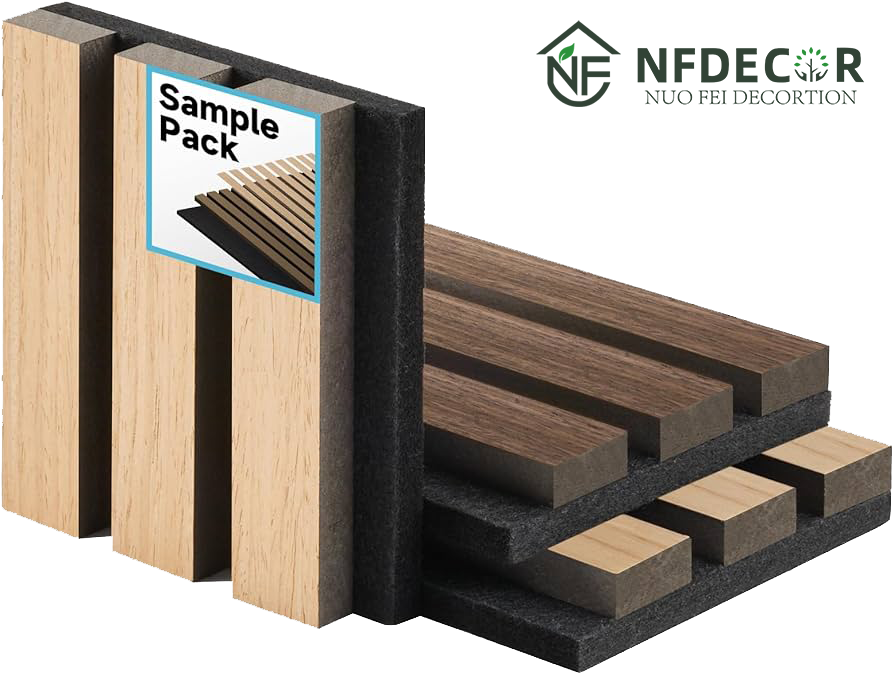
Understanding why suede acoustic wood panels perform differently starts with the structure. Every panel from NF Decor is built with three distinct layers:
| Layer | Material | Function |
|---|---|---|
| Surface | Soft microfiber leather (suede) | Luxury finish, tactile quality, light diffusion |
| Core | Half-round MDF slat (CARB P2 standard) | Structural rigidity, 3D shadow profile |
| Backing | 100% recyclable PET felt | Sound absorption, eco-friendly credentials |
The CARB P2 certification on the MDF core matters for B2B buyers selling into the North American and European markets. It confirms that formaldehyde emissions are within the strictest regulated limits — a non-negotiable for hospitality and healthcare projects.
Surface Performance: Suede vs. Standard Felt Backing
Standard felt-backed panels expose the felt material in the gaps between slats. Over time, in high-traffic commercial environments, this felt collects dust and shows wear. The suede surface on these panels covers the entire half-round slat profile, including the sides and grooves. This means:
- Dust resistance is higher because the tight microfiber weave does not trap particles the way open-weave felt does.
- Colour consistency holds longer because the suede coating is applied uniformly across the full 3D surface.
- Cleaning is straightforward — a dry microfiber cloth is enough for routine maintenance in most commercial settings.
Acoustic Performance: Does the Suede Surface Affect NRC?
This is the question I get most often from technical buyers. The short answer is no — the suede surface does not reduce the Noise Reduction Coefficient (NRC). The acoustic absorption is driven primarily by the PET felt backing and the air gaps created by the half-round slat profile. The suede coating is thin enough that it does not block sound transmission to the backing layer.
For most commercial applications, suede acoustic wood panels achieve an NRC rating in the range of 0.65–0.85, which is comparable to standard wood slat acoustic panels in the same thickness category. If you need a specific NRC value for a project specification, we can provide test reports on request. You can also explore our wooden slat acoustic panels for standard veneer options in the same performance range.
Which Commercial Spaces Are Driving Demand for Suede Acoustic Wood Panels?
The demand for suede acoustic wood panels is not coming from one sector — it is coming from everywhere that high-end interiors and acoustic performance overlap. If you are a distributor or project supplier, understanding where the demand is concentrated helps you position your product range more effectively.
The strongest demand is currently coming from luxury hospitality (hotels and resorts), premium corporate offices, and high-end residential developments. These three sectors share a common requirement: the space must look expensive and sound quiet at the same time. Suede acoustic wood panels are one of the very few products that satisfy both criteria without compromise.

suede acoustic panels for hotel office restaurant commercial spaces
I have seen this shift happen in real time over the past few years. Clients who used to specify standard wood veneer panels are now asking specifically for the suede finish — not because an acoustic consultant told them to, but because they saw it in a competitor’s project and wanted the same look. That is a powerful market signal for distributors.
Luxury Hotels and Resorts
Hotels are the single largest commercial application for suede acoustic wood panels. The reasons are straightforward. Guest rooms, corridors, lobby areas, and conference facilities all require sound control. At the same time, every surface in a luxury hotel is a brand statement. Standard acoustic panels fail the brand test. Suede panels pass it.
The half-round profile in colours like Dimgray or sandy beige works particularly well in hotel corridor walls, where the three-dimensional shadow line creates visual depth without requiring additional architectural detailing. According to ISO 18233, hotel guest rooms in the luxury segment are expected to maintain background noise levels below 35 dB(A). Suede acoustic panels installed on key reflection surfaces contribute directly to meeting this standard.
Premium Corporate Offices and Co-Working Spaces
Open-plan offices are acoustically hostile environments. The shift to hybrid working has made this worse, not better — employees now share spaces with colleagues on video calls, which creates a constant layer of background noise. Facilities managers and interior designers are under pressure to solve this problem without making the office look like a call centre.
Suede acoustic wood panels in a neutral grey or warm beige finish integrate naturally into a premium office design scheme. They can be specified for feature walls behind reception desks, meeting room partitions, and open-plan acoustic baffles. For distributors targeting the commercial fit-out sector, this is a high-volume, repeat-order market. Our custom acoustic wall panels can be produced in project-specific dimensions and colours to meet exact design briefs.
Restaurants, Bars, and Hospitality F&B Venues
Restaurant noise is consistently ranked as the second most common customer complaint in the hospitality industry, behind only poor service. Yet most restaurant owners treat acoustics as an afterthought. The ones who do not — the ones who specify acoustic wall treatments from the design stage — create environments where guests stay longer and spend more.
Suede acoustic wood panels are well suited to F&B environments because the surface is easy to clean and the material does not absorb food odours the way fabric panels can. The warm, tactile finish also complements the natural materials — stone, timber, leather — that are standard in premium restaurant interiors. For project suppliers working with restaurant groups and hotel F&B operators, this is a strong upsell opportunity alongside our 3D wall panels and felt wall panels.
How Do You Source Suede Acoustic Wood Panels Directly from a Chinese Manufacturer?
Sourcing acoustic panels from China is not complicated if you know what to look for. The challenge most B2B buyers face is not finding suppliers — it is finding the right supplier. There is a significant quality gap between factories that produce suede acoustic panels correctly and those that cut corners on the suede coating process or the MDF core specification.
The most reliable way to source suede acoustic wood panels from China is to work directly with a factory that holds current CARB P2 certification on their MDF core, can provide SGS or equivalent test reports for the suede surface material, and has a documented quality control process for the coating application. Asking for these three things upfront will eliminate the majority of low-quality suppliers immediately.

suede acoustic panel factory china wholesale manufacturer
I have walked through the production process for suede acoustic wood panels many times. The quality of the finished panel depends almost entirely on two things: the quality of the suede material itself, and the precision of the wrapping process that bonds the suede to the half-round MDF slat. Both of these are process-intensive steps that separate serious manufacturers from assembly operations.
The Sourcing Process: From Sample to Bulk Order
Here is the standard process I recommend for B2B buyers sourcing suede acoustic wood panels for the first time:
| Stage | Action | Timeline |
|---|---|---|
| 1. Initial inquiry | Send project specs: dimensions, colour, quantity, certification requirements | Day 1 |
| 2. Sample request | Request physical samples in your target colours (free samples available) | Day 2–3 |
| 3. Sample evaluation | Test surface quality, check NRC test report, verify certifications | Day 7–14 |
| 4. Price negotiation | Confirm MOQ, unit price, lead time, and packaging requirements | Day 14–16 |
| 5. Production | Factory produces your order to confirmed specifications | 15–25 days |
| 6. Quality inspection | Pre-shipment inspection, either third-party or factory QC report | Day 35–40 |
| 7. Shipment | FCL or LCL depending on order volume | 20–35 days transit |
What to Check Before Placing a Bulk Order
Before committing to a bulk order of suede acoustic wood panels, verify the following with your supplier:
Certifications to request:
- CARB P2 certificate for the MDF core (mandatory for North America)
- CE marking documentation (mandatory for EU projects)
- SGS or equivalent test report for the suede surface material — you can verify any SGS certificate directly at sgs.com
- Fire rating certificate (Class B1 or equivalent for commercial projects)
Production questions to ask:
- What is the minimum order quantity (MOQ) for custom colours?
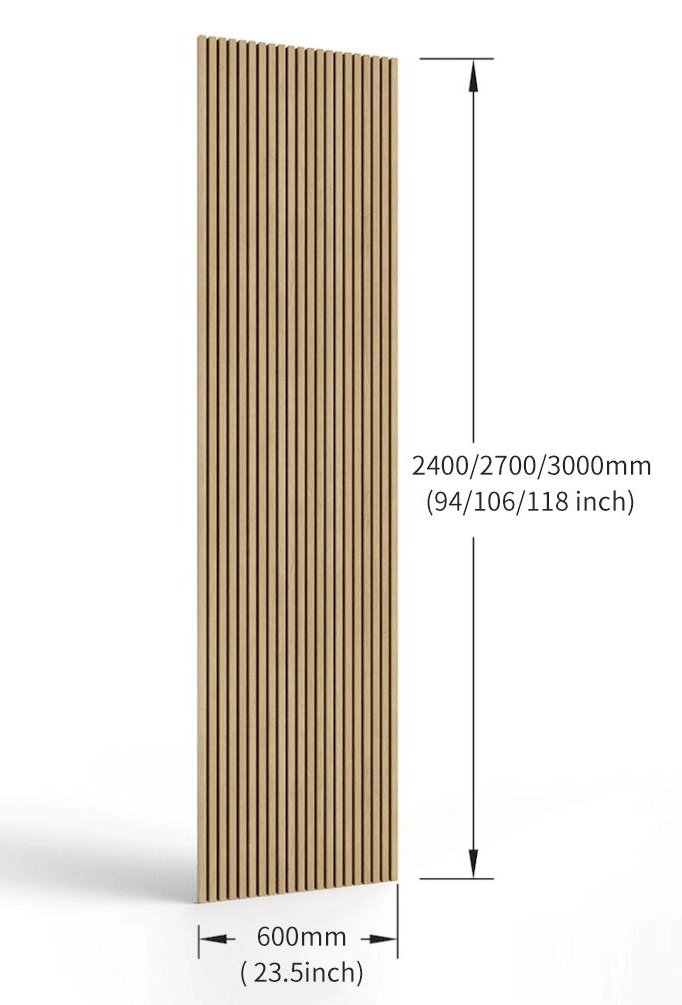
- Can you produce custom panel dimensions for non-standard project requirements?
- Do you offer OEM/ODM services for distributors who want private-label packaging?
- What is the lead time for a repeat order once the first order has been completed?
At NF Decor, our standard MOQ for suede acoustic wood panels is flexible enough to support both project-based orders and stocking distributors. We offer free samples, 48-hour quotation turnaround, and full OEM support for distributors who want to build their own brand on top of our manufacturing capability. You can also explore our full range of hexagon acoustic panels for complementary product options.
Conclusion
Suede acoustic wood panels are no longer a niche product — they are becoming the specification of choice for any commercial project where aesthetics and acoustic performance both matter. If you are a distributor or project supplier looking to add a premium acoustic panel to your range, now is the right time to source directly from a certified manufacturer.