


Knowing how to clean acoustic panels safely can prevent a minor handover issue from becoming costly replacement work. Dust, fingerprints, and installation marks may look easy to remove, but the wrong tool or cleaner can scratch finishes, leave residue, or cover absorptive surfaces1. I recommend identifying the material first and then using the least aggressive compatible method.
To clean acoustic panels safely, I first identify the exact surface and review the manufacturer’s maintenance instructions. I remove loose dust with an approved gentle method, test any further treatment in a concealed area, and increase cleaning intensity only after confirming compatibility. I avoid excess moisture, aggressive rubbing, and unapproved chemicals because each panel finish responds differently.
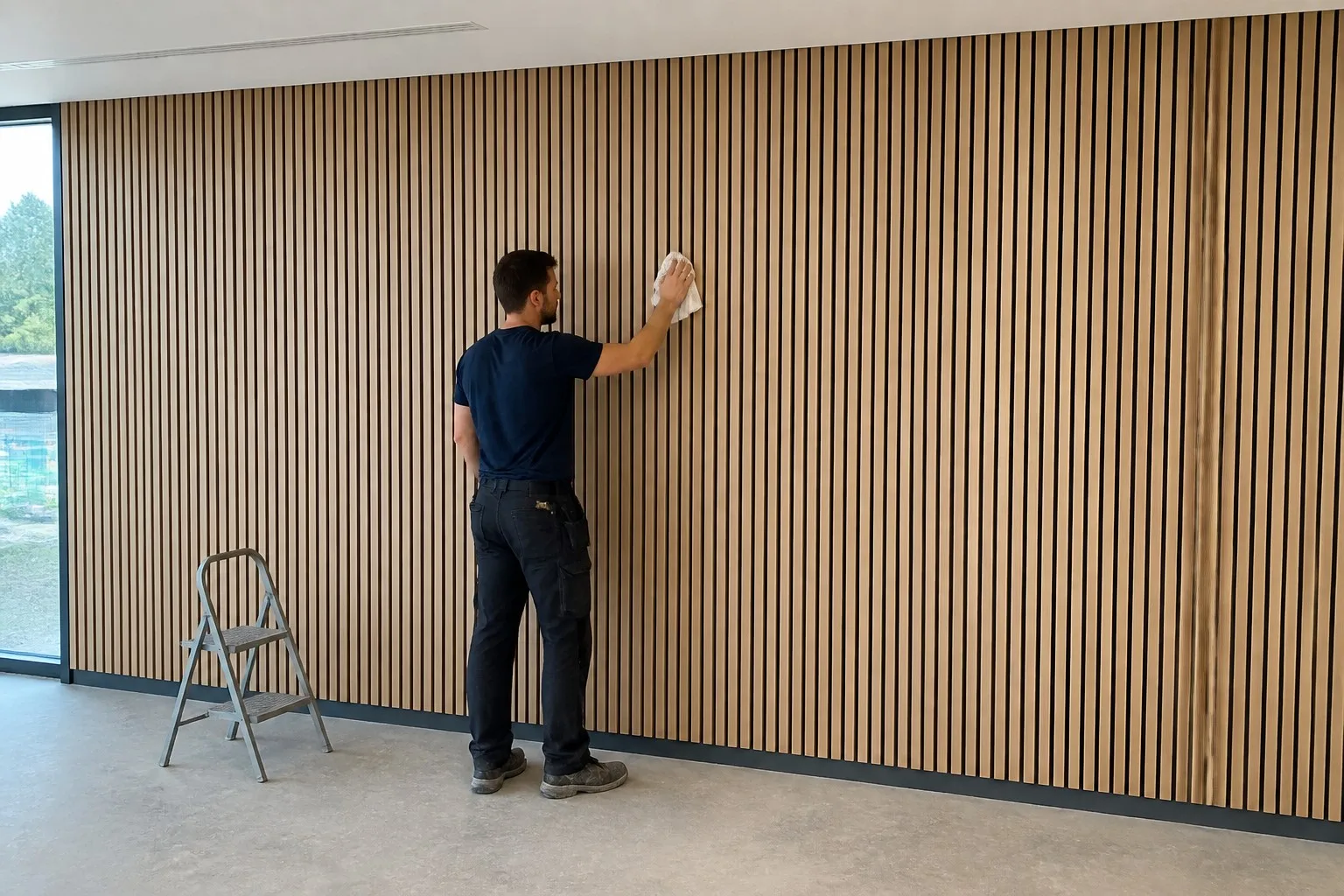
I have seen attractive panels scratched, dulled, or discolored during last-minute project cleaning. In most cases, the team was trying to solve a small problem quickly. A controlled process takes longer at the start, but it may prevent rework, replacement costs, and handover delays.
Why Should I Identify the Surface Before I Clean Acoustic Panels?
A visible stain often attracts immediate attention, so an installer may start with the strongest available cleaning method. That approach reverses the correct decision process. If I do not know whether the surface is veneer, solid wood, felt, fabric-like material, laminate, or a coating, I cannot judge what may damage it.
The surface type should determine how I clean acoustic panels, not the apparent severity of the mark. I check product labels, approved samples, purchase documents, finish schedules, and manufacturer instructions before selecting a method. If identification remains uncertain, I stop and ask the panel supplier rather than experimenting on an installed feature wall.
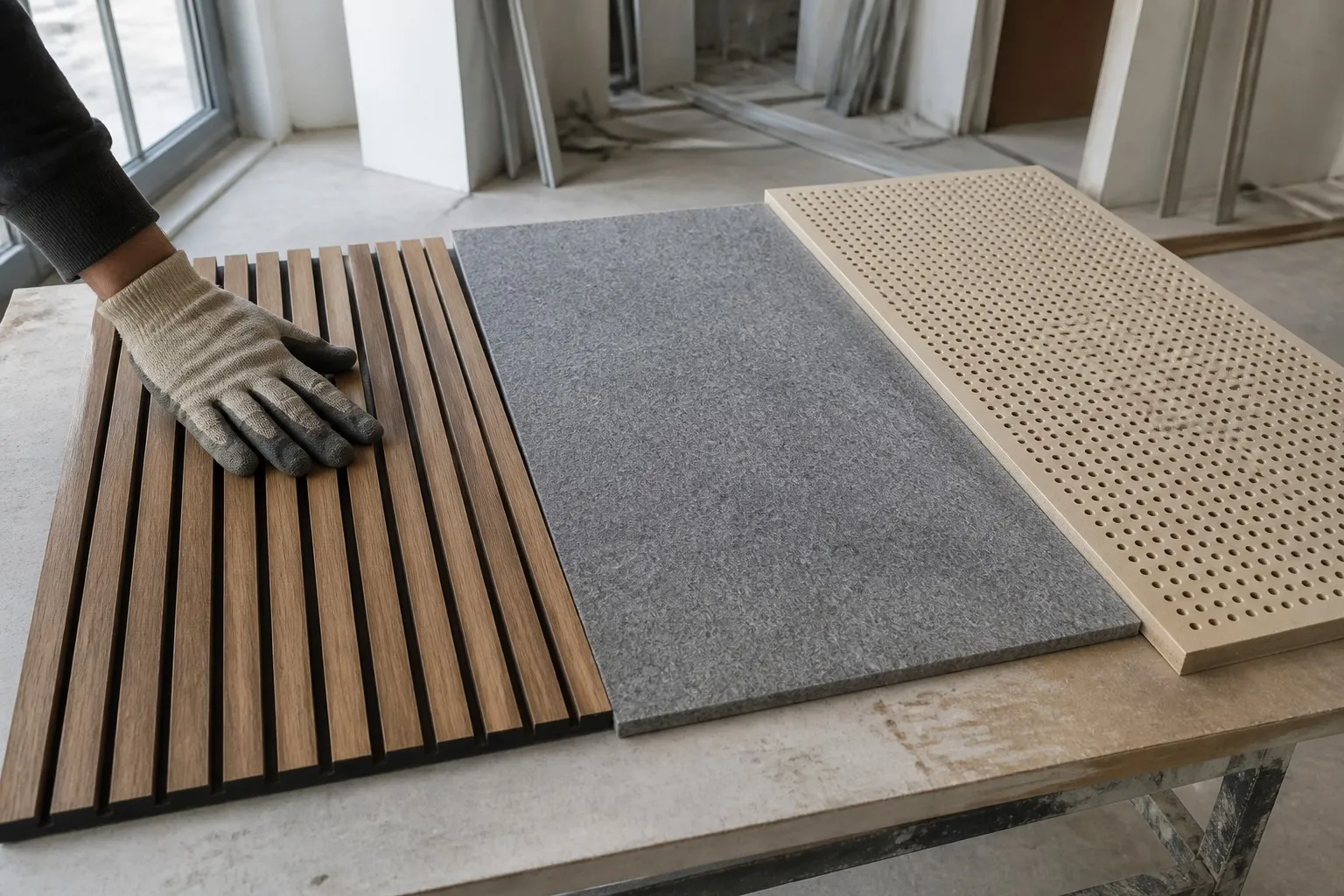
Similar-looking panels can require different care
Acoustic panels can look similar in project photographs while using very different materials. For example, a slatted panel may combine a decorative wood surface, a substrate, and an absorptive backing2. A felt panel may use recycled fibers, a decorative finish, or an additional printed surface. An artistic panel may also have a coating that changes its cleaning limitations.
I therefore separate the panel into its visible and functional components:
- Decorative face: This may be wood veneer, laminate, painted material, suede-like material, fabric, or felt.
- Edges and joints: These areas may expose adhesives, backing layers, or more moisture-sensitive substrates.
- Absorptive surface: Felt, porous fabric, perforations, gaps, and open-cell materials may collect residue.
- Mounting system: Excess liquid may reach concealed fixings, walls, or adhesive layers.3
- Applied finish: Oil, lacquer, paint, stain, print, or another coating may react differently to friction and cleaning agents.
| Surface or component | Potential cleaning concern | What I verify first |
|---|---|---|
| Wood veneer | Scratching, gloss change, discoloration, moisture exposure | Veneer and finish specification |
| Solid or engineered wood face | Grain damage, finish incompatibility, edge swelling | Approved maintenance procedure |
| Felt surface | Fiber disturbance, staining, trapped residue | Manufacturer-approved dust or spot-cleaning method |
| Fabric-like finish | Color transfer, watermarking, texture change | Fabric composition and care instructions |
| Painted or coated panel | Dulling, softening, coating removal | Coating type and chemical compatibility |
| Slat gaps or perforations | Dust accumulation and residue deposition | Approved low-contact removal method |
| Absorptive backing | Cleaner residue or accidental coating | Whether the backing should be touched at all |
I once reviewed project photos in which a cleaning team had treated a wood-look surface as though it were a durable plastic laminate. The rubbing marks became more visible under directional lighting. That case did not prove that every similar panel would react the same way, but it showed why visual appearance alone is an unreliable guide.
For commercial projects, I recommend recording the product code, finish code, batch information, and supplier contact before cleaning begins. The contractor can then link the cleaning decision to a specific supplied product instead of relying on a general internet procedure.
What Is the Lowest-Risk Way to Clean Acoustic Panels?
Project teams often face time pressure just before inspection. That pressure can encourage immediate wet wiping or aggressive spot treatment. However, every extra tool, liquid, or cleaning agent introduces another compatibility question. I prefer a staged process that starts with documentation and loose-dust removal.
The lowest-risk way to clean acoustic panels is to follow a controlled sequence: confirm the product, review its maintenance instructions, document the affected area, remove loose contamination gently, and test any additional treatment on a concealed sample. I escalate only after the supplier or manufacturer confirms that the proposed method is compatible with the specific surface and finish.
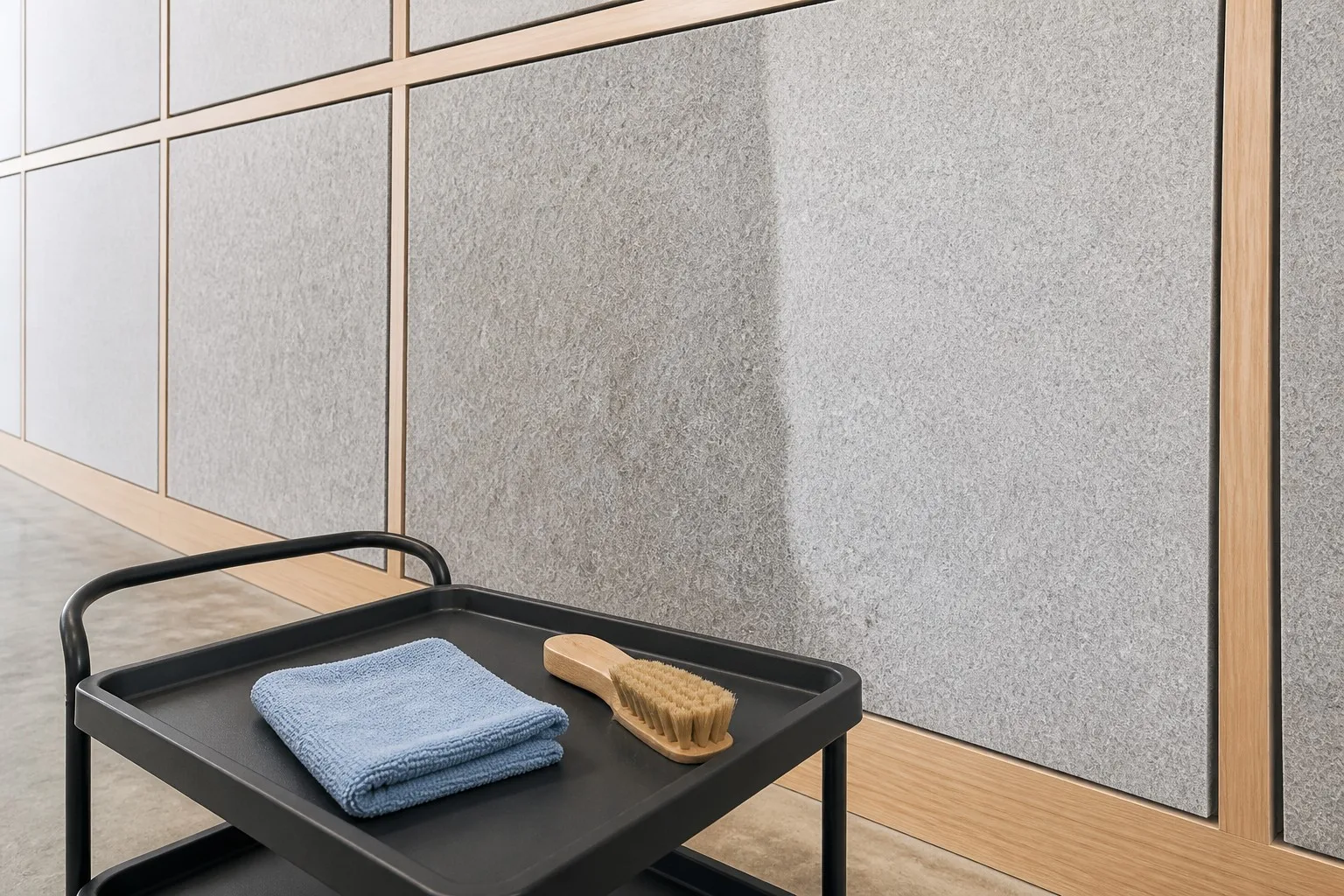
My five-stage cleaning decision
I use the following sequence when contractors ask how they should approach dust or marks:
-
Identify the panel and finish.
I check the approved submittal, invoice description, sample, packaging label, or finish schedule. A generic description such as “wood acoustic panel” is not always detailed enough. -
Read the supplied maintenance guidance.
I look for instructions covering tools, moisture, cleaning products, direction of movement, and prohibited methods. If the documentation is unclear, I ask for written clarification. -
Document the condition.
I take photographs under normal and side lighting. I also record whether the issue is loose dust, fingerprints, adhesive residue, paint overspray, water staining, or physical damage. Different problems require different decisions. -
Begin with the least aggressive approved action.
Loose dust should not automatically trigger wet cleaning. Depending on the confirmed material, the approved action may involve a soft, non-abrasive tool or another low-contact method. I do not assume that one tool is suitable for every felt, fabric, or coated surface. -
Test and inspect before expanding.
I test the confirmed method on a spare panel, offcut, or concealed area. I then inspect it after the surface has returned to normal conditions. Immediate appearance alone may not reveal a gloss, color, or texture change.4
I treat the concealed-area test as a compatibility check, not as proof that every installed panel will respond identically.
Why documentation matters
A short cleaning record can protect both the contractor and the buyer. I suggest noting:
- The panel product and finish code
- The location and size of the affected area
- Photographs taken before treatment
- The maintenance instruction consulted
- The tool or treatment approved
- The test location
- Photographs after inspection
- The person who authorized broader cleaning
This record is especially useful when several trades are working near the wall. It can distinguish normal dust from paint overspray, adhesive transfer, sealant marks, or damage caused by another activity.
I also recommend setting aside spare panels or finish samples during procurement. A sample gives the project team a better testing surface than a prominent installed wall. For large commercial orders, buyers can ask the supplier to include project-specific maintenance guidance in the submittal package before shipment.
How Can I Clean Acoustic Panels With Wood or Wood-Slat Surfaces?
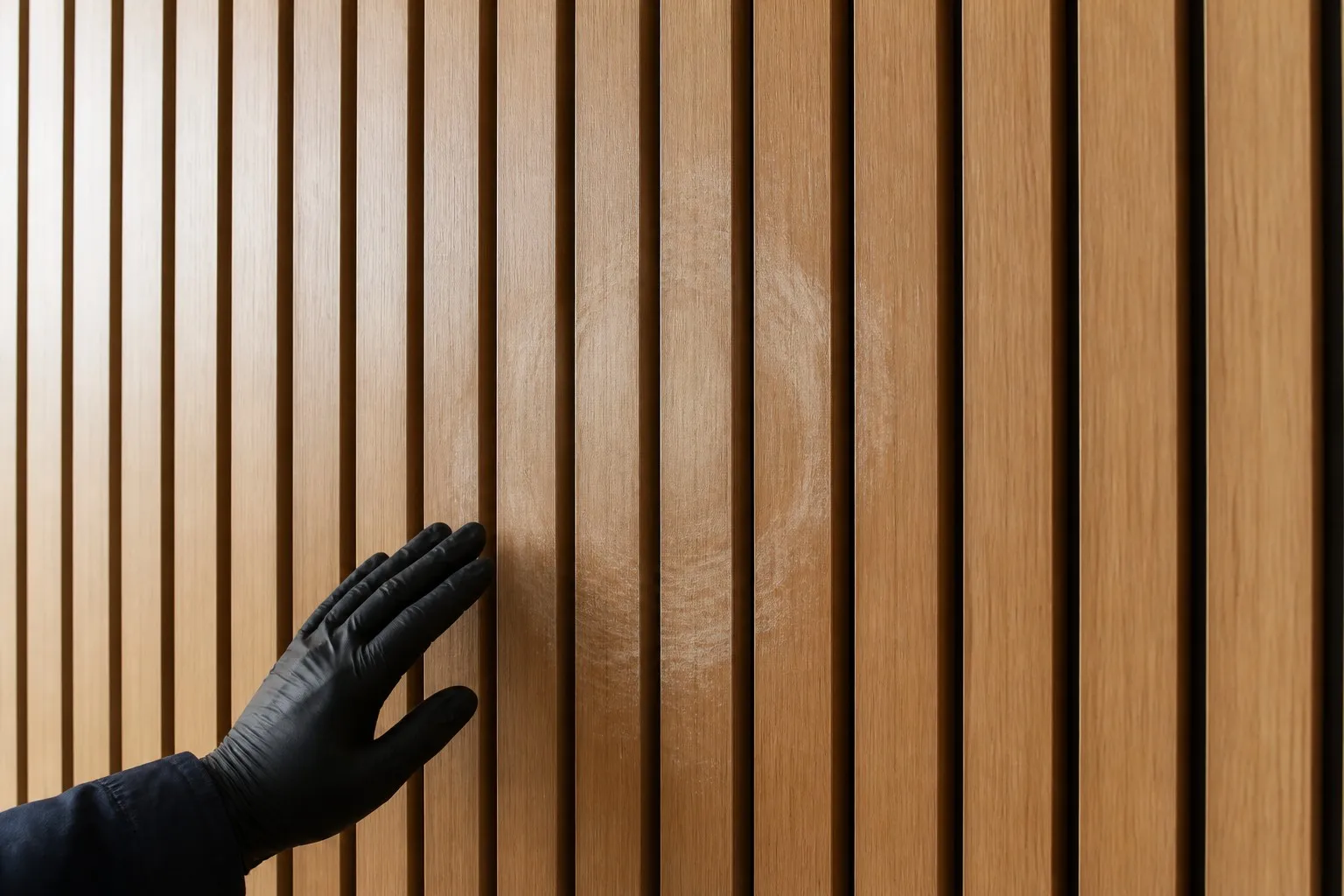
Wood-faced panels create a particular handover challenge because directional lighting can reveal fine scratches, uneven gloss, and rubbing marks. A method that appears harmless in a dark corner may look unacceptable across a full feature wall. Excess moisture can also reach edges, joints, or supporting materials.5
When I clean acoustic panels with a confirmed wood or wood-slat face, I first remove loose dust using the manufacturer-approved low-contact method. I avoid aggressive rubbing, abrasive tools, excess moisture, and unconfirmed cleaning products. For fingerprints or marks, I request finish-specific guidance and test the approved treatment on an offcut or concealed location.
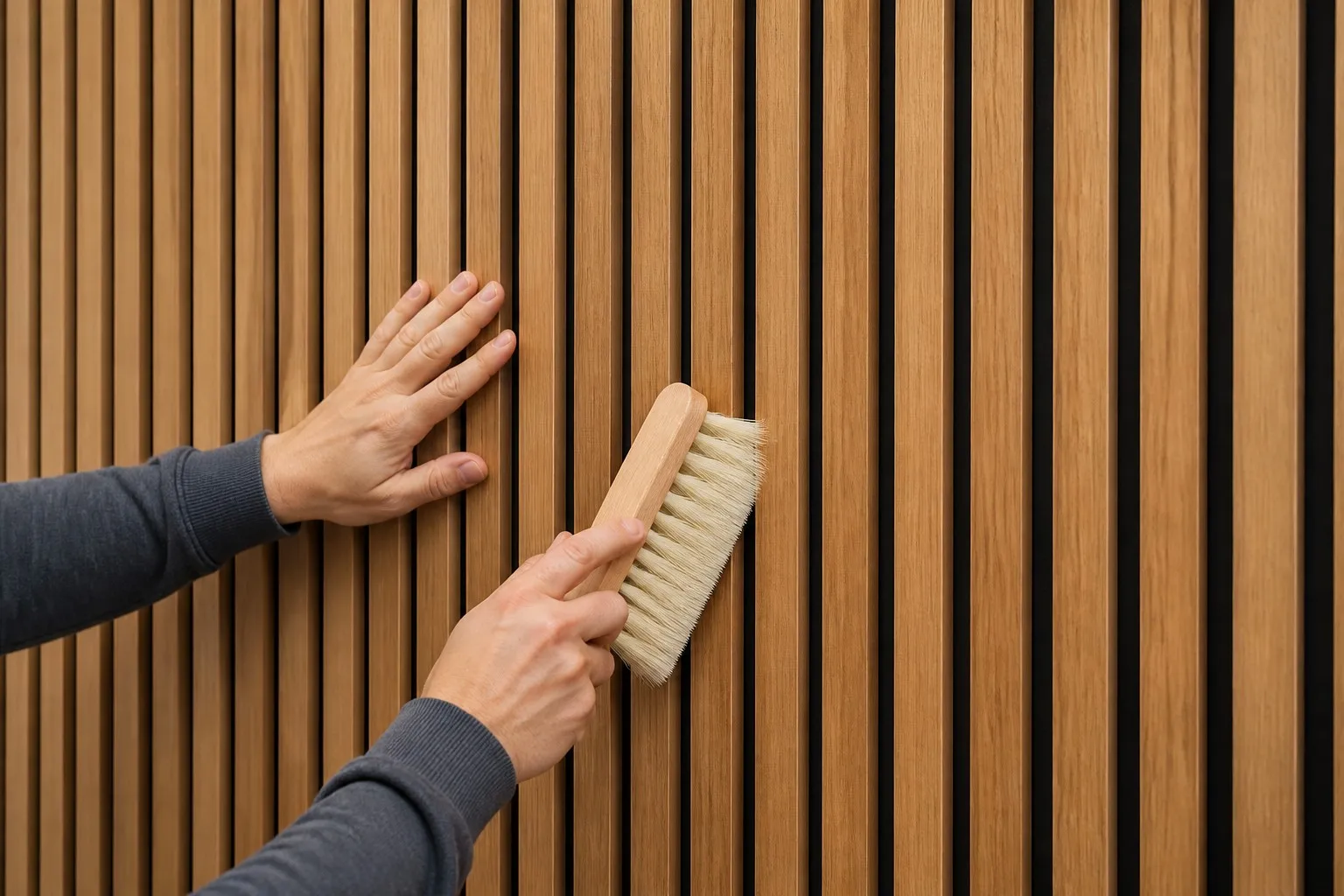
Common causes of visible wood-finish damage
From the production and project feedback I have encountered, several actions deserve caution:
- Abrasive cloths or pads can create fine scratches.
- Repeated hard rubbing can change the local gloss level.
- Dirty cleaning tools can drag grit across the surface.
- Excess liquid can collect along edges, grooves, and joints.
- Unconfirmed chemicals may soften, dull, stain, or discolor a finish.
- Cleaning against a textured direction may make rubbing patterns more visible.
- Treating one small area repeatedly can create a noticeable patch under side lighting.
I have seen a dark wood finish develop a dull area after someone repeatedly worked on one fingerprint. The fingerprint was less visible, but the altered sheen created a larger defect. This was one project-specific result, not a universal outcome for every wood coating. Still, it illustrates why more rubbing does not always produce a better finish.
Separate dust from physical damage
I ask teams to classify the problem before they act:
| Observed condition | Likely category | Appropriate decision |
|---|---|---|
| Loose construction dust | Surface contamination | Use only the approved gentle dust-removal method |
| Fingerprint or light handling mark | Local surface contamination | Confirm finish-specific treatment and test |
| Adhesive or sealant transfer | Bonded contamination | Contact the supplier before using a remover |
| Paint or coating overspray | Deposited coating | Stop and request specialist evaluation |
| Scratch through the finish | Physical damage | Cleaning will not restore the lost finish |
| Chipped veneer or damaged edge | Material damage | Assess repair or panel replacement |
| Uneven gloss after rubbing | Possible finish alteration | Stop further cleaning and inspect under project lighting |
I do not treat scratches, chips, or finish removal as cleaning problems. Additional cleaning may enlarge the damaged area. A qualified finisher, installer, or manufacturer representative should assess whether a controlled repair is possible. Replacement may be more predictable when the defect sits in a highly visible location.
For procurement, I encourage buyers to evaluate cleanability before ordering. They can request a finish sample and ask the supplier for the maintenance document. They can also test realistic handling conditions on the sample, provided the supplier approves the evaluation method. This step helps contractors create a project-specific handover plan rather than improvising after installation.
How Should I Clean Acoustic Panels Made With Felt or Fabric-Like Surfaces?
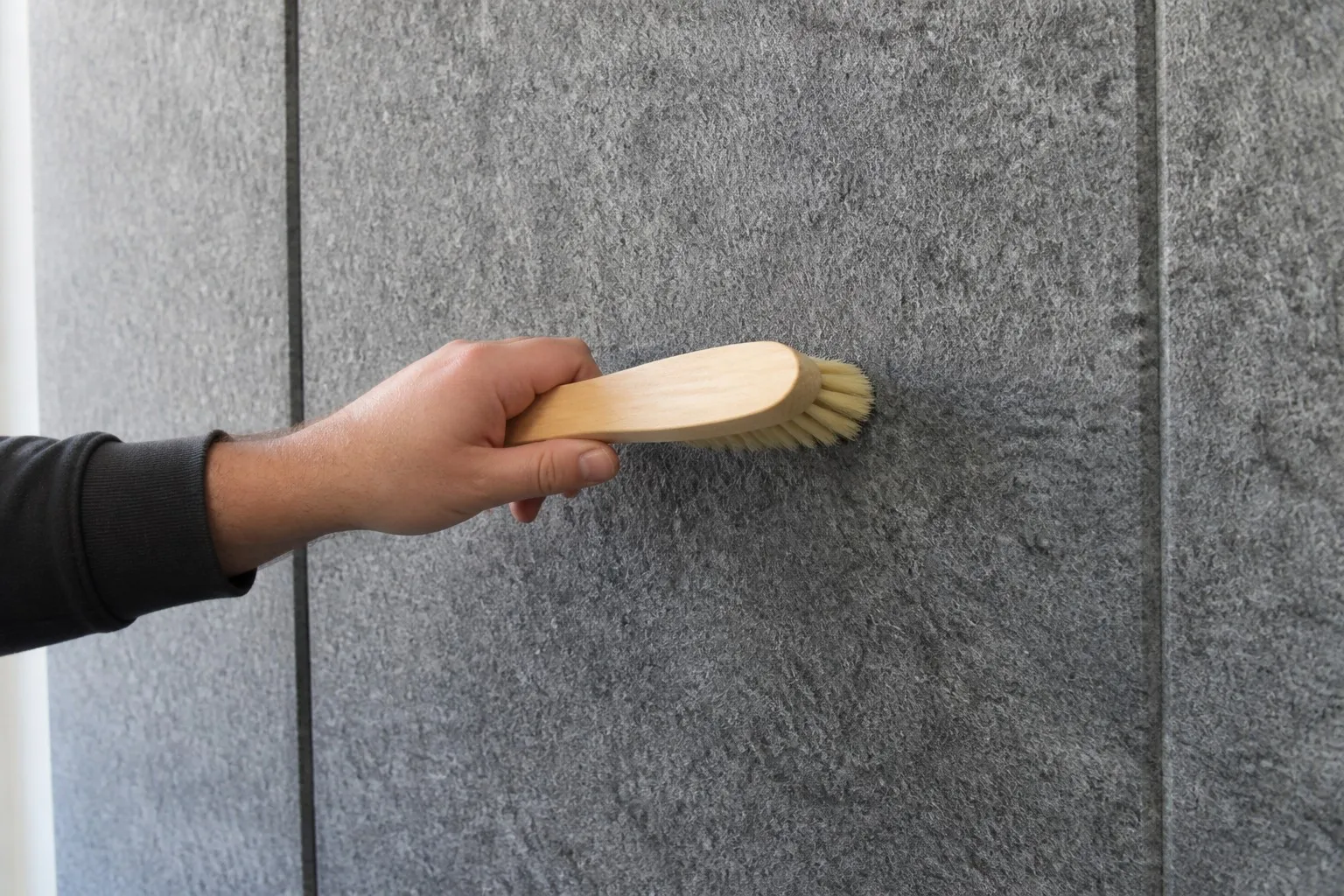
Felt and fabric-like panels can trap dust within a textured surface6, which makes a quick wipe tempting. However, rubbing may disturb fibers or spread contamination7. Moisture may also create a larger visible area, while an unsuitable tool can change the surface texture.
Before I clean acoustic panels with felt or fabric-like faces, I verify the material composition and the manufacturer’s care instructions. I start only with an approved loose-dust method. I do not apply water, detergent, solvent, stain treatment, or strong suction unless the supplier confirms compatibility and a concealed-area test produces an acceptable result.
Why I avoid transferring wood advice to felt
My strongest direct experience concerns wood and wood-slat finishes. I therefore do not assume that a method used on a confirmed wood coating is suitable for polyester felt, natural fibers, printed felt, suede-like finishes, or upholstered acoustic products.
Even within a broad category such as “felt,” products can differ in:
- Fiber composition
- Density and thickness
- Surface texture
- Dye or printing method
- Laminated backing
- Adhesive system
- Fire-retardant treatment
- Water or stain-resistant treatment
- Installation method
These differences can affect colorfastness, fiber movement, drying appearance, and compatibility with cleaning tools. The manufacturer should provide the relevant product-specific guidance.
Contamination type changes the decision
I distinguish between loose particles and contamination bonded to the surface:
Loose dust may be removable through a supplier-approved, low-contact method. The team should control the surrounding work first so the dust does not return immediately.
Smears, food marks, or unidentified spots need product-specific advice. I avoid guessing what caused the mark because an incorrect assumption can lead to an incompatible treatment.
Adhesive, paint, plaster, or sealant residue usually requires escalation. A product that dissolves construction residue may also affect fibers, dyes, binders, or backing materials.
Deep discoloration or water staining may not be a surface-cleaning issue. The team should check for moisture sources, substrate problems, or contamination behind the panel.
I once received images of an absorptive surface that had been partially covered by construction residue. The site team initially described the issue as dust, but close photographs suggested that the material had bonded to the surface. I recommended that the team stop brushing it and send product and residue details for review. That pause reduced the risk of spreading the affected area.
Control dust before it reaches the panels
Prevention is usually easier than cleaning. I advise contractors to:
- Keep panels packaged until dusty work is complete.
- Store cartons in a clean, dry area according to supplier instructions.
- Protect installed walls during cutting, sanding, painting, and ceiling work.
- Avoid attaching protective films or tapes directly to panel faces unless approved.
- Use clean gloves when handling light-colored surfaces.
- Inspect panels in stages rather than waiting until final handover.
- Keep spare offcuts for compatibility tests.
These controls can reduce cleaning work and make responsibility clearer across trades.
Can Cleaning Affect Acoustic Panel Performance?
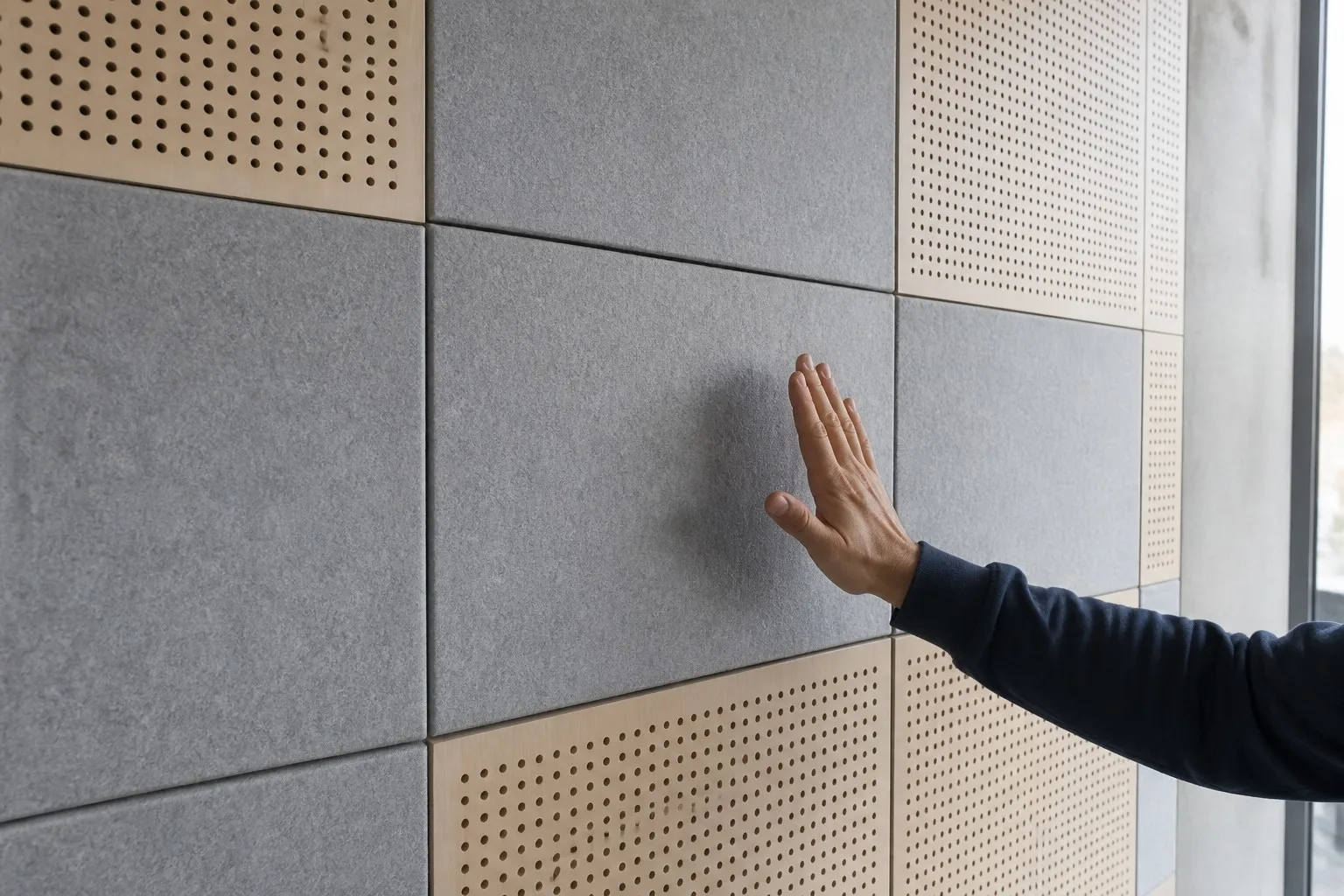
Teams may focus only on appearance during handover. However, absorptive panels depend partly on exposed pores, fibers, perforations, gaps, or backing materials8. A cleaner residue, paint film, sealant, or added coating may cover those features even if the wall still looks acceptable.
Cleaning may affect acoustic panel performance if it leaves residue, compresses or mats an absorptive surface, blocks perforations, fills slat gaps, or adds an untested coating. The actual effect depends on the panel design and the extent of coverage. I do not claim a measurable performance change without product-specific acoustic testing or qualified technical evaluation.
Cleaning and coating are different activities
I distinguish normal maintenance from applying a new material. A light mist, polish, stain treatment, paint, sealant, or protective coating may appear to be part of cleaning, but it can alter the panel surface. The project team should not apply it without written confirmation from the manufacturer.
Potential concerns include:
- Residue collecting between felt fibers
- Paint bridging small perforations
- Coating covering porous surfaces
- Polish changing a wood finish’s gloss
- Sealant filling gaps between slats
- Liquid reaching the absorptive backing
- Fibers becoming compressed or matted
- Added material changing fire or emissions documentation
I use bounded language here because visual inspection cannot establish a specific change in sound absorption. A covered area may create an acoustic concern, but the size and significance depend on the product construction, affected surface area, frequency range, and installed assembly.
When a technical review is appropriate
I recommend escalation when:
- A large area has received overspray or coating.
- Perforations, gaps, or porous faces appear blocked.
- Cleaner residue remains after the approved process.
- The absorptive backing has become wet or contaminated.
- Fibers have visibly matted or changed texture.
- The client requires verified post-cleaning acoustic performance.
- The proposed treatment differs from the tested product construction.
The manufacturer can confirm whether the treated panel still matches the supplied specification. For performance-critical rooms, an acoustical consultant or qualified testing professional should evaluate the application. Examples include recording spaces, conference rooms, auditoriums, and projects with contractual reverberation requirements.
I also advise buyers to treat certifications and test reports as documents to verify. A report applies to the tested product configuration, materials, thickness, installation, and test method. An added site coating or unapproved treatment may not be represented by the original report.9 The supplier should explain the scope of its documentation, while a qualified professional should interpret project-specific acoustic requirements.
When Should I Stop Cleaning Acoustic Panels and Request Help?
A deadline can encourage a team to continue until a mark disappears. That persistence can turn a localized imperfection into a larger finish problem. I stop when the surface begins to change or when the contamination requires a treatment that the supplier has not approved.
I stop trying to clean acoustic panels when I see color transfer, gloss change, fiber disturbance, spreading moisture, finish softening, edge swelling, or persistent residue. I also stop when the mark is actually paint, adhesive, sealant, a scratch, or substrate damage. At that point, I request guidance from the manufacturer or an appropriate repair professional.
Practical stop signs
The following conditions justify an immediate pause:
- The cleaning tool picks up the panel’s color.
- The treated area becomes lighter, darker, shinier, or duller.
- The surface texture changes.
- Fibers begin to pill, fuzz, or flatten.
- Moisture reaches panel edges, joints, or backing.
- The mark spreads instead of becoming smaller.
- The finish becomes sticky or soft.
- A chemical odor remains.
- Residue collects in perforations or slat gaps.
- The cleaning method conflicts with supplied instructions.
I advise the team to photograph the area, label the test location, and prevent anyone else from continuing with a different method. A series of unrecorded treatments makes the cause harder to diagnose.
Who should review the problem?
| Problem | Recommended reviewer |
|---|---|
| Uncertain panel or finish type | Supplier or manufacturer |
| Fine scratches or uneven wood gloss | Qualified wood finisher or manufacturer |
| Paint, adhesive, or sealant residue | Manufacturer and relevant trade specialist |
| Wet or contaminated backing | Manufacturer and building moisture professional |
| Possible blocked absorptive surface | Manufacturer or acoustical consultant |
| Large replacement area | Contractor, designer, supplier, and client representative |
| Contractual performance concern | Qualified acoustical professional |
For NF Decor projects, I encourage B2B buyers to share the product code, finish reference, order information, photographs, and contamination description when requesting guidance. That information helps a manufacturer review the actual construction rather than offer generic advice. Buyers should still verify the proposed method on a spare piece or concealed area before approving broader work.
A clear escalation procedure can also be added to the project method statement. It tells cleaners and installers who has authority to approve treatment. That small procurement and site-management step can prevent well-intended but incompatible cleaning attempts.
Frequently Asked Questions
Can I wipe every acoustic panel with a damp cloth?
No. I do not recommend one damp-wiping procedure for every acoustic panel. Water may affect some finishes, fibers, edges, adhesives, or substrates. I first identify the panel, review its maintenance instructions, and test any supplier-approved method on a spare sample or concealed area.
Can I vacuum felt acoustic panels?
That depends on the specific felt construction and the manufacturer’s instructions. Suction level, attachment design, tool cleanliness, and contact with the fibers can all matter. I only use a vacuum method when the supplier confirms it and a controlled test does not alter the surface.
How do I remove fingerprints from wood slat acoustic panels?
I first remove loose dust using the approved method so grit does not scratch the finish. I then check the maintenance guidance for that exact wood surface and coating. I test the approved treatment on an offcut or concealed area and stop if the gloss or color changes.
Can I paint over stains on an acoustic panel?
I would not paint an acoustic panel without written manufacturer approval. Paint may change its appearance, fire-related documentation, and exposed absorptive features.10 If acoustic performance matters, the project team should also obtain a qualified technical evaluation because the original test data may not cover the modified surface.
What information should I send the panel supplier?
I send the product code, finish or color reference, order number, installation location, photographs under normal and side lighting, and a description of the contamination. I also explain which cleaning attempts have already occurred. This information allows the supplier to give more relevant, product-specific guidance.
Conclusion
The safest way to clean acoustic panels is to make a material-specific decision rather than follow a universal housekeeping routine. I identify the surface, review the maintenance instructions, remove loose dust gently, test approved treatments, and stop when appearance or texture begins to change. I also treat residue or coatings on absorptive surfaces as a possible performance concern without assuming a measurable loss.
For an NF Decor project, contact our team with your panel specification, finish code, order details, and clear photographs. We can help you review the supplied product information and plan an appropriate test before full-area cleaning.
Related technical guides
- Can Acoustic Panels Be Used Outdoors? What You Need to Know Before Specifying
- NRC vs STC: Which Rating Does Your Project Actually Need?
""Sound absorption properties of additively manufactured ...", https://digitalcommons.mtu.edu/michigantech-p2/2113/. Materials-maintenance guidance and acoustic-material research indicate that abrasive contact, chemically incompatible cleaners, and deposited residues can alter finish appearance or affect exposed porous surfaces. Evidence role: general_support; source type: research. Supports: That abrasive cleaning, unsuitable chemicals, and deposited residues can alter surface appearance or affect porous material surfaces.. Scope note: The specific response depends on the panel's finish, binder, coating, and construction. ↩
"National Association of Broadcasters Engineering Handbook", https://www.academia.edu/109202531/National_Association_of_Broadcasters_Engineering_Handbook. Architectural-acoustics teaching materials describe sound-absorbing panel systems as assemblies in which a decorative facing may be combined with substrates, cavities, or porous backing materials that contribute to acoustic behavior. Evidence role: general_support; source type: education. Supports: That many acoustic wall-panel systems use a visible facing together with a backing or core intended to provide sound absorption.. Scope note: Not every slatted panel has the same layer sequence or uses the same backing material. ↩
"Moisture Control Guidance for Building Design, ...", https://www.epa.gov/sites/default/files/2014-08/documents/moisture-control.pdf. Building-materials research recognizes that liquid water entering joints and interfaces can reach concealed substrates and adhesive-bonded layers, where moisture sensitivity may affect durability. Evidence role: mechanism; source type: research. Supports: That liquid water can enter joints and interfaces in building assemblies and may affect moisture-sensitive substrates or adhesive bonds.. Scope note: Whether migration occurs, and whether it causes damage, depends on joint geometry, quantity of liquid, materials, and installation details. ↩
"Dry Cleaning Approaches for Unvarnished Paint Surfaces", https://www.academia.edu/67722227/Dry_Cleaning_Approaches_for_Unvarnished_Paint_Surfaces. Coatings research shows that exposure to liquids and cleaning agents can produce changes in gloss, color, or surface condition that are more reliably assessed after drying or equilibration rather than immediately after treatment. Evidence role: mechanism; source type: paper. Supports: That surface appearance measurements and visible changes in coatings can vary after exposure, drying, and equilibration.. Scope note: The timing and magnitude of any delayed change vary by coating chemistry and exposure conditions. ↩
"Diagnostic Guide for Evaluating Surface Distortions in ...", https://www.fpl.fs.usda.gov/documnts/fplgtr/fpl_gtr143.pdf. Wood-products guidance from the U.S. Forest Service explains that wood and wood-based panels respond to moisture through dimensional change and that prolonged or excessive wetting can affect panel assemblies and bonded components. Evidence role: mechanism; source type: government. Supports: That wood and wood-based composite products change dimensionally with moisture exposure and that moisture can affect bonded panel assemblies.. Scope note: The degree of risk depends on species, finish, edge sealing, substrate, adhesive, and duration of exposure. ↩
"Contamination of fabric surface by the particles woven ... - PMC", https://pmc.ncbi.nlm.nih.gov/articles/PMC12125313/. Research on textile and fibrous surfaces indicates that airborne particles can be retained within fibers and surface texture, making particulate removal dependent on material structure and cleaning method. Evidence role: mechanism; source type: paper. Supports: That fibrous and textured textile surfaces can retain particulate matter within fibers and surface irregularities.. Scope note: Retention and cleanability differ substantially among fiber types, densities, finishes, and environmental conditions. ↩
"Stain Removal", https://mci.si.edu/stain-removal. Textile-care and conservation literature recognizes that mechanical rubbing can abrade or distort fibers and may redistribute soluble or particulate contamination rather than removing it cleanly. Evidence role: mechanism; source type: research. Supports: That mechanical rubbing can disturb textile fibers and may redistribute certain soils or stains across a surface.. Scope note: The outcome depends on the fiber, weave or felt structure, contaminant, moisture level, and applied force. ↩
"Sound absorption of a perforated panel backed with ...", http://ui.adsabs.harvard.edu/abs/2023MSSP..18509762L/abstract. Architectural-acoustics references explain that sound absorption in panel systems may depend on porous or fibrous media, perforated facings, air spaces, and backing conditions that govern acoustic energy dissipation. Evidence role: mechanism; source type: education. Supports: That porous absorbers, fibrous materials, perforated facings, air gaps, and backing conditions can contribute to sound absorption.. Scope note: The relative contribution of each feature varies with the panel design, mounting arrangement, and sound frequency. ↩
"Examination of the Measurement of Absorption Using the ...", https://ntrs.nasa.gov/api/citations/20150023091/downloads/20150023091.pdf. Sound-absorption testing standards and laboratory reporting practices define results for the specimen configuration and mounting conditions that were tested, so untested site-applied modifications are not automatically covered by the original result. Evidence role: definition; source type: institution. Supports: That laboratory sound-absorption results are associated with the specimen, mounting, and test conditions described in the applicable report.. Scope note: The consequences of a particular modification require product-specific assessment or further testing. ↩
"Article 5. Emission Standards for Architectural ... - Virginia Law", https://law.lis.virginia.gov/admincodefull/title9/agency5/chapter45/partII/article5/. Fire-testing and acoustics documentation generally applies to the tested product construction; adding a site-applied coating can change the exposed surface and may place the modified assembly outside the documented configuration. Evidence role: general_support; source type: institution. Supports: That product fire classifications and acoustic test results are tied to tested constructions, while added coatings can modify exposed surface conditions.. Scope note: Whether a particular coating invalidates, changes, or remains within a documented classification must be determined from the applicable test evidence and manufacturer approval. ↩