


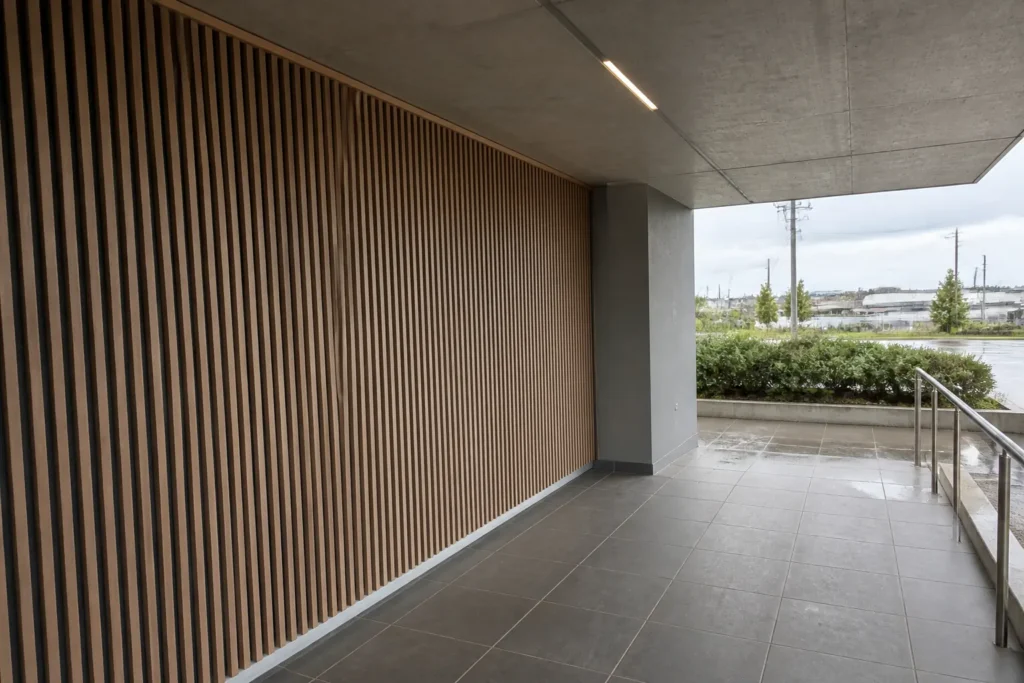
Acoustic panels can be used outdoors only when the specific product is documented as suitable for that exact environment. Standard indoor panels cannot be assumed to tolerate direct rain, standing water, wind-driven moisture, prolonged sunlight or UV exposure. A covered entrance, an open-air restaurant and an exposed garden wall create very different risks, so “outdoor” alone is not a specification. Treat every outdoor enquiry as an exposure assessment: identify the mounting location, the moisture and UV load, then ask the supplier for written confirmation and test evidence for that product. For indoor installations, compare wood slat acoustic panels first.
Acoustic panels can be used outdoors only when the specific product is documented as suitable for the exact installation environment. Standard indoor panels cannot be assumed to withstand direct rain, standing water, wind-driven moisture, prolonged sunlight, or UV exposure. Covered semi-outdoor applications may be possible, but they require project-specific review and written supplier confirmation.
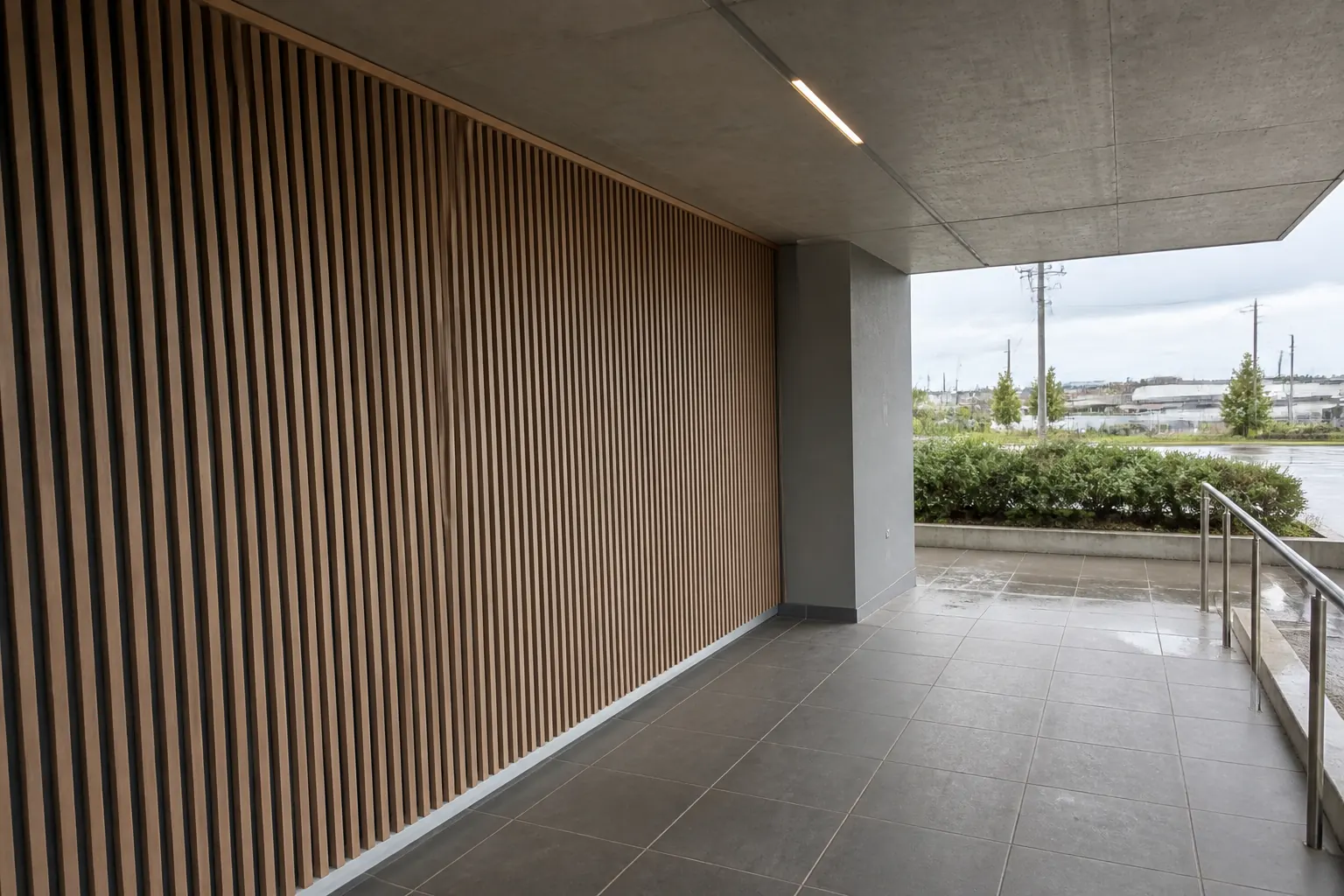

When importers and distributors ask me about outdoor installation, I start by clarifying what “outdoor” means for their project. A covered entrance, an open-air restaurant, and an exposed garden wall create very different risks. Those differences determine what evidence buyers should request before specifying or reselling a panel.
Can Acoustic Panels Outdoors Withstand Every Type of Exposure?
The term “outdoor” often hides the most important specification details. A buyer may describe a wall as covered even though wind-driven rain reaches it several times each season. If we do not identify the real exposure conditions, both the supplier and buyer may evaluate the wrong product characteristics.
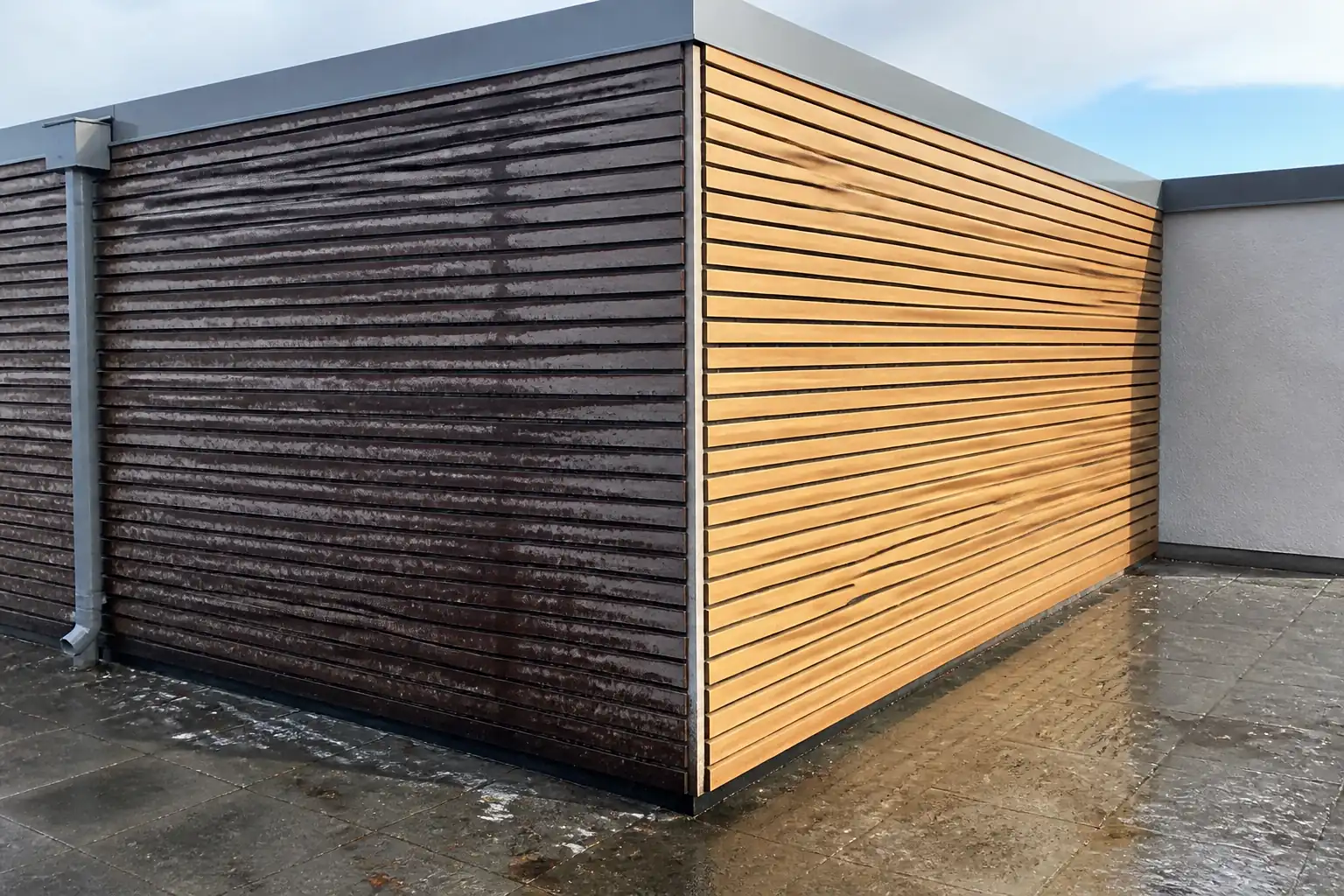
Acoustic panels outdoors must be assessed according to their actual exposure to direct rain, standing water, wind-driven rain, humidity, sunlight, temperature changes, and airborne contaminants. Fully exposed locations generally require products specifically designed and documented for exterior use. Protected semi-outdoor locations may allow more options, subject to product-specific and project-specific confirmation.
I Separate Outdoor Locations Into Practical Categories
I usually divide inquiries into three broad categories. These categories do not replace professional building-envelope analysis, but they help buyers communicate the installation conditions clearly.
| Installation category | Typical examples | Main exposure concerns | Procurement approach |
|---|---|---|---|
| Fully exposed | Garden walls, uncovered terraces, exterior façades | Direct rain, UV, wind-driven water, temperature changes | Request a specifically outdoor-rated system with supporting documentation |
| Covered semi-outdoor | Canopies, sheltered walkways, open-air restaurants | Humidity, indirect rain, occasional wind-driven water, reflected sunlight | Submit the exact environment for written product confirmation |
| Enclosed but unconditioned | Some warehouses, enclosed balconies, seasonal rooms | Condensation, humidity changes, limited climate control | Review moisture, substrate, ventilation, and temperature conditions |
The category alone does not establish suitability. Two covered areas can expose a panel to very different conditions. A deep hotel entrance may stay dry throughout normal weather, while a shallow canopy may offer little protection during strong wind.
I Start With Two Questions
When I review a request to install acoustic panels outdoors, I first ask:
- Will the panels face direct rain, standing water, splashing, condensation, or wind-driven rain?
- Will the panels receive prolonged sunlight or UV exposure?
These questions reveal more than the general label “outdoor.” I then ask buyers to provide:
- The project country and city
- The wall’s orientation
- The depth and height of any canopy
- The distance between the panel and the open edge
- Photographs or architectural drawings
- The presence of gutters, drains, or nearby water features
- Expected cleaning methods
- The wall substrate and fixing method
- Whether the space is heated, cooled, or naturally ventilated
- Any local fire, façade, or building-code requirements
I once received an inquiry for panels in a “covered outdoor corridor.” After we reviewed the drawings, we found that the panel wall was close to the open side of the corridor. The roof blocked vertical rain, but it could not reliably block wind-driven rain. That detail changed the product discussion completely.
I never treat a roof as automatic proof that an installation is protected from water or sunlight.
A qualified architect, façade consultant, acoustic consultant, or other appropriate professional should assess application-specific risks. As a manufacturer and supplier, I can review product documentation and manufacturing options, but I do not replace project engineering or local code review.
Does Acoustic Performance Make Acoustic Panels Outdoors Weather-Resistant?
A panel may provide useful sound absorption in an indoor test or installation, yet that performance says nothing by itself about resistance to rain or UV exposure. When buyers combine these separate properties, they can select an acoustically suitable product that is materially unsuitable for the installation environment.
Acoustic performance does not establish weather resistance. Sound absorption data describes how a tested product manages sound under stated conditions, while outdoor suitability concerns moisture, sunlight, dimensional stability, finishes, adhesives, fasteners, and supporting materials.1 Buyers should verify both sets of requirements independently through product-specific documents and qualified project review.
I Treat Common Water-Resistance Terms Carefully
The terms below are often used loosely in sales conversations. I do not consider them interchangeable.
| Term | What buyers may assume | What buyers should verify |
|---|---|---|
| Moisture-resistant | The panel tolerates any wet environment | The intended humidity conditions, test method, limits, and affected components |
| Water-resistant | Water cannot damage the panel | The amount, duration, direction, and test conditions of water exposure |
| Waterproof | The complete installed system blocks water | Whether the claim applies to the surface, core, joints, edges, fasteners, or full assembly |
| Exterior-grade | The product works in all outdoor climates | The documented exposure class, limitations, installation method, and maintenance |
| Outdoor-rated | The panel is suitable for any exterior application | The specific rating basis, test evidence, exclusions, and supplier warranty terms |
A decorative face may repel occasional droplets while the panel’s cut edges, backing, adhesive, or substrate remains vulnerable.2 A finish may also resist short-term moisture without being intended for repeated wetting. Buyers should therefore review the complete panel assembly rather than one visible component.
I Review the Whole Product Construction
For wooden slat, felt-backed, suede-faced, tambour, hexagon, or artistic 3D panels, I recommend checking each relevant component:
- Decorative surface: Buyers should verify how the finish responds to moisture, sunlight, cleaning, and abrasion.
- Core material: Buyers should ask whether moisture could cause swelling, softening, movement, or loss of integrity.
- Acoustic backing: Buyers should confirm whether the backing can tolerate the expected humidity and wetting conditions.
- Adhesives: Buyers should request evidence that the adhesive system suits the stated exposure.
- Edges and joints: Buyers should identify cut edges, openings, seams, and other paths for moisture.
- Fasteners: Buyers should confirm that the specified fasteners suit the environment and substrate.
- Supporting wall: Buyers should review drainage, ventilation, condensation, and moisture behind the panels.
- Finish consistency: Buyers should consider whether UV exposure may alter color or appearance.
I also ask whether product samples and test specimens match the proposed order. A test report for one construction should not automatically be applied to a different core, thickness, finish, backing, adhesive, or installation system.3
I Keep Certifications in Their Proper Context
NF Decor holds documents that include CE, SGS, ISO, and FSC certifications or reports, depending on the relevant product and scope. However, I do not present general company credentials as proof that a specific panel is suitable for exterior exposure.
Buyers should verify:
- The named manufacturer and manufacturing site
- The exact product or product family
- The tested construction and thickness
- The issuing or testing organization
- The document date and validity
- The referenced test standard
- The measured result and classification
- Any limitations or installation conditions
A certification may support supplier qualification or a specific product characteristic. It does not prove unrelated weathering performance unless its stated scope directly addresses that requirement.4
What Can Go Wrong When Specifying Acoustic Panels Outdoors?
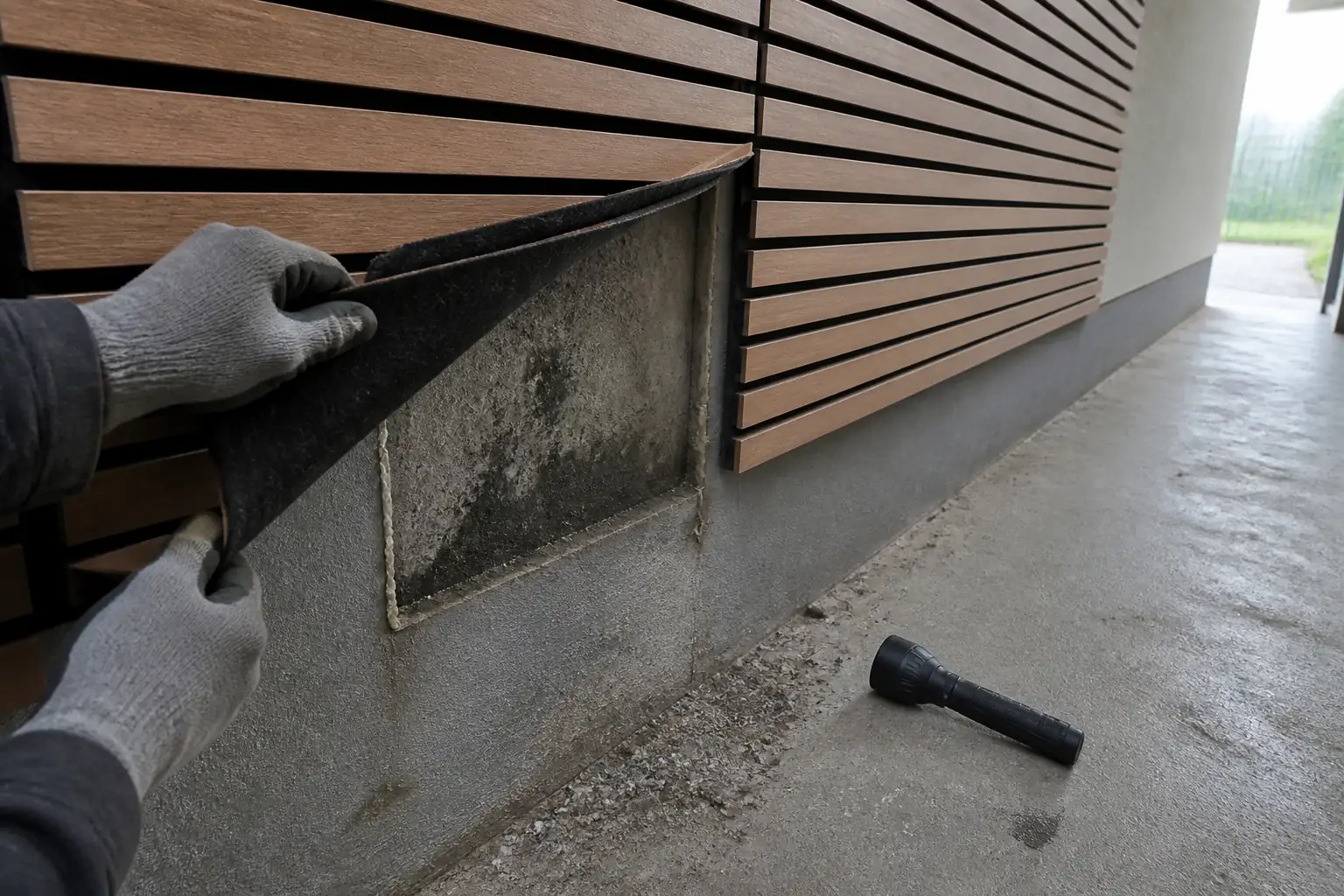
An incompatible specification may look acceptable when the panels are first installed. Problems can appear later, after repeated humidity changes, water contact, cleaning, or sunlight exposure. Importers and wholesalers then face more than replacement costs because the dispute may involve installers, end customers, project schedules, and unclear warranty responsibility.
When acoustic panels outdoors are not matched to their exposure conditions, potential outcomes include dimensional change, surface deterioration, discoloration, delamination, corrosion of unsuitable fixings, loss of adhesion, and reduced visual consistency.5 The actual failure mode depends on the product and environment, so buyers should not infer performance without product-specific evidence.
I Focus on Commercial Risk as Well as Product Risk
For B2B buyers, a specification problem can move through the whole supply chain. A distributor may receive the original inquiry, an importer may place the order, a contractor may install the panels, and a property owner may report the problem. Each party may have understood “outdoor suitable” differently.
Common downstream risks include:
- Product replacement and reinstallation costs
- Delays while replacement material is manufactured or shipped
- Customer complaints and withheld payments
- Damage to the distributor’s reputation
- Disagreement about installation responsibility
- Warranty exclusions caused by an incompatible environment
- Color differences between original and replacement batches
- Disposal, labor, access, or scaffolding expenses
I have found that a short written clarification before quotation is far easier than reconstructing verbal conversations after installation.
I Recommend a Written Exposure Statement
A buyer can reduce ambiguity by including a clear installation statement in the request for quotation. For example:
The panels will be installed under a covered exterior canopy. The wall is open to the west and may receive afternoon sunlight and occasional wind-driven rain. The nearest panel edge is approximately two metres from the canopy opening. Please confirm in writing whether the proposed product is suitable, identify any limitations, and provide supporting product documentation.
This statement is more useful than asking, “Can this panel be used outdoors?” It gives the supplier a defined condition to review.
The buyer should also ensure that the quotation, technical data sheet, sample approval, purchase order, and warranty terms describe the same product. A salesperson’s informal message should not override formal technical limitations.
I Use Samples as a Selection Tool, Not Final Proof
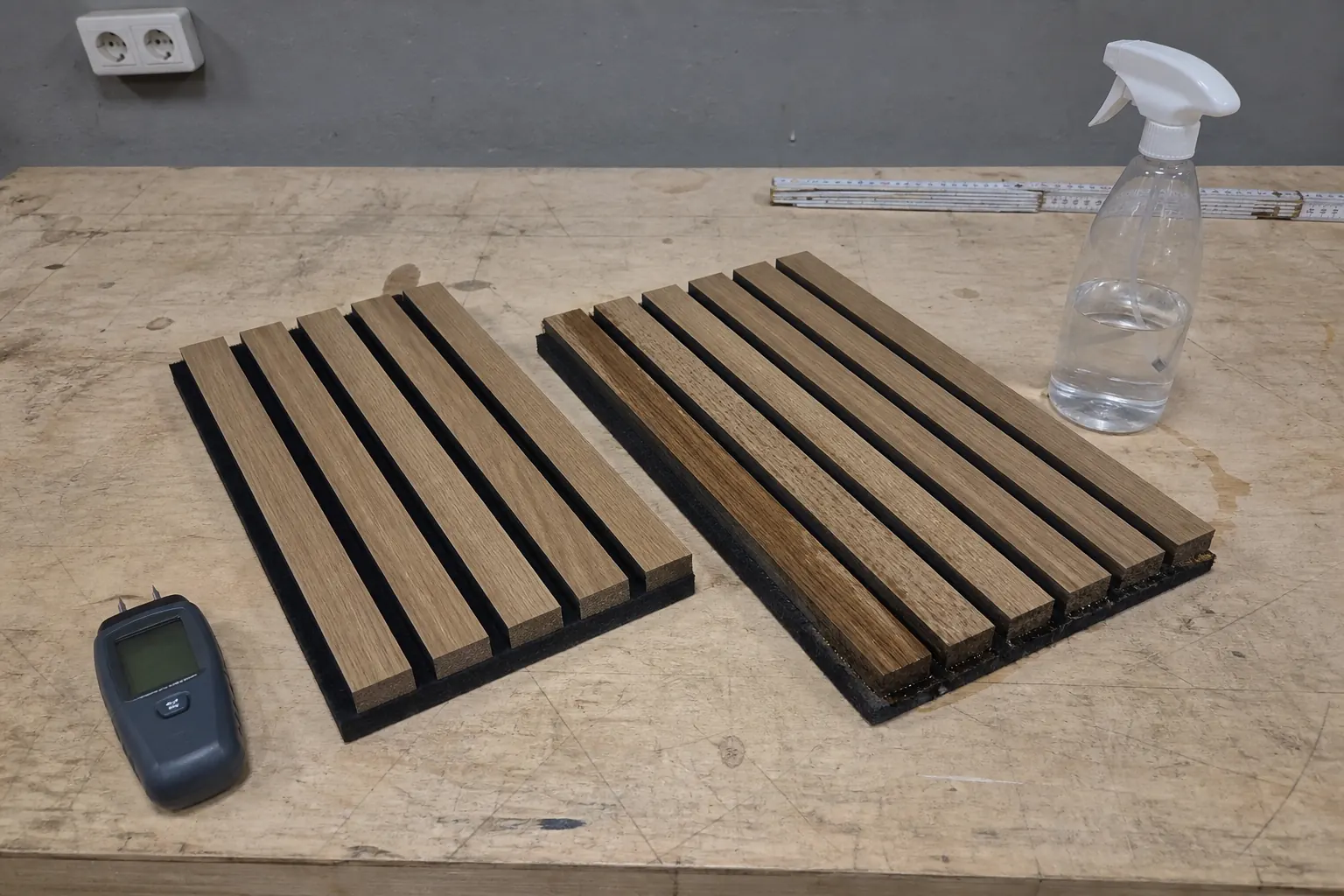
Samples help buyers inspect color, texture, dimensions, surface quality, and basic construction. However, a sample cannot prove long-term exterior performance.6 An informal water-droplet demonstration also cannot establish weather resistance because real installations may involve repeated wetting, cut edges, joints, heat, sunlight, cleaning agents, and substrate moisture.
Where the application requires technical evidence, buyers should ask which recognized test methods apply. A qualified project professional should determine the required criteria. Any proposed numerical limits, weathering cycles, UV exposures, or water-resistance classifications require verification against applicable standards and product documentation.
How Should Buyers Evaluate Suppliers of Acoustic Panels Outdoors?
Supplier evaluation becomes difficult when a seller gives an immediate yes without asking where or how the panels will be installed. Buyers need a documented review process because product customization, installation details, and environmental exposure can all change the answer. A careful supplier should be willing to define limitations.
Buyers evaluating acoustic panels outdoors should compare suppliers by their questions, documentation, sample control, manufacturing consistency, and willingness to provide written suitability statements. Buyers should request evidence for the exact construction being quoted and should obtain qualified professional approval when the application involves façades, public safety, code compliance, or complex moisture conditions.
I Use a Step-by-Step Procurement Process
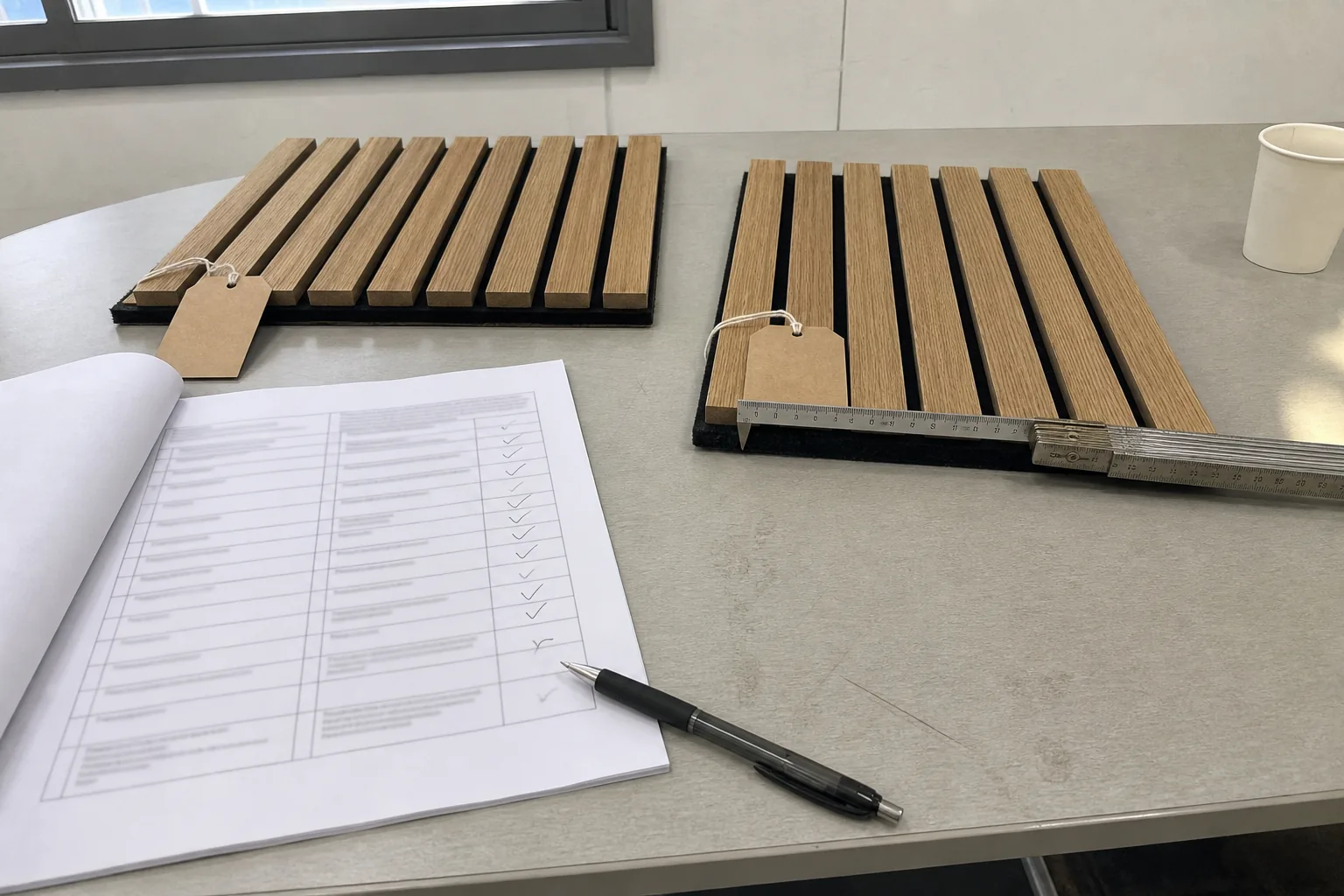
I recommend the following process for importers, distributors, and wholesalers:
-
Define the location.
The buyer should provide plans, photographs, climate information, wall orientation, and canopy dimensions. -
Identify exposure paths.
The project team should consider direct rain, wind-driven rain, splashing, condensation, standing water, sunlight, UV, cleaning, and humidity. -
Set product requirements.
A qualified professional should define acoustic, fire, moisture, structural, finish, and local code requirements. -
Request the exact construction.
The supplier should identify the core, surface, backing, dimensions, finish, adhesive, edge treatment, and recommended fixing method. -
Review supporting documents.
The buyer should confirm that reports apply to the proposed product rather than a different model or generic product family. -
Approve a controlled sample.
Both parties should record the sample code, color, finish, dimensions, and construction. -
Obtain written confirmation.
The supplier should state whether the proposed product is suitable for the described environment and list limitations. -
Align contractual documents.
The purchase order, specification, warranty, packaging requirements, and installation guidance should use consistent terms. -
Inspect production and shipment.
The buyer should define acceptable quality criteria, sampling plans, labeling, moisture protection, and packaging before dispatch.
I Compare Suppliers Beyond Unit Price
At NF Decor, we operate five production lines with stated monthly capacity above 50,000 m² across our manufacturing operations in Hebei and Shandong. Capacity and manufacturing experience can support supplier evaluation, but they do not prove that every product is outdoor-rated. Buyers should still verify the exact panel specification.
A practical supplier comparison can include:
| Evaluation area | Questions I recommend asking |
|---|---|
| Application review | Did the supplier ask about rain, sunlight, humidity, substrate, and location? |
| Product traceability | Can the supplier identify the exact model, materials, finish, and batch? |
| Documentation | Do reports and certificates match the quoted construction? |
| Customization control | Will a change in color, finish, size, or backing affect documented performance? |
| Quality control | Which dimensions, appearance points, and assembly features are inspected? |
| Packaging | How will the supplier protect panels from moisture and damage during transport? |
| Written limitations | Will the supplier state prohibited uses and installation conditions? |
| Complaint handling | Does the supplier have a process for evidence collection and root-cause review? |
I become cautious when a supplier uses phrases such as “completely waterproof” or “suitable everywhere” without defining a test, product construction, exposure condition, or limitation. Responsible specification language is usually more bounded. It may state that suitability cannot be assumed, remains subject to project-specific confirmation, or must be verified against product documentation.
Frequently Asked Questions
Can standard indoor acoustic panels be installed under a covered patio?
Standard indoor panels should not be assumed suitable simply because the patio has a roof. I recommend checking wind-driven rain, splashing, condensation, humidity, canopy depth, and sunlight. The buyer should submit drawings and photographs to the supplier and request written product-specific confirmation before specifying the panels.
Are wooden slat acoustic panels waterproof?
Buyers should not assume that wooden slat acoustic panels are waterproof. Their suitability depends on the face material, core, backing, adhesive, finish, edges, fixings, and complete installation. I recommend requesting evidence for the exact construction and checking whether any claim covers occasional moisture, direct rain, or a complete exterior system.
Does an FSC or CE document prove outdoor suitability?
No. FSC documentation concerns relevant chain-of-custody or responsible sourcing scope, while CE documentation relates to applicable regulatory requirements for the stated product and intended use.7 Neither should be treated automatically as proof of weather resistance. Buyers must review each document’s exact product scope, standard, result, validity, and limitations.
Can acoustic panels be used in an open-air restaurant?
Some panels may be suitable for certain protected open-air restaurants, but the answer depends on direct rain, humidity, sunlight, cooking contaminants, cleaning methods, and installation details.8 I recommend a project-specific review, written supplier confirmation, and evaluation by qualified professionals where code, fire, hygiene, or façade requirements apply.
What information should I send a supplier for an outdoor-use check?
I recommend sending the project location, plans, photographs, wall orientation, canopy dimensions, distance from open edges, expected rain and sunlight exposure, substrate, fixing method, cleaning process, and required certifications or test results. The supplier should review the exact environment and respond with product-specific limitations in writing.
Conclusion
Acoustic panels outdoors should never be selected through a general indoor product claim or a simple waterproof label. I first distinguish fully exposed areas from covered semi-outdoor spaces, then review rain, standing water, wind-driven moisture, UV, humidity, construction, and installation details. Buyers should verify technical documents for the exact product and obtain written supplier confirmation, while qualified professionals should assess project-specific engineering and code requirements. Contact NF Decor with your drawings, photographs, exposure details, and target specification so our team can review the proposed application before quotation.
"ing Durability, recyclability and life cycle of green insulating ...", https://upcommons.upc.edu/bitstreams/ce9d5f76-db5a-46f5-909d-096204fb5b67/download. Acoustical test standards define methods for measuring sound absorption, while durability properties such as moisture resistance, weathering, and adhesion are evaluated by separate material-specific methods. Evidence role: definition; source type: institution. Supports: Sound-absorption standards measure acoustic behavior under specified test conditions, whereas separate standards address moisture, weathering, corrosion, adhesion, or dimensional stability.. Scope note: Applicable durability standards depend on the panel materials, intended use, and installation system. ↩
"Determining Moisture Condition of External Thermal Insulation ...", https://pmc.ncbi.nlm.nih.gov/articles/PMC11818731/. Research on panel assemblies and composites finds that exposed edges and interfaces can provide moisture-entry paths that affect substrates and adhesive bonds independently of the visible face layer. Evidence role: mechanism; source type: paper. Supports: Moisture can enter panel systems through exposed edges, joints, interfaces, and defects, potentially affecting substrates and adhesive bonds even where a facing layer limits surface wetting.. Scope note: The degree of vulnerability depends on the specific substrate, edge sealing, adhesive chemistry, and exposure duration. ↩
"Sustainable Test Methods for Construction Materials ... - PMC", https://pmc.ncbi.nlm.nih.gov/articles/PMC7040815/. Conformity-assessment practice treats test results as evidence for the tested product configuration and conditions, with material changes requiring assessment of continued applicability. Evidence role: general_support; source type: institution. Supports: Test findings apply to the tested specimen and stated conditions; changes in construction or installation can affect whether results remain representative.. Scope note: Whether a specific change requires retesting depends on the governing standard, certification scheme, and technical significance of the change. ↩
"16 CFR Part 255 -- Guides Concerning Use of ...", https://www.ecfr.gov/current/title-16/chapter-I/subchapter-B/part-255. Conformity-assessment guidance explains that certificates and test reports provide evidence only for the specified product, requirements, and scope of assessment. Evidence role: definition; source type: institution. Supports: Product certification and test documentation are limited to their defined scope, requirements, product identification, and assessment conditions.. Scope note: The precise evidentiary value of a document must be determined from its issuing body, standard, product identification, and stated conditions. ↩
"Moisture Control Guidance for Building Design ...", https://nepis.epa.gov/Exe/ZyPURL.cgi?Dockey=P100HF07.TXT. Durability literature links moisture, solar weathering, thermal cycling, and corrosive exposure to dimensional change, surface degradation, adhesive-bond failure, and corrosion in susceptible construction materials. Evidence role: general_support; source type: paper. Supports: Moisture, ultraviolet radiation, thermal cycling, and corrosive environments can contribute to dimensional instability, finish degradation, bond failure, and corrosion in susceptible material systems.. Scope note: The listed failure modes are possible outcomes, not inevitable results, and their occurrence depends on materials, design, installation, and exposure severity. ↩
"Metrology for Accelerated Laboratory Weathering | NIST", https://www.nist.gov/programs-projects/metrology-accelerated-laboratory-weathering. Weathering-evaluation guidance distinguishes visual sample inspection from controlled durability testing because long-term exterior performance depends on repeated and combined environmental exposures. Evidence role: general_support; source type: government. Supports: Short-term sample inspection and simple water-contact demonstrations do not replicate the combined, repeated environmental stresses involved in long-term outdoor exposure.. Scope note: Even accelerated weathering tests may not perfectly predict service life in every climate or installation. ↩
"Chain of Custody Certification", https://fsc.org/en/chain-of-custody. FSC guidance defines chain-of-custody certification as a material-traceability system, while European Commission guidance describes CE marking as conformity with applicable EU requirements for a product's stated scope and intended use. Evidence role: definition; source type: institution. Supports: FSC chain-of-custody certification addresses the traceability of certified forest-based materials, while CE marking indicates conformity with applicable European Union requirements for a product within its intended scope.. Scope note: Neither document category alone demonstrates weather resistance unless the relevant product documentation explicitly assesses that property. ↩
"Selection and Use of Home Cleaning Products - Publications", https://pubs.nmsu.edu/_g/G304/. Research on food-service and surface-maintenance environments indicates that grease deposition, cleaning agents, moisture, and repeated cleaning can influence surface condition and material compatibility. Evidence role: mechanism; source type: research. Supports: Food-service environments can expose surfaces to grease aerosols, cleaning chemicals, moisture, and frequent cleaning, all of which may affect finish selection and maintenance requirements.. Scope note: This evidence is contextual; it does not establish that every protected restaurant installation requires an exterior-rated acoustic panel. ↩