


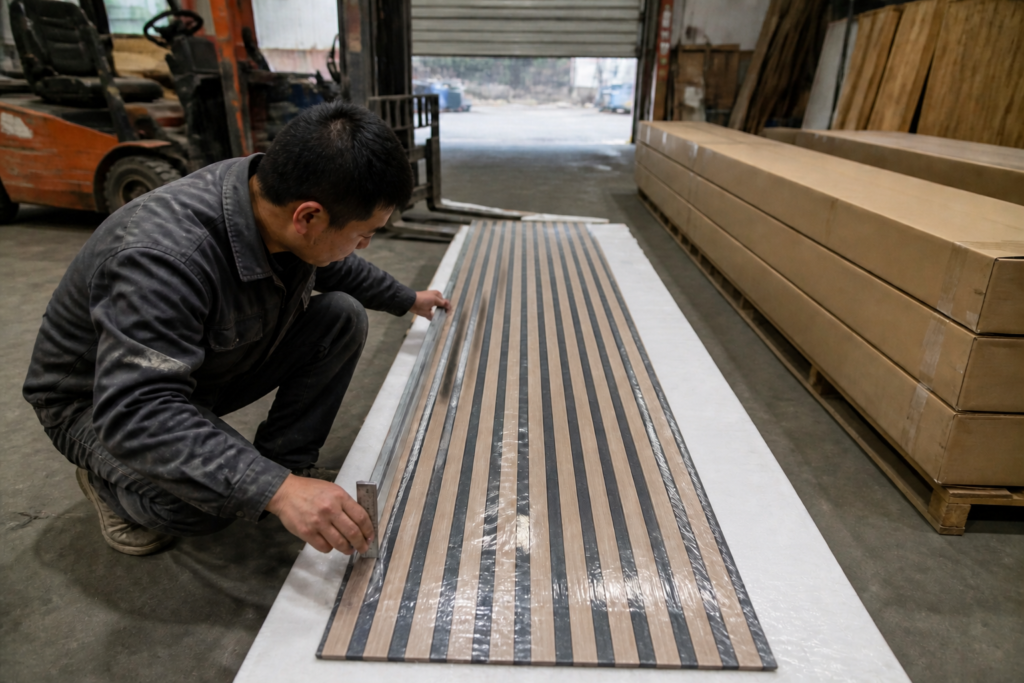
The delivery note in front of me asks for one thing: a signature. The cartons are intact, the count matches, the stretch film is unmarked, and the driver has another drop to make. Nothing on that sheet records whether the boards inside are straight. Once I sign, the panels are mine, and a bowed board cannot be straightened later by an installer who is already booked for Monday. The claim window starts closing the moment the goods leave my yard.
So I stopped treating flatness as something I would discover during installation. I measure it on the warehouse floor, with the pallet labels still attached, before the delivery note is signed. What follows is the sequence I use, what I measure with, how I separate a factory issue from a container issue, how I document a claim that survives an argument, and the sentence I now write into every purchase order so the argument does not happen again.
The product this applies to is the frameless full board: roughly 0.6 m wide by 2.6 m long, regular rectangular slats running continuously from one end to the other, bonded to continuous black PET felt, finished face covered with a transparent protective film. No L-shaped corner returns, no slat interruptions, no WPC cavity. That geometry is exactly why flatness has to be verified rather than assumed.
1. Why Does a Small Bow Matter More on a 2.6 m Full Board Than on a Sample?
Problem: The sample arrived flat, so I assumed the bulk order would be flat too. On a full-height board, a deviation I would have ignored on a 300 mm offcut becomes a visible shadow line running the whole height of the room.
Agitation / Answer: A frameless 0.6 × 2.6 m board has no frame to resist a curve, and its continuous slats give the eye an unbroken line to follow. A deviation that hides on a sample becomes a wavy joint and an uneven cavity on the wall, so I judge flatness on full boards against a written number.

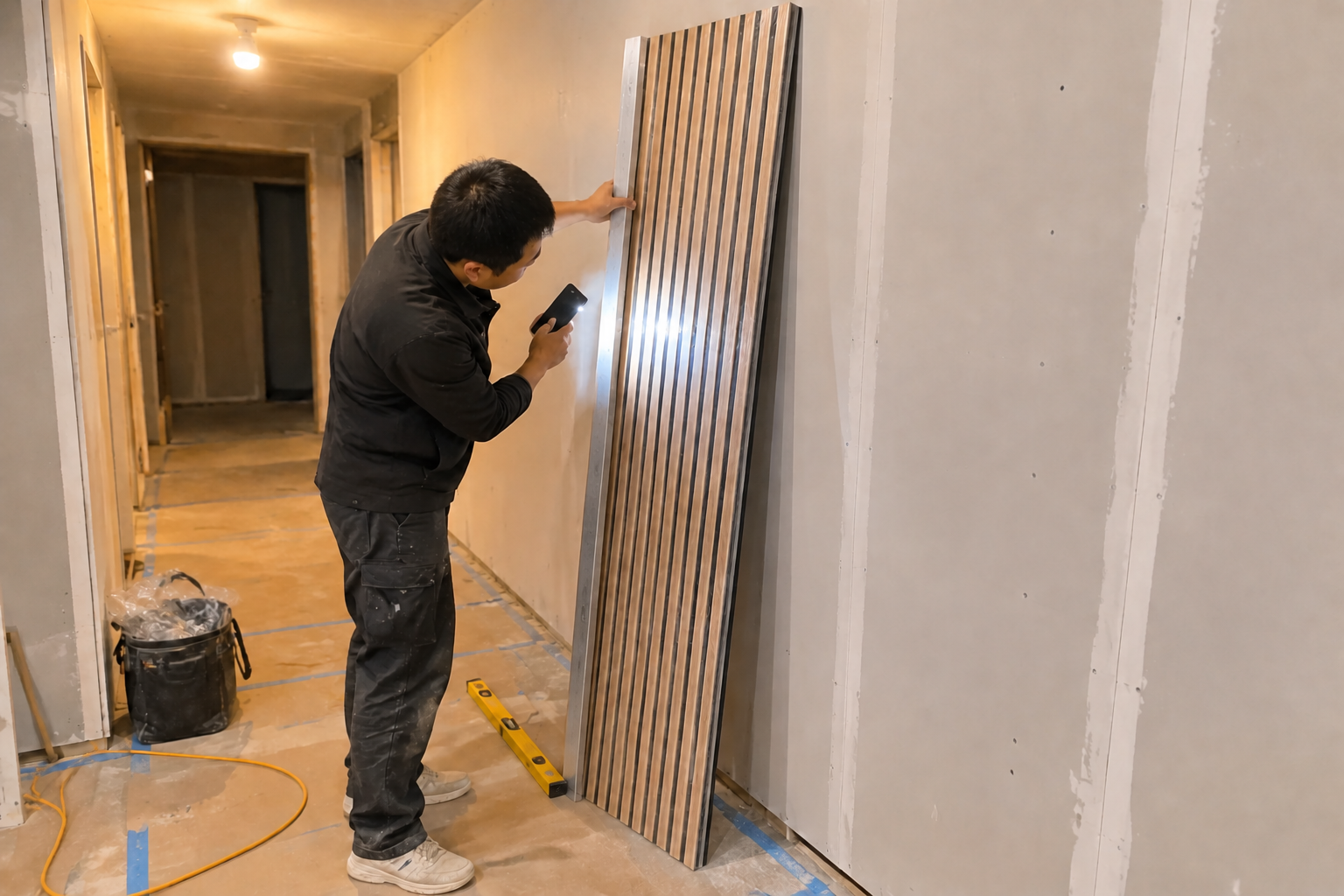
A frameless board roughly 0.6 m wide and 2.6 m long gives a bow nowhere to hide. Its slats run continuously from one end to the other, bonded to continuous black PET felt, with a transparent protective film over the finished face. There is no frame, no L-shaped return, and no break in the slat line. That is what makes it fast to install, and why nothing in it can pull a deviation straight: a frame resists a curve, continuous felt follows one.
A bow that looks minor on a table becomes obvious on a wall. The eye tracks a continuous slat for the full height of the room, so a deviation at mid-span reads as a shadow band, and the joint to the next board stops running parallel. An installer can close a small gap with pressure; he cannot remove a wave from an unbroken 2.6 m line. The rules for planning joints, edges, and cutouts assume boards that sit flat before fixing starts.
Flatness also sits underneath the acoustic claim. Absorption coefficients are measured in a laboratory under a defined mounting, and ASTM C423 warns that measured values must be applied with caution because practical areas and sound fields differ from the test room.1 ISO 11654 then rates absorption from laboratory data into classes.2 Neither tells you what a bowed wall will do. A bowed board leaves an uneven cavity behind it and an uncontrolled perimeter gap, so the wall you build is not the assembly that was tested.
I treat flatness as a purchasing characteristic with a number attached, not an installation detail. My notes on choosing wood slat acoustic panels for bulk orders cover the rest of the specification.
2. How Do I Measure Bow on an Incoming Board Without a Lab?
Problem: I have a tape measure, a concrete floor, and forty minutes before the driver leaves. I do not have a granite table, a profile projector, or a metrology team, and the supplier’s inspection report describes a board I have never seen.
Agitation / Answer: Flatness can be measured with a straight edge, a steel rule, and a flat floor, provided the method is fixed before anyone argues. I measure the concave face up, along the 2.6 m length and across the 0.6 m width, check twist and diagonals, and photograph every reading with the board label in frame.
I work on the flattest surface available: a level concrete slab or a long pallet deck, never gravel, a truck bed, or a stack of cartons. I lift boards from the top, middle, and bottom of each pallet, and from the first and last pallet unloaded, so a single bad layer cannot hide. The board goes down concave face up, the worst case and the one that matters on a wall.
For the reading I use a straight aluminium edge of at least 2.6 m, otherwise a taut string line with a steel rule. I place it along the length, find the largest gap at mid-span, and record that worst number rather than an average. I repeat it across the 0.6 m width, because a board can be straight one way and cupped the other. Then I stand the board on its long edge and sight down the slat line.
Twist and squareness need two more checks. Pressing alternate corners on a flat floor shows a rocking, twisted board even when the straight edge looks acceptable. Comparing corner-to-corner diagonals shows squareness: equal diagonals mean a true rectangle, while a difference means the board is out of square and its joints will open progressively along a run. Film wrinkles are not bow, and I never measure to the film.
Every reading goes onto one line of a sheet: board label, pallet position, gap at mid-span, gap across width, twist, diagonal difference, ambient conditions, time. I photograph the rule inside the frame so the number is visible without explanation, and compare it only with the figure already in my purchase order or approved drawing. I do not invent an acceptance value on the warehouse floor.
3. What Causes Bow Between the Factory and My Site, and How Do I Tell Which One It Is?
Problem: The supplier says the boards left the factory flat, my site manager says they arrived curved, and the warehouse says nothing changed on their watch. Everyone has a plausible story and nobody has a measurement taken at the right moment.
Agitation / Answer: Wood moves as it reaches moisture equilibrium with the air around it, and a board with wood on one face and PET felt on the other responds unevenly. Container heat, condensation, and a week leaning against a site wall all bend a straight board, so I measure at unpacking and again after storage to locate the cause.
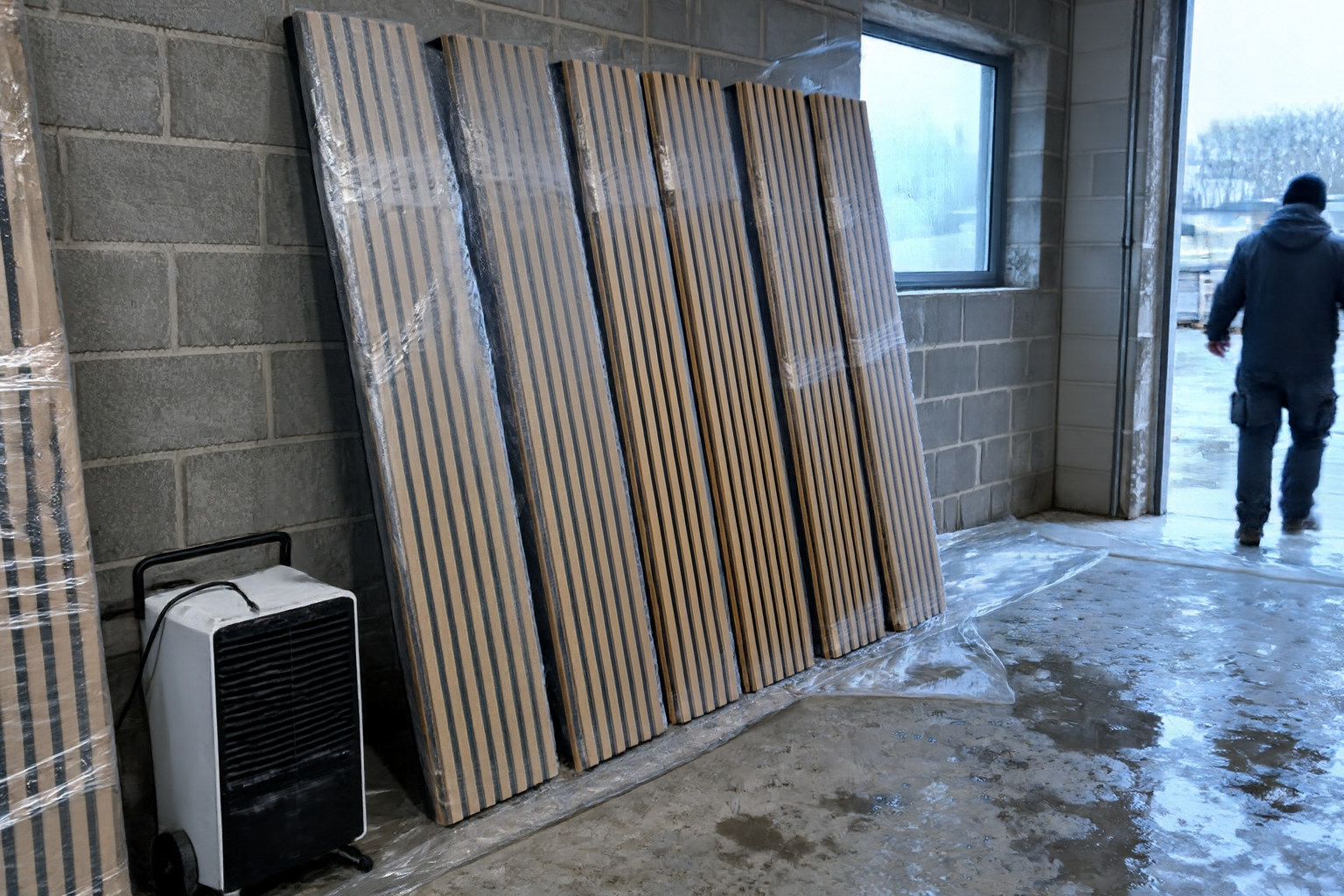
The USDA Forest Products Laboratory notes that wood comes to equilibrium with the humidity of the air around it, that correct drying, handling, and storage minimise later changes, and that protective coatings retard dimensional change but do not prevent it.3 That is the mechanism behind most bow after the factory gate. The board is also asymmetric: wood slats on the face, continuous black PET felt on the back, film on the finished side. The faces take up and release moisture at different rates, so the board cups toward the drier face.
A container adds three more. Heat builds by day and falls at night, so air cycles and condenses on cooler surfaces, and loading in a humid port leaves that moisture in the box for the voyage. Exposed core edges and slat ends absorb it first, which is why edges cup before the centre.
Storage is the third cause, and the most common. Panels leaned against an unconditioned wall for a week bend under their own weight across 2.6 m, as do boards laid on a damp slab or on bearers spaced so widely the middle sags.
To separate the causes I measure in the first hours of unpacking, with bands on, and again after storage. If every board in a pallet bows the same way, the history goes back to packing or the voyage. If scattered boards bow while neighbours in the same layer are straight, handling is more likely. If boards were straight at unpacking and curved three days later, the site did it. A pin meter on exposed core edges, read against a board kept sealed in its original film, shows whether moisture is moving. Panels for humid interiors need this permanently, so the guidance on wood acoustic panels in humid interiors sits with my receiving sheet.
4. How Should I Document a Flatness Claim So It Cannot Be Argued Away?
Problem: My first claim came back rejected. The photographs had no scale, the boards had already been cut and partly installed, and the reply was a single line saying the goods had left the factory in good condition.
Agitation / Answer: A claim survives on timing, scale, and quantity. I keep disputed boards uncut and in their original packing, photograph label, straight edge, and rule in one continuous sequence, count exactly how many boards of how many are affected, and state the remedy I want inside the claim window.
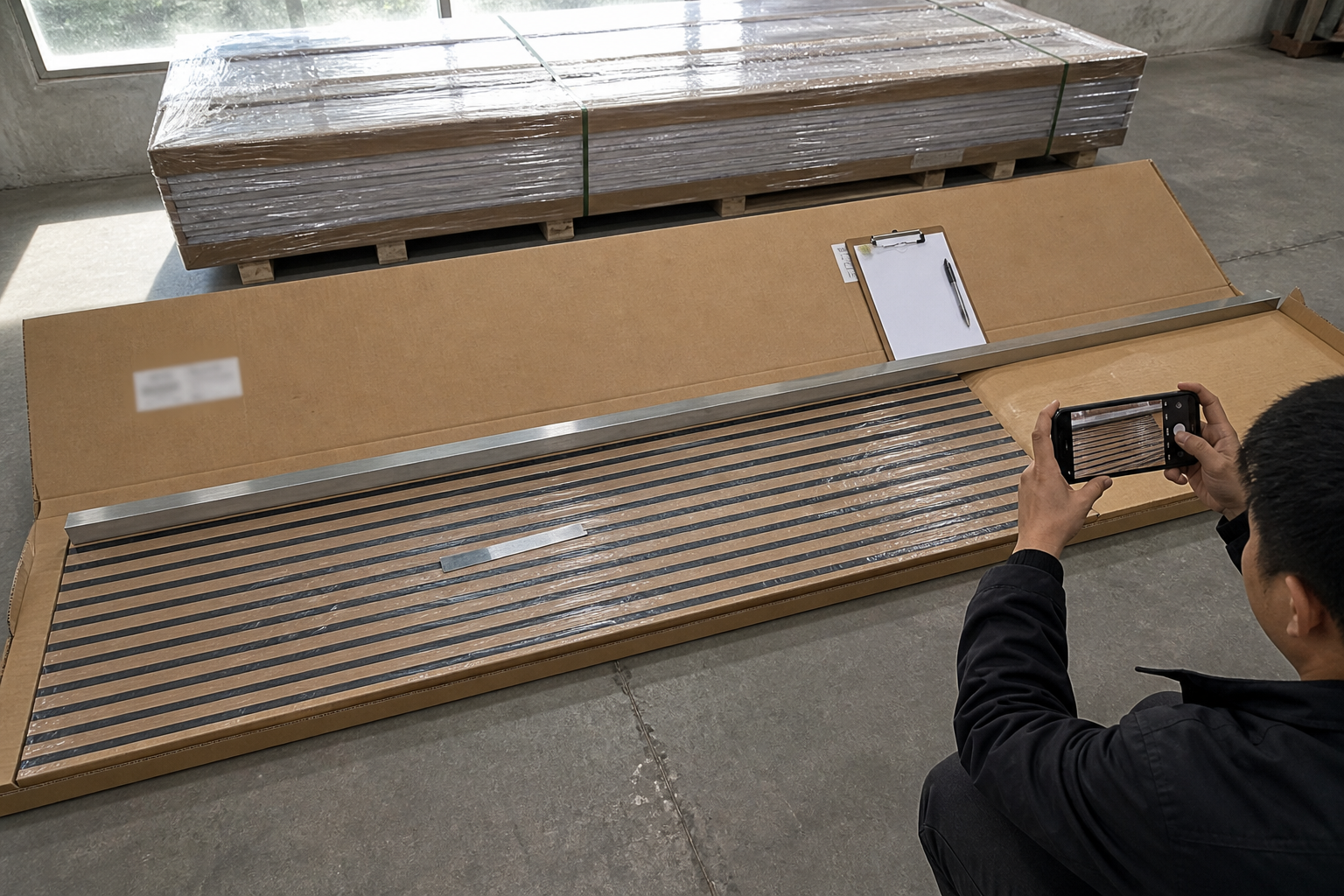
The first rule: disputed boards are not cut, drilled, or installed. Once a board is trimmed, the discussion shifts from the product to my workmanship, and no photograph recovers it. Boards stay in their original cartons with labels and pallet positions intact.
The second rule is a photo sequence that stands alone. A wide shot shows the pallet label and the whole board. A mid shot shows the straight edge in contact at both ends. A close-up shows the steel rule at the point of maximum gap, with the board label legible in the same frame. Three images, one board, plus the same board re-measured after twenty-four hours to show whether the shape is stable or moving.
The third rule is quantity. “The panels are bent” is an opinion; “eleven of sixty boards, all from pallets three and four, with the rest of the consignment straight” is a claim a factory can act on, because it points at a production window or a loading position.
I keep three categories apart: dimensional deviation, transit damage such as crushed edges or fork damage, and surface or film damage. Each needs a different remedy; mixing them lets a supplier answer the easiest one and ignore the rest.
Then I write, inside the claim window in the purchase order, with the sheet and photographs attached, naming what I want: replacement boards from a matched batch, a credit, or a technician on site. A specific request gets a specific answer. If the quantity justifies it, I use a third-party inspector while the boards are laid out, and keep two representative boards aside. The same discipline applies when I read an acoustic panel test report: both depend on knowing what was measured. For the wider due-diligence picture, compare my notes on verifying a wood panel supplier.
5. How Do I Write Flatness Into the Next Purchase Order So This Does Not Repeat?
Problem: My previous order said “flat panels, good quality.” Nothing in it could be measured, so nothing in it could be enforced, and the factory was not wrong to read it loosely.
Agitation / Answer: Flatness becomes enforceable when the order states a maximum deviation, the direction of measurement, the surface, the moisture condition, and how many boards are checked. I write the method and sampling plan into the order, add packing and loading requirements, and label batches so any recurrence points back to a production run.

One sentence replaces “flat”: a maximum deviation over the 2.6 m length and across the 0.6 m width, measured with a straight edge on a flat surface, concave face up. Concave-up and concave-down give different numbers, so the direction is part of the specification.
The moisture condition belongs in the same clause. A deviation limit without a moisture content range is not a limit: a dry board and a damp board of the same build will not measure alike. I ask the factory to record moisture content at packing and measure it on arrival with the same kind of meter.
Then the sampling plan: how many boards per pallet, how many per container, and a full visual pass over everything.
Packing and loading come next. Boards stacked flat on bearers at a stated spacing, edge protection on the corners, film left intact, a moisture barrier for humid routes, and no long unsupported spans in the container. I ask for pre-shipment photographs of a straight edge on two or three boards per batch, with the batch label visible, and a batch code on every board so a later problem traces to a run instead of a conversation.
Two exclusions go in as well: damage caused after unloading, and storage conditions on site. If I want a supplier to accept responsibility for a bowed delivery, I cannot leave my own storage undefined. The same logic governs the rest of the commercial file, so the checklist for evaluating an acoustic panel manufacturer sits beside this clause rather than replacing it. Where certified material is required, I verify the certificate code and scope in the issuing body’s public database rather than accepting a logo on a brochure.4
References
- ASTM International, ASTM C423-17: Standard Test Method for Sound Absorption and Sound Absorption Coefficients by the Reverberation Room Method. ↩
- International Organization for Standardization, ISO 11654:1997: Acoustics — Sound absorbers for use in buildings — Rating of sound absorption. ↩
- USDA Forest Service, Forest Products Laboratory, Drying and control of moisture content and dimensional changes, Wood Handbook chapter, FPL-GTR-113. ↩
- Forest Stewardship Council, What is forest certification. ↩
Frequently Asked Questions
1. How much bow is acceptable on a wood slat acoustic panel?
There is no universal figure I can quote for you. The acceptable deviation is whatever your signed purchase order or approved drawing states, measured by the method written beside it. If the order says only “flat,” agree a number before production rather than after delivery.
2. Can a bowed panel be pulled flat during installation?
Partly, with additional fixings, but the load goes into the felt and the fixings, and the curve often telegraphs through the face. That decision belongs before installation, not after. Disputed boards should stay untouched until the claim is settled.
3. Should panels be stored flat or stood on edge on site?
Flat, on dry bearers, on a level surface, out of direct sun and away from wet trades. Leaning a 2.6 m board against a wall for a week is the most common way a straight delivery becomes a curved one.
4. Does the transparent protective film keep the board straight?
No. It protects the finished face and adds no stiffness. Leaving it on in direct sun can trap moisture against the surface, and wrinkles in the film should never be read as bow.
5. Does bow change the acoustic performance?
The published rating comes from a laboratory mounting, not from your wall. A bowed board changes the cavity behind it and the perimeter gap, so the installed assembly is no longer the tested one. Fix flatness before you rely on the number.
CTA
If you are preparing a bulk order, send me your drawing, panel quantity, destination port, and the delivery date you are working to. I will come back with a measurable flatness clause, a packing and loading requirement, and a one-page receiving sheet your site team can fill in at the container, so the signature at the bottom of the delivery note stops being a guess. Start from the wooden slat acoustic panel specification and we will build the acceptance terms around it.