


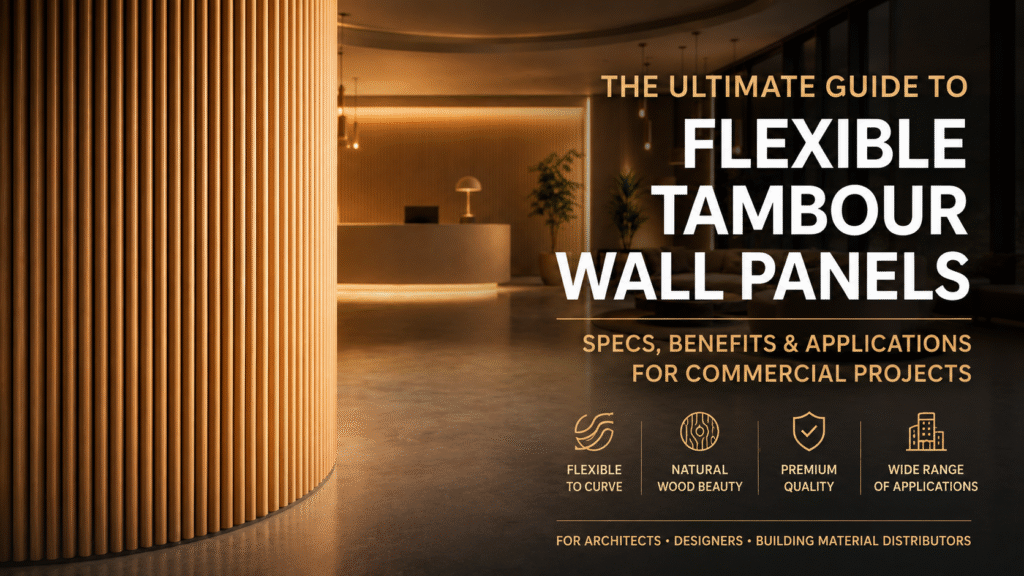
Many commercial interior designers and building material distributors struggle to find decorative wall coverings that combine high-end natural wood aesthetics with the flexibility needed to wrap around curved architectural surfaces smoothly.
A tambour wall panel is a flexible decorative cladding system made of individual full half-round cylindrical wood slats mounted onto a kerf-cut MDF board. The precisely spaced kerf cuts on the back of the MDF allow the entire panel to bend and wrap seamlessly around curved walls, columns, reception desks, and furniture without cracking or splitting.


flexible tambour wall panel — natural maple and black walnut half-round profiles
I have seen countless commercial projects where traditional rigid panels failed on curved columns, but switching to a flexible tambour wall panel saved both installation time and material costs. Let us explore how these innovative panels are manufactured, their core B2B advantages, and how global distributors can choose a reliable tambour panel manufacturer.
How Tambour Wall Panels Are Made?
Distributors and procurement managers often worry about the structural integrity of flexible wood tambour panel shipments, especially when dealing with moisture-sensitive commercial projects in humid climates.
A premium wood tambour panel is manufactured by precision-CNC-routing full half-round cylindrical slats from solid wood or high-density MDF, bonding them tightly side by side onto a rigid MDF board, then cutting evenly spaced kerf slots into the back of the board to create controlled flexibility that allows the panel to bend around curved surfaces.
The result is a product that is structurally rigid when flat, yet can flex smoothly around columns and curved walls on-site without any additional cutting or custom millwork. The table below outlines the key manufacturing specifications that B2B buyers should verify when sourcing from a tambour panel manufacturer:
| Specification | Details |
|---|---|
| Slat Profile | Full half-round (semicircle cross-section), CNC-routed |
| Slat Diameter | 15mm – 25mm per slat (varies by SKU) |
| Core Board | CARB P2 compliant MDF, 9mm – 12mm thickness |
| Flexibility Mechanism | Precision kerf cuts on the back of MDF board |
| Available Wood Species | White Oak, Black Walnut, Maple, Beech, Custom Veneer |
| Standard Panel Size | 2440mm × 122mm (custom sizes available) |
| Surface Finish | Unfinished, UV lacquer, custom stain, natural oil |
Benefits Of Flexible Tambour Panels?
Architects and contractors often hesitate to specify decorative tambour panel products because they assume curved surface applications require expensive custom millwork or complex on-site fabrication.
The primary benefit of a flexible tambour panel is that the kerf-cut MDF backing allows the entire panel to bend both concave and convex around any curved architectural surface — columns, reception desks, curved walls, and furniture edges — while maintaining perfectly even slat spacing and a seamless, joint-free appearance.
By choosing high-quality flexible tambour wall panels from a certified manufacturer, commercial projects gain several critical advantages:
| Benefit | Traditional Rigid Panels | Flexible Tambour Wall Panel |
|---|---|---|
| Curved Surface Application | Requires expensive custom millwork | Bends on-site, no extra fabrication |
| Slat Spacing Consistency | Inconsistent when forced to curve | Perfectly even spacing maintained |
| Installation Speed | Slow, complex substrate framing | Fast adhesive + brad nail application |
| Visual Continuity | Visible joints on curves | Seamless wrap, no visible seams |
| B2B Margin Potential | Low (commodity product) | High (premium architectural product) |
Applications Of Tambour Wall Panels?
Many commercial procurement managers struggle to visualize how a single product line of decorative tambour panel sheets can serve multiple design intents across diverse high-end commercial spaces.
A flexible wood tambour panel is the ideal solution for wrapping luxury hotel lobby columns, cladding curved reception desks, creating bold feature walls in modern offices, and finishing the sides of high-end kitchen islands — anywhere that demands the warmth of natural wood combined with the ability to follow a curved form.

tambour panels for curved walls — white oak half-round profile wrapping a lobby column
The most common commercial applications of tambour wall cladding in B2B projects are as follows:
- Tambour Panels for Hotels: Perfect for luxury lobby accent walls, curved reception counters, and elevator cab interiors. The bold half-round profiles cast strong shadow lines that add visual depth and a sculptural quality to any space.
- Tambour Panels for Offices: Ideal for executive boardrooms, conference room feature walls, and curved partition wraps. The natural wood grain creates a warm, premium atmosphere that flat painted walls cannot achieve.
- Tambour Panels for Curved Walls and Columns: The kerf-cut MDF backing allows the panel to wrap structural columns as tight as a 150mm radius, eliminating the need for custom-fabricated curved millwork entirely.

tambour wall covering — black walnut half-round profile on a kitchen island
Tambour Panel vs Traditional Wall Panels?
Many B2B buyers find it difficult to justify the cost of decorative tambour panel inventory when compared to cheaper traditional flat panels or standard fluted panels that look superficially similar.
The key difference between a tambour wall panel and a standard fluted panel is structural: fluted panels are rigid boards with grooves routed into the surface, while tambour panels feature individually rounded half-round slats on a kerf-cut flexible board, giving them a fully three-dimensional sculptural profile and the ability to bend around curved surfaces.
| Feature | Flexible Tambour Wall Panel | Standard Fluted Panel | Traditional Flat Panel |
|---|---|---|---|
| Slat Profile | Full half-round (3D sculptural) | V-groove or U-groove (2.5D) | Flat surface (2D) |
| Flexibility | Bends around curves | Rigid, flat only | Rigid, flat only |
| Shadow & Depth | Strong, dramatic shadow lines | Moderate groove shadows | No shadow effect |
| Installation on Columns | Seamless wrap | Requires kerfing or cutting | Not possible |
| Price Positioning | Premium architectural product | Mid-range commodity | Low-cost commodity |
How To Choose A Tambour Panel Manufacturer?
Sourcing from an unreliable tambour panel manufacturer often leads to critical issues: delaminating slats, inconsistent half-round profiles, warped MDF boards, and delayed shipments that derail commercial project schedules.
A reliable tambour panel manufacturer must use CARB P2 certified MDF cores, apply precision CNC routing for consistent half-round slat profiles, use high-strength adhesive bonding between slats and board, and offer full customization of wood species, slat diameter, panel dimensions, and surface finish for commercial projects.
When evaluating a potential B2B partner for your custom tambour panels inventory, I recommend verifying the following capabilities before placing a bulk order:
- CNC Precision: Ask for tolerance specifications on slat diameter and spacing. Inconsistent slat sizing creates uneven shadow lines that are immediately visible after installation.
- MDF Board Quality: Confirm the MDF is CARB P2 compliant and moisture-resistant grade, especially for projects in humid climates like the Middle East, Southeast Asia, or coastal regions.
- Kerf Cut Engineering: The depth and spacing of kerf cuts on the back of the board determine the minimum bend radius. A professional manufacturer should be able to provide the exact minimum bend radius for each panel SKU.
- Finish Consistency: Request a physical sample batch to verify that the surface finish (lacquer, oil, or stain) is consistent across the full panel length before approving a production run.
FAQ
Q1: What is the minimum bend radius for a flexible tambour wall panel?
The minimum bend radius depends on the MDF board thickness and kerf cut spacing. A standard 9mm MDF tambour board with precision kerf cuts can typically achieve a minimum bend radius of approximately 150mm, making it suitable for most commercial column and reception desk applications.
Q2: What is the difference between a tambour panel and a fluted panel?
A fluted panel is a rigid board with grooves routed into its flat surface, suitable only for flat walls. A tambour wall panel features individually bonded full half-round cylindrical slats on a kerf-cut MDF board, providing a fully three-dimensional profile and the flexibility to wrap curved surfaces [1].
Q3: Can tambour panels be used on ceilings?
Yes. Because the MDF board is lightweight and the panel dimensions are manageable, tambour panels can be installed on flat or vaulted ceilings using high-tack construction adhesive and brad nails. The vertical shadow lines created by the half-round slats add dramatic visual depth to ceiling applications.
Q4: What wood species are available for custom tambour panels?
The most popular species for commercial projects are White Oak (light, neutral grain), Black Walnut (rich dark brown), Maple (very light, almost white), and Beech (warm mid-tone). Custom veneer wrapping over MDF slats is also available for projects requiring specific color matching [2].
Q5: How are tambour panels shipped for international B2B orders?
Tambour panels are typically packed flat in wooden crates with foam corner protection. Because the panels are flexible, they can also be carefully rolled for container shipment, which significantly reduces packaging volume and freight costs for large wholesale orders.
Conclusion
Flexible tambour wall panels — with their bold half-round profiles, kerf-cut MDF flexibility, and premium wood species options — give global distributors and commercial contractors the most versatile decorative cladding solution available for curved architectural surfaces today.
References
- [1] World Panel Products, Solid Wood Tambour Panels Product Catalog
- [2] Woody Walls, What Is Tambour Wood? – The Ultimate Overview