


Acoustic panels do not have a single universal certification checklist. What you need depends on the destination market, the intended application, the panel construction and the project specification. Buyers selling into the EU commonly look for CE documentation, while SGS-issued test reports, FSC chain-of-custody claims and reports based on applicable ASTM standards answer different questions. Define where the panels will be sold and how they will be used first, then request evidence whose scope covers the exact model on the order. Buyers sourcing wood slat acoustic panels should match each document to the specific risk it addresses.
Acoustic panels do not have one universal certification checklist. Buyers should identify where the panels will be sold, how they will be used, and what materials they contain. They can then request market-relevant evidence, such as CE documentation, SGS-issued reports, FSC sourcing claims, or reports based on applicable ASTM standards.
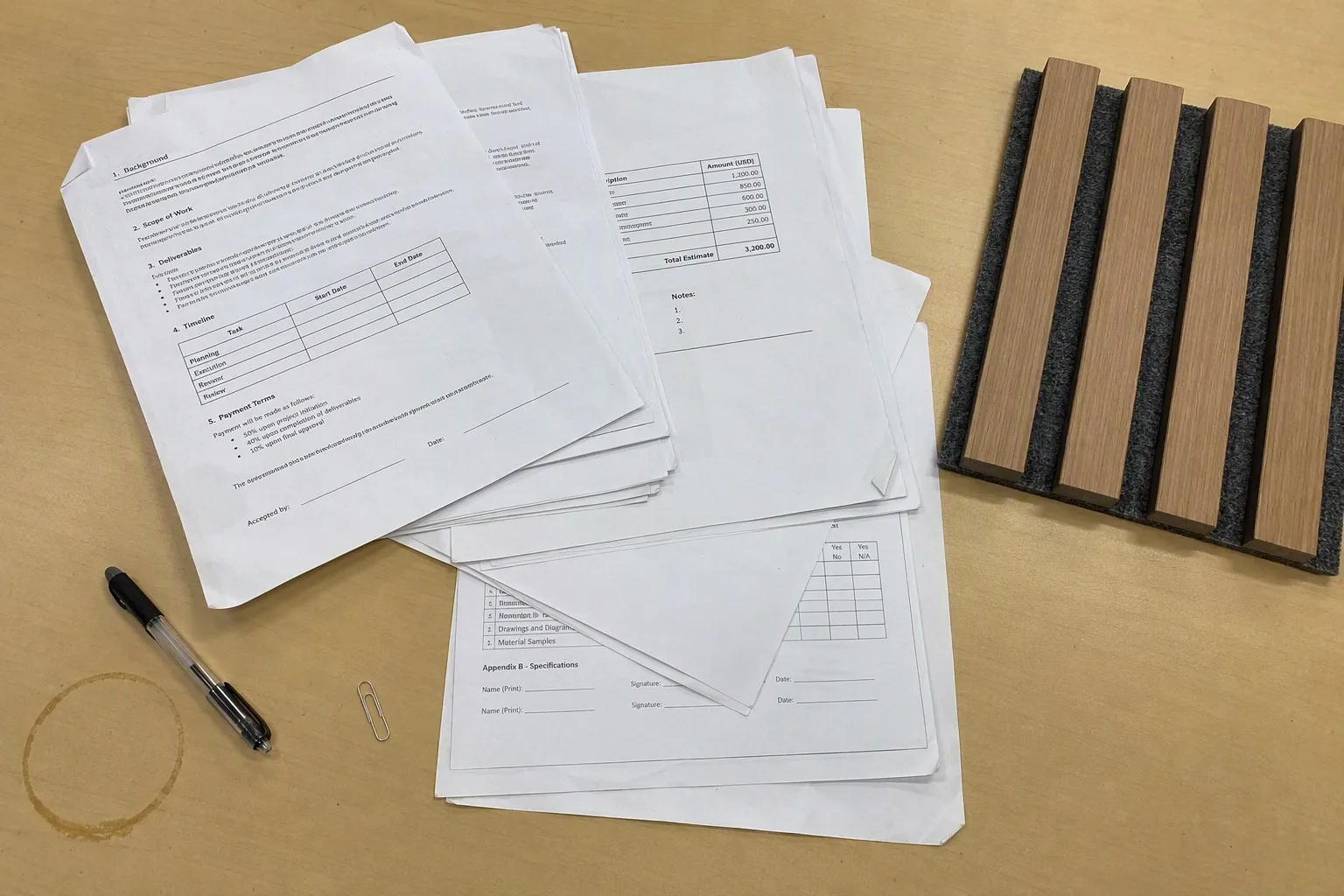
I have handled document inquiries from importers, distributors, and wholesalers in many markets. The most effective buyers do not collect certification logos for marketing purposes. Instead, they match each document to a specific regulatory, performance, sourcing, or procurement risk.
Which Acoustic Panel Certifications Do Buyers Actually Need?
Buyers often ask me for “all available certificates” before they have explained the destination or application. This approach sounds cautious, but it can create more uncertainty. A large document package is not useful when the reports do not cover the ordered panel or the requirements of the target market.
The acoustic panel certifications a buyer needs depend on four factors: the destination market, intended application, product construction, and project specifications. Buyers should define these factors first, identify what must be demonstrated, and then request evidence with a scope that matches the exact panel model being purchased.


Start with the destination market
When a buyer asks, “What certifications do I need?”, my first question is usually, “Which country or region will receive the panels?”
The answer affects the review process. A document commonly requested for a European distribution program may not answer the questions raised by a North American contractor. Likewise, a private commercial project may have submittal requirements that go beyond general market-access documents.
I encourage buyers to define the following before approaching suppliers:
- Destination country or region
- Importing entity and sales channel
- Residential or commercial application
- Wall, ceiling, furniture, or decorative installation
- New construction or renovation
- Project-specific fire, acoustic, or environmental criteria
- Exact panel materials and assembly
Local building codes, customs procedures, and product rules can change. I therefore suggest confirming application-specific requirements with a qualified compliance professional, code consultant, importer of record, or relevant local authority.
Match evidence to the risk
I treat document selection as a risk-matching process rather than a logo-collecting exercise.
| Procurement risk | Question to ask | Possible evidence to investigate |
|---|---|---|
| Market access | Can this product legally carry a required marking or declaration? | Applicable declaration, technical assessment, or regulatory documentation |
| Fire performance | How did the exact assembly perform under a relevant method? | Laboratory fire-test report |
| Acoustic performance | What absorption or transmission result was measured? | Acoustic test report with test method and specimen details |
| Responsible sourcing | Can a wood-based claim be supported through the supply chain? | Valid chain-of-custody information and claim documentation |
| Chemical or material concern | Were specified substances or emissions evaluated? | Test report identifying methods, limits, and samples |
| Project approval | Does the product meet the architect’s written specification? | Complete technical submittal reviewed by the project team |
Check the ordered construction
One importer once sent me a list containing CE, SGS, FSC, and ASTM as if they were four versions of the same quality certificate. I first asked where the panels would be sold. I then asked whether the ordered construction used MDF, plywood, solid wood, polyester felt, or another backing.
That information mattered because a report for one construction might not apply to another. For example, a slatted panel can vary in:
- Slat material and density
- Slat dimensions and spacing
- Veneer, paint, laminate, or coating
- Felt composition and thickness
- Adhesive system
- Overall panel thickness
- Mounting method
- Optional insulation installed behind the panel
A useful report should identify enough of these details to connect the tested specimen to the purchased product. I do not assume that a similar appearance means equivalent performance.
What Does CE Mean for Acoustic Panel Certifications?
Some buyers describe CE as a general quality certificate. That description can lead to incorrect expectations. CE marking has a specific regulatory role, and its applicability depends on the product, intended use, relevant European legislation, and the route used to assess the product.
CE marking is not a universal acoustic-panel quality award.1 It indicates that a manufacturer takes responsibility for a product’s conformity with applicable European Union requirements when CE marking legally applies. Buyers should verify the relevant legal framework, declared performance, assessment route, and exact product covered by the supporting documents.
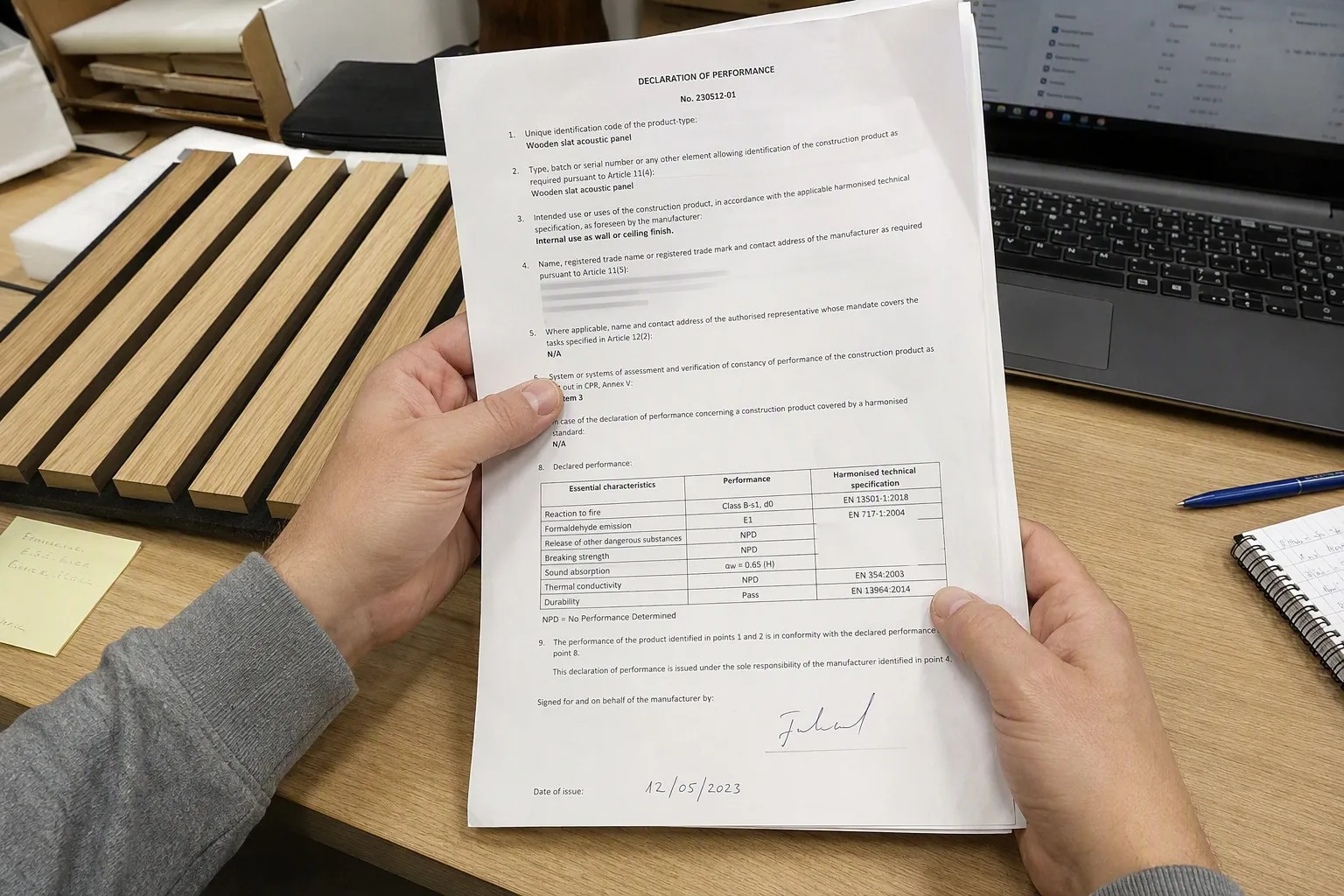
CE is a regulatory marking, not a laboratory brand
I explain CE to buyers as a market-conformity marking, not as proof that every aspect of a product has superior quality. The letters do not automatically tell a buyer:
- How much sound the panel absorbs
- Whether the finish is durable
- Whether the dimensions are consistent
- Whether the panel meets a particular project specification
- Whether the product will receive local building approval
- Whether customs will accept an incomplete shipment file
For construction products, the applicable process may depend on whether the product falls within the scope of a harmonised technical specification or another recognized assessment route. The manufacturer may need to prepare supporting technical documentation and, where applicable, a Declaration of Performance. The involvement of a notified body can vary according to the applicable assessment system.
Because product classification is technical and market-specific, I avoid telling a buyer that every acoustic wall panel automatically requires the same CE route. I recommend that buyers verify the position with an experienced European compliance professional.
What should buyers examine?
When a supplier provides CE-related documents, I suggest checking more than the logo. Buyers can review:
- Manufacturer’s legal name and address
- Product name, type, code, or model
- Declared intended use
- Applicable technical specification
- Declared characteristics or performance
- Date and authorized signature
- Notified-body information, if applicable
- Consistency between labels, invoices, cartons, and declarations
A generic PDF with a CE symbol should not end the review. The document needs to relate to the product in the purchase order.
Product changes require attention
A change in the product can affect the relevance of existing evidence. A buyer should ask for clarification when the order changes from:
- Standard MDF to fire-retardant MDF
- Polyester felt to another backing
- Natural veneer to painted or laminated slats
- One adhesive to another
- One thickness or density to a substantially different specification
At NF Decor, we organize available CE documentation as part of the buyer’s technical file, but I still ask the buyer to confirm whether the documentation satisfies the destination market and project. CE documents should be reviewed, not merely displayed.
Is SGS an Acoustic Panel Certification?
SGS is a familiar name in international procurement, so buyers sometimes request an “SGS certificate” without identifying what they want tested or inspected. This creates a vague requirement. A supplier may provide an SGS-issued document that is genuine but unrelated to the buyer’s actual concern.
SGS is a testing, inspection, and certification service provider, not a single acoustic panel certification.2 An SGS report may cover fire behavior, chemical substances, materials, inspection, or another defined scope. Buyers should read the report title, test method, sample description, results, dates, and issuing laboratory details.
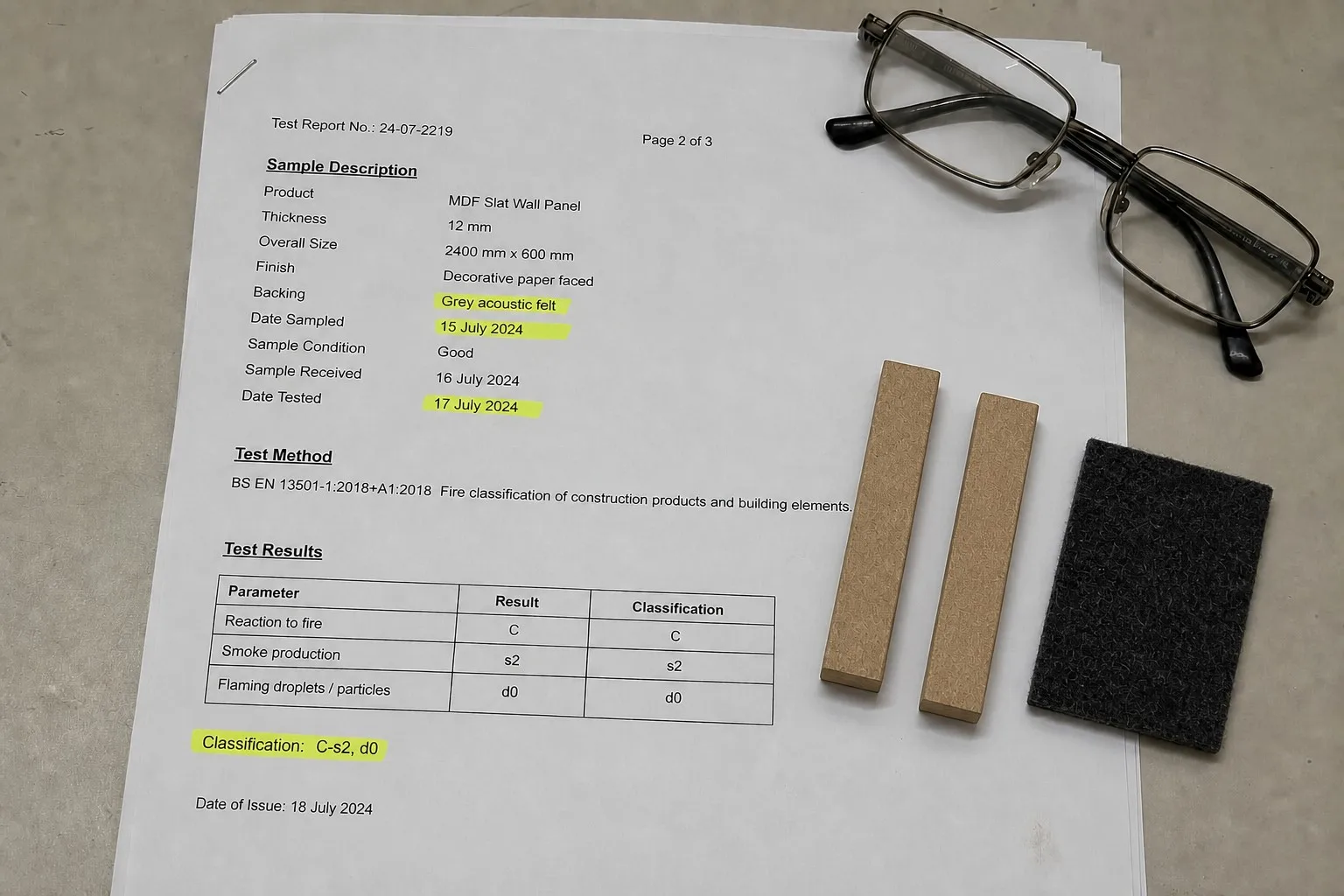
Ask what the SGS document demonstrates
The name of the issuing organization does not replace the technical content. I always ask buyers what risk they want an SGS document to address.
For example, they may want to investigate:
- Fire-test results
- Restricted substances
- Formaldehyde or other emissions
- Material composition
- Dimensional inspection
- Pre-shipment quantity checks
- Packaging condition
- Factory or social audits
- Product-specific performance
These activities do not produce interchangeable conclusions. A pre-shipment inspection report does not demonstrate fire performance. A chemical screening report does not prove sound absorption. A factory audit does not automatically cover every product leaving that factory.
Read the report from the inside out
I recommend reviewing an SGS report in the following order:
- Report title and purpose: What was evaluated?
- Applicant and manufacturer: Who requested the work, and where was the sample made?
- Sample description: What product, material, color, and model were submitted?
- Test standard or protocol: Which method was used?
- Results: What measurements or observations were recorded?
- Conclusion: Does the report state pass/fail, or does it only present data?
- Dates: When was the sample received, tested, and reported?
- Limitations: Does the report restrict reproduction or application to the tested sample?
- Verification features: Can the report number or digital signature be checked?
I never treat the SGS logo by itself as evidence that a panel meets every market or project requirement.
The sample may not match the shipment
This is one of the most important procurement issues. A report can accurately describe the tested sample while still being irrelevant to the current order.
Suppose the report covers a 12 mm MDF slat bonded to 9 mm polyester felt. The order may use a different MDF grade, slat thickness, coating, adhesive, or felt density. The buyer should ask whether those differences affect the claimed result and whether additional evaluation is needed.
I have seen buyers focus heavily on the issuing organization while overlooking the sample description. I usually bring the discussion back to the bill of materials. The report’s value depends on the match between what was tested and what will be delivered.
How Does FSC Relate to Acoustic Panel Certifications?
Wood sourcing has become an important procurement topic, especially for distributors serving environmentally conscious customers. However, buyers sometimes interpret FSC documentation as proof of acoustic performance, fire safety, or overall product quality. That interpretation gives the document a role it was not designed to perform.
FSC certification relates to responsible forest management and chain-of-custody controls for eligible forest-based materials and claims.3 It does not certify acoustic absorption, fire performance, or manufacturing quality. Buyers should verify the supplier’s certificate status, scope, product eligibility, claim, and transaction documents before marketing panels as FSC certified.
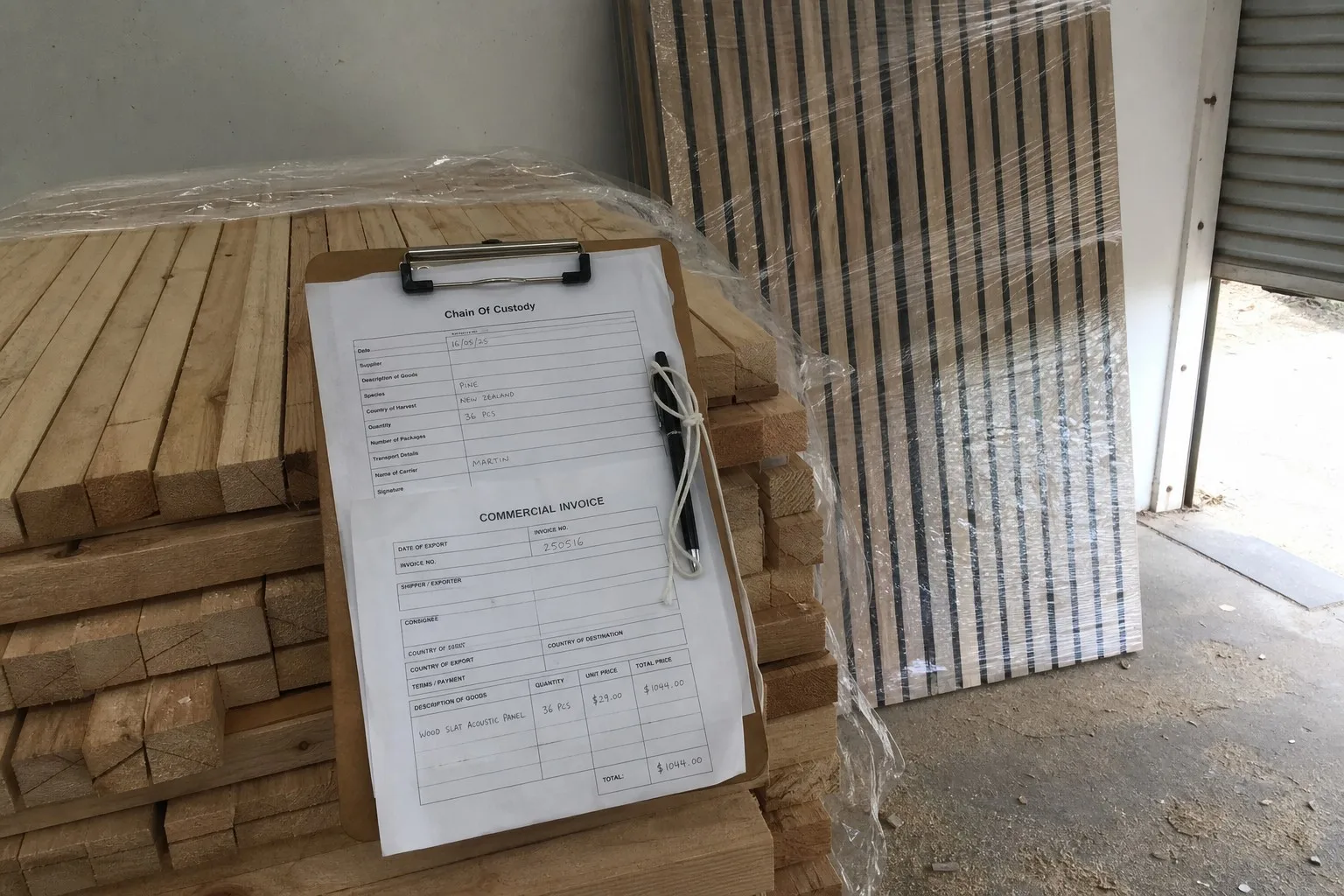
FSC addresses sourcing and traceability
I view FSC primarily through the lens of supply-chain claims. Its role differs from a fire test or acoustic measurement. For a wood slat acoustic panel, FSC may be relevant to eligible wood-based components and the way certified material moves through the supply chain.
A buyer should not assume that any company using some certified wood can apply an FSC claim to every finished panel. The certificate scope, sourcing category, chain-of-custody controls, labeling rules, and transaction claims all matter.
The buyer can review:
- Certificate holder’s legal name
- Certificate code and current status
- Validity dates
- Certified sites and activities
- Product groups within scope
- Claim shown on quotations and invoices
- Authorization for any on-product or promotional label
- Consistency between purchase and sales documents
Buyers can also check certificate status through the appropriate official FSC database or verification channel. I recommend doing this close to the order date rather than relying on an old certificate saved in a supplier presentation.
Clarify which components are covered
Acoustic wall panels are composite products. A typical design can include MDF or plywood slats, veneer, polyester felt, adhesive, coating, and packaging. An FSC-related claim may not mean that every component comes from a forest-based certified source.
Buyers should ask precise questions:
- Which wood-based component carries the claim?
- What claim will appear on the commercial invoice?
- Is the finished product included in the supplier’s certified scope?
- Can the claim be passed to the buyer?
- Does the buyer need its own chain-of-custody certification to resell with a specific claim?
- Are promotional uses of the trademark properly authorized?
I help buyers gather these documents, but I do not make independent certification decisions. The certification body or an FSC-qualified professional should answer questions about claim eligibility.
FSC does not replace manufacturing inspection
Responsible sourcing and manufacturing consistency are separate procurement concerns. Even when a claim is valid, buyers should still evaluate:
- Slat straightness and edge quality
- Veneer matching
- Color tolerance
- Felt density and appearance
- Adhesive coverage
- Panel dimensions
- Packaging strength
- Batch traceability
At NF Decor, our procurement conversations often cover both documentation and physical quality control. I keep those discussions separate because a sourcing claim cannot substitute for sample approval, production inspection, or agreed acceptance criteria.
Which ASTM Standards Support Acoustic Panel Certifications?
ASTM references can sound authoritative, but the phrase “ASTM certified” is often too vague for procurement. ASTM International develops voluntary consensus standards.4 A test laboratory may evaluate a product according to one of those standards, but ASTM itself is generally not acting as the product certifier.
ASTM standards define test methods, classifications, specifications, or practices. For acoustic panels, commonly discussed methods may address sound absorption, sound transmission, or surface-burning characteristics. Buyers should identify the exact ASTM designation, report edition, specimen construction, laboratory, mounting method, and project acceptance criteria.
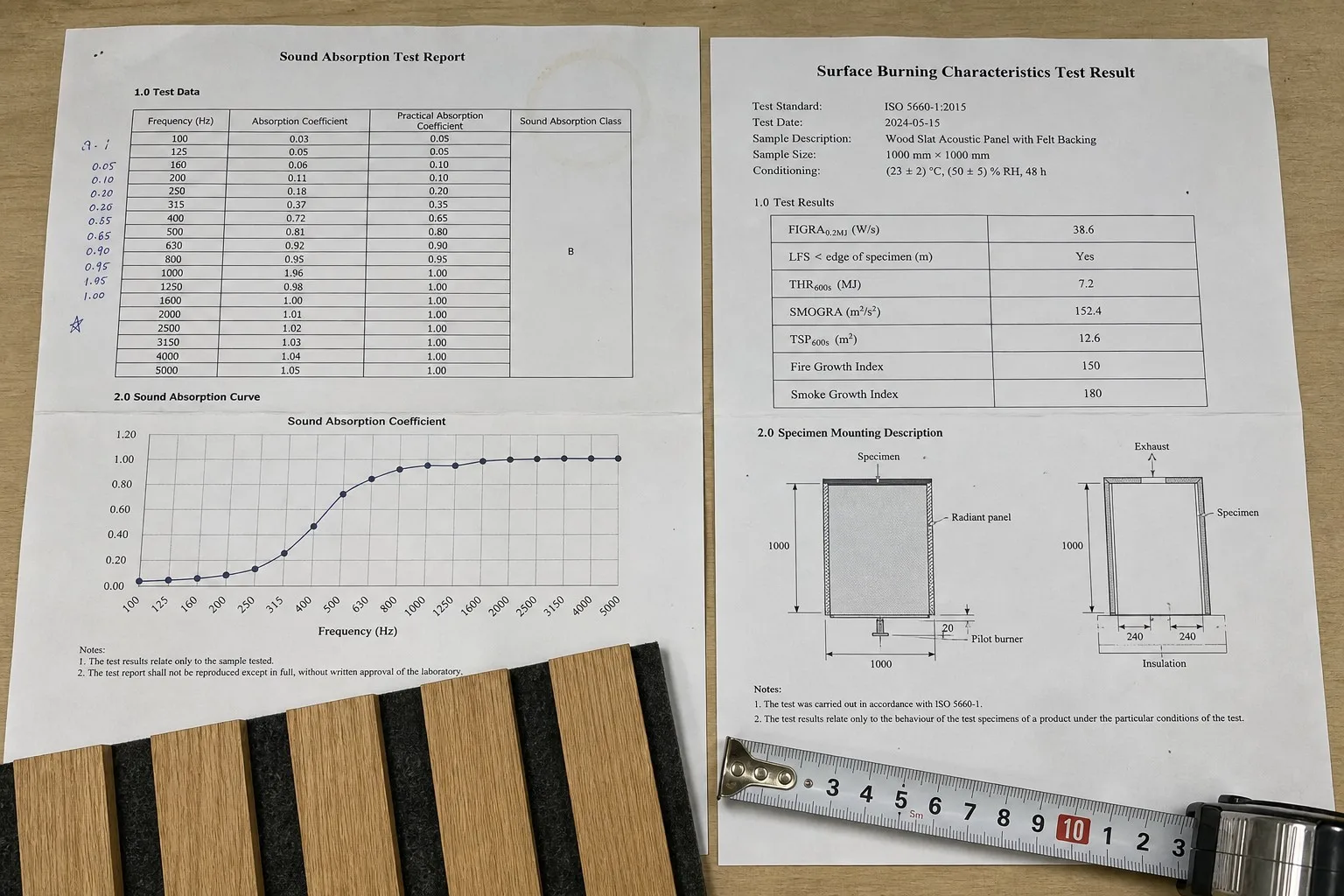
Common ASTM references serve different purposes
Several ASTM methods may appear in acoustic-panel procurement files. Their relevance depends on the intended application and project requirements.
| ASTM reference | General subject | Procurement question |
|---|---|---|
| [ASTM C423 | Sound absorption and sound absorption coefficients measured in a reverberation room](https://ntrs.nasa.gov/api/citations/20150023091/downloads/20150023091.pdf)%%%FOOTNOTE_REF_5%%% | How much incident sound did the tested assembly absorb under the stated mounting conditions? |
| [ASTM E90 | Laboratory measurement of airborne sound transmission loss through building partitions and elements](https://www.intertek.com/building/standards/astm-e-90/)%%%FOOTNOTE_REF_6%%% | How did a tested assembly reduce sound passing through it? |
| ASTM E413 | Classification of sound insulation ratings derived from transmission-loss data | What single-number rating was calculated from applicable data? |
| [ASTM E84 | Surface-burning characteristics of building materials](https://www.capitaltesting.org/astm-e84-surface-burning-laboratory-testing)%%%FOOTNOTE_REF_7%%% | What flame-spread and smoke-developed indices were reported under the test conditions? |
I do not treat these methods as interchangeable. Sound absorption is not the same as sound isolation. A decorative slat panel may reduce reflected sound within a room, but that does not automatically mean it will block noise transmission through a wall.
Mounting conditions can change acoustic results
An acoustic report should describe the tested installation. The same visible panel can produce different results when it is:
- Mounted directly against a rigid surface
- Installed over battens
- Installed with an air cavity
- Combined with mineral wool or another absorber
- Tested in a different thickness or coverage area
For this reason, I look for the complete frequency data and mounting description rather than relying only on one headline number. A Noise Reduction Coefficient, for example, provides a convenient single-number summary, but it does not show every frequency-specific result.8
Fire reports also need context
ASTM E84 is frequently discussed for North American projects, but buyers should not assume that one result automatically secures approval in every state, province, building type, or installation. Local codes and project documents determine how results are used.
A fire-test report should clearly identify:
- Slat and core materials
- Backing or felt
- Coatings and adhesives
- Specimen thickness
- Mounting and substrate
- Test date and laboratory
- Reported indices or classification
- Limitations on interpretation
A laboratory report based on an ASTM method is evidence of a test result under stated conditions. It is not a universal guarantee of code acceptance or real-world fire performance. I recommend review by the project’s architect, fire consultant, code professional, or authority having jurisdiction.
How Should Buyers Verify Acoustic Panel Certifications Before Ordering?
Certification files often arrive late in sourcing, sometimes after pricing and samples have already been approved. That sequence can expose buyers to avoidable risk. I prefer to discuss document requirements during quotation so the supplier can confirm product coverage before production materials are purchased.
Buyers should verify acoustic panel certifications by comparing every document with the destination, application, purchase specification, and actual panel construction. They should confirm the issuer, validity, scope, test method, model, materials, dimensions, and manufacturing site, then obtain qualified local review when regulatory or project acceptance is uncertain.
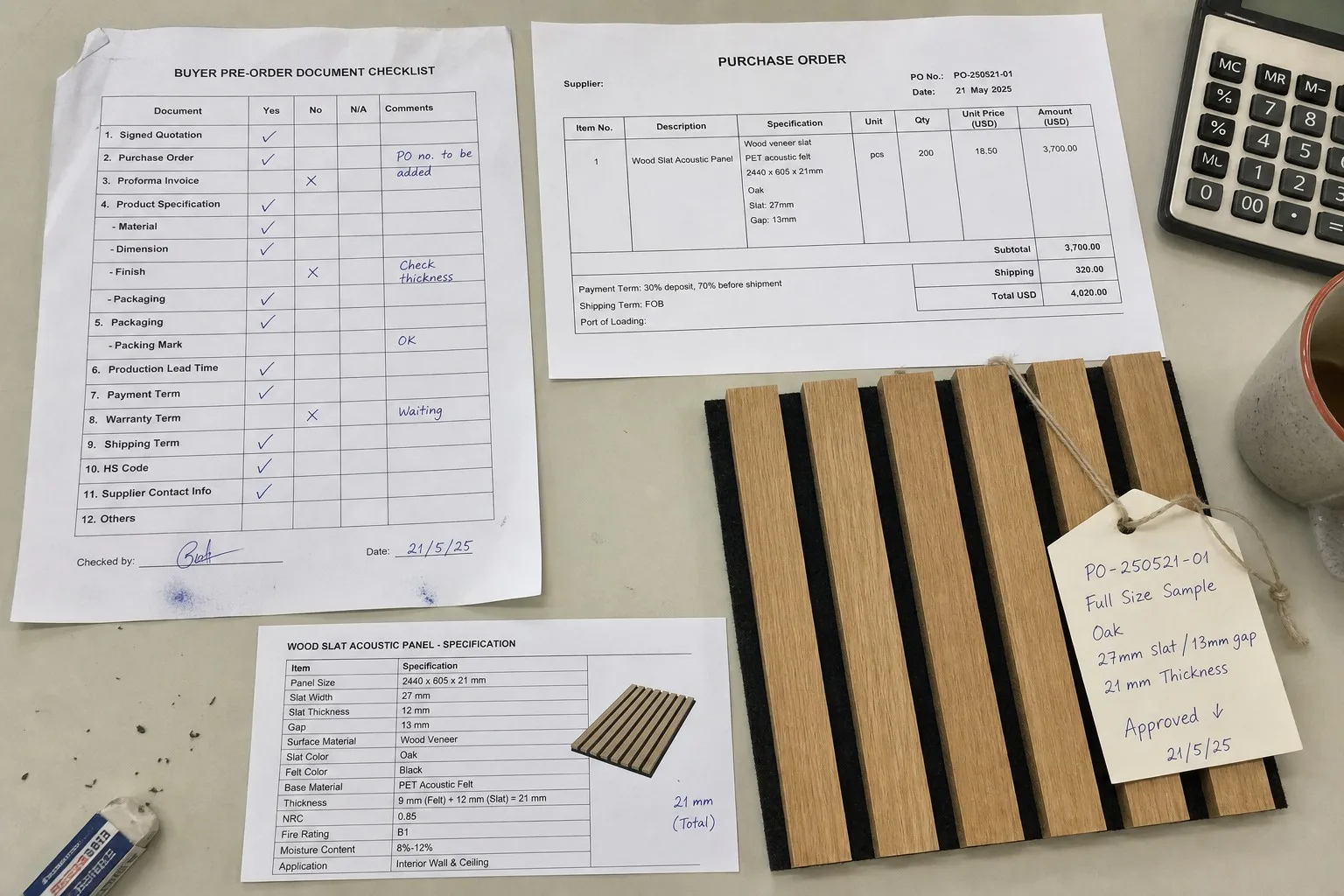
Use a four-stage review process
I use a simple sequence when helping buyers organize their requirements.
1. Define the market and use case
The buyer should record:
- Destination country
- Customer type
- Building type
- Wall or ceiling use
- Installation method
- Required claims
- Applicable project specification
2. Identify what must be demonstrated
The buyer can separate requirements into categories:
- Regulatory conformity
- Fire behavior
- Acoustic performance
- Responsible sourcing
- Chemical or emissions testing
- Factory quality systems
- Shipment inspection
This separation prevents a sourcing certificate from being used to answer a fire question or a quality-management certificate from being used as product-performance evidence.
3. Request the corresponding evidence
I suggest using a document matrix during supplier comparison.
| Requirement | Document requested | Exact product covered? | Current and verifiable? | Qualified review needed? |
|---|---|---|---|---|
| Market conformity | Declaration and supporting file | Yes/No | Yes/No | Yes/No |
| Fire performance | Full laboratory report | Yes/No | Yes/No | Yes/No |
| Acoustic absorption | Full test report | Yes/No | Yes/No | Yes/No |
| Responsible sourcing | Certificate and transaction claim | Yes/No | Yes/No | Yes/No |
| Quality management | ISO certificate and scope | Yes/No | Yes/No | Yes/No |
4. Confirm scope against the order
The final comparison should include the quotation, approved sample, specification sheet, purchase order, and certificate or report. I pay particular attention to product names because suppliers and laboratories may use different naming systems.
At NF Decor, we manufacture several constructions, including wooden slat acoustic panels, felt panels, suede acoustic wood panels, tambour panels, hexagon panels, and artistic 3D wall panels. A document for one family should not automatically be assigned to another. We provide available CE, SGS, ISO, and FSC documentation for buyer review, but buyers should verify its relevance to their market and exact order.
Frequently Asked Questions
Does every acoustic panel need CE marking?
No. CE applicability depends on the market, product classification, intended use, and applicable European legislation or technical specifications. I recommend that buyers confirm the correct conformity route with a qualified EU compliance professional rather than assuming every decorative or acoustic panel follows the same process.
Is an SGS report proof that an acoustic panel is safe?
Not by itself. SGS can issue many types of reports, and each report has a limited scope. Buyers should check what was tested, which method was used, what sample was evaluated, and what results were reported. A specific report cannot prove performance outside its stated scope.
Does FSC certification mean that an acoustic panel is environmentally friendly?
FSC documentation can support defined responsible-sourcing and chain-of-custody claims for eligible forest-based materials. It does not evaluate every environmental impact of a finished panel. Buyers should verify the exact FSC claim and separately assess emissions, recycled content, durability, packaging, and other environmental criteria.
Which ASTM test measures acoustic-panel sound absorption?
ASTM C423 is commonly used to measure sound absorption in a reverberation room. Buyers should examine the mounting method, specimen size, frequency-specific absorption coefficients, and reported single-number ratings. They should not compare headline ratings unless the products were tested under reasonably comparable conditions.
Can one test report cover different colors, sizes, or materials?
Sometimes a technical assessment may justify limited variations, but buyers should not assume coverage. Changes to thickness, core material, coating, backing, adhesive, density, or mounting can affect performance. I recommend asking the laboratory, certification body, or qualified consultant whether the proposed variation remains within the report’s scope.
Conclusion
Acoustic panel certifications should be selected through risk matching, not logo counting. I recommend that buyers first define the destination market, application, and exact product construction. They can then distinguish CE conformity documentation from SGS services, FSC sourcing claims, and ASTM-based test reports. Every document should be checked against the ordered model, materials, manufacturing site, and project criteria.
If you are sourcing acoustic wall panels for distribution or a commercial project, contact NF Decor with your destination, specifications, quantity, and document checklist. Our team can provide available files for review and help you organize a product-specific quotation.
Related technical guides
- NRC vs STC: Which Rating Does Your Project Actually Need?
- What Is NRC Rating? A Plain-English Guide for B2B Acoustic Panel Buyers
"Compliance FAQs: CE Marking | NIST", https://www.nist.gov/standardsgov/compliance-faqs-ce-marking. European Commission guidance explains that CE marking indicates a manufacturer's declaration that a product complies with applicable EU requirements; it is not a general award for product quality. Evidence role: definition; source type: government. Supports: The legal purpose of CE marking and the manufacturer's responsibility for conformity with applicable EU requirements.. ↩
"SGS S.A.", https://en.wikipedia.org/wiki/SGS_S.A.. SGS describes its activities as testing, inspection, and certification services; an SGS-issued document therefore has to be interpreted according to its stated service scope and test or inspection purpose. Evidence role: definition; source type: institution. Supports: SGS's role as a provider of testing, inspection, and certification services.. Scope note: The issuing organization's identity alone does not establish whether an individual report covers a particular product requirement. ↩
"Chain of Custody Certification", https://fsc.org/en/chain-of-custody. FSC documentation states that its certification system includes responsible forest management and chain-of-custody controls intended to support claims about eligible forest-based materials moving through the supply chain. Evidence role: definition; source type: institution. Supports: The distinction between FSC forest-management certification and chain-of-custody certification for material claims through supply chains.. Scope note: Eligibility for a claim on a particular finished panel depends on the certificate scope, product group, transaction documentation, and applicable FSC rules. ↩
"ASTM International", https://en.wikipedia.org/wiki/ASTM_International. ASTM International identifies its standards as voluntary consensus standards developed through a consensus process, rather than as universal product certificates. Evidence role: definition; source type: institution. Supports: ASTM International's role in developing voluntary consensus standards.. ↩
"Examination of the Measurement of Absorption Using the ...", https://ntrs.nasa.gov/api/citations/20150023091/downloads/20150023091.pdf. ASTM C423 specifies a reverberation-room method for measuring sound absorption and sound absorption coefficients of acoustical materials and assemblies under stated test conditions. Evidence role: definition; source type: institution. Supports: The stated scope of ASTM C423 as a reverberation-room method for measuring sound absorption and sound absorption coefficients.. Scope note: Reported results apply to the tested specimen and mounting configuration rather than automatically to all visually similar products. ↩
"ASTM E90: Laboratory Measurement of Airborne Sound ...", https://www.intertek.com/building/standards/astm-e-90/. ASTM E90 describes laboratory procedures for determining airborne sound transmission loss through building partitions and building elements under controlled test conditions. Evidence role: definition; source type: institution. Supports: The scope of ASTM E90 for laboratory measurement of airborne sound transmission loss of building partitions and elements.. Scope note: Laboratory transmission-loss results may differ from field performance because construction, flanking paths, and installation conditions can vary. ↩
"ASTM E84 - Surface Burning Characteristics", https://www.capitaltesting.org/astm-e84-surface-burning-laboratory-testing. ASTM E84 is a test method for evaluating the surface-burning characteristics of building materials and reporting flame-spread and smoke-developed indices for the tested specimen. Evidence role: definition; source type: institution. Supports: That ASTM E84 evaluates surface-burning characteristics and reports flame-spread and smoke-developed indices under its test conditions.. Scope note: An ASTM E84 result is not by itself a determination of code acceptance, full-scale fire behavior, or performance of untested installation configurations. ↩
"Noise reduction coefficient", https://en.wikipedia.org/wiki/Noise_reduction_coefficient. Acoustics references describe the Noise Reduction Coefficient as a single-number summary calculated from absorption coefficients at specified frequency bands; the underlying band-by-band data retain information not conveyed by the summary value alone. Evidence role: mechanism; source type: research. Supports: How Noise Reduction Coefficient summarizes absorption measurements and why frequency-band data provide additional information.. Scope note: The applicable calculation convention and reported companion ratings may depend on the test standard and edition used. ↩