


Sourcing wood slat wall panels wholesale sounds simple — until your shipment arrives late, the veneer peels after six months, or your supplier suddenly stops responding. I’ve seen this happen to distributors who skipped the due diligence. This guide will help you avoid those costly mistakes.
The safest way to source wood slat wall panels wholesale is to work directly with a certified Chinese manufacturer. A reliable factory offers lower unit prices, full customization, CARB P2 and CE-certified materials, and direct quality control — cutting out the middleman margin and the communication risk that comes with it.


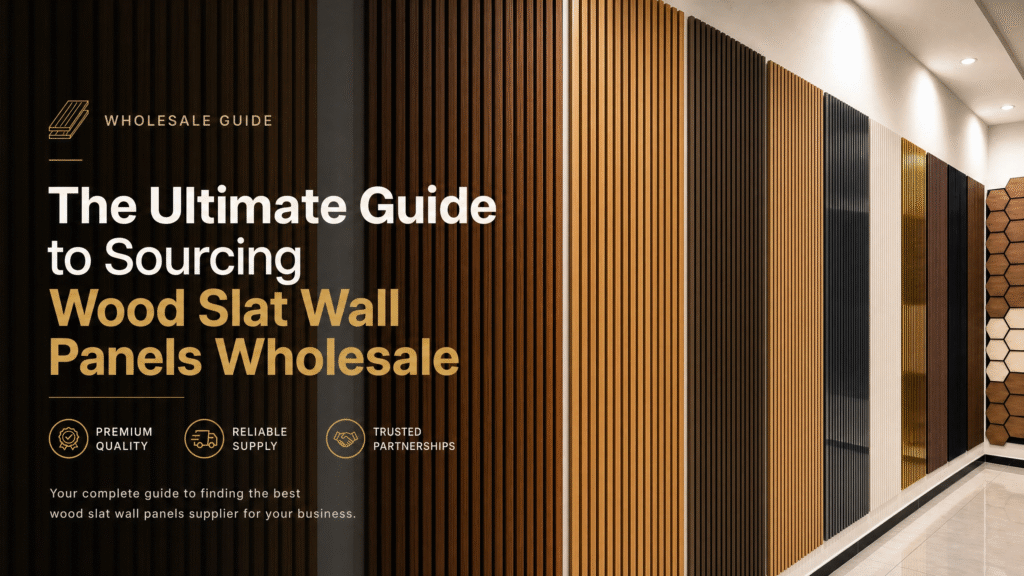
wood slat wall panel wholesale — NF Decor showroom displaying multiple veneer finishes
Whether you are a distributor building a product catalog, a contractor pricing a large commercial job, or a designer specifying materials for a hospitality project, the sourcing decision you make at the start determines your margin, your lead time, and your reputation. Let me walk you through what you actually need to know — starting with the products themselves.
What Types of Wood Slat Wall Panels Are Available for Wholesale Buyers?
Most wholesale buyers assume wood slat wall panels are all the same. They are not. The type you choose affects your price point, your target market, and your installation requirements — and getting this wrong costs real money.
Wood slat wall panels for wholesale fall into four main categories: standard veneer acoustic panels, suede-finish acoustic panels, outdoor composite panels, and flexible wave panels. Each serves a different market segment and carries a different margin profile for distributors.

wood slat wall panel types available for wholesale — from standard veneer to suede acoustic and outdoor composite
Understanding the differences before you place a bulk order is not optional — it is the difference between a product line that sells and one that sits in your warehouse.
Standard Veneer Acoustic Panels
This is the core product in the wood slat wall panel category. A standard panel consists of real wood veneer slats bonded to an MDF substrate, with a black PET felt backing for sound absorption. The veneer options typically include White Oak, Walnut, Black Oak, and Cassia Siamea.
These panels are the highest-volume product in the category and the best entry point for new distributors. They work across residential, commercial, and hospitality applications.
| Specification | Standard Range |
|---|---|
| Panel Size | 2400mm × 600mm (custom available) |
| Slat Width | 14mm, 18mm, 22mm |
| Veneer Options | White Oak, Walnut, Black Oak, Cassia Siamea |
| Felt Backing | Black PET felt, 9mm thickness |
| Certification | CARB P2, CE, SGS |
| MOQ (wholesale) | 50 panels per finish |
Suede Acoustic Panels
Suede panels use a half-round MDF slat profile wrapped in a micro-suede coating instead of natural wood veneer. The result is a softer, more tactile surface that appeals to luxury hotel, high-end restaurant, and premium office fit-out markets.
These panels carry a higher unit price and a higher margin. If you are selling into the hospitality or luxury residential segment, suede panels are worth adding to your catalog. You can learn more about this product in our detailed guide on suede acoustic wood panels.
Outdoor Composite Panels
Outdoor panels use a WPC (Wood Plastic Composite) or aluminum substrate instead of MDF, making them moisture-resistant and UV-stable. These are specified for exterior cladding, covered terraces, and commercial facades.
The outdoor segment is growing fast as architects push the wood slat aesthetic beyond interior walls. Distributors who carry outdoor panels alongside interior panels can offer complete project solutions to their clients.
Flexible Wave Panels
Flexible panels use a segmented MDF backing that allows the panel to curve around columns, arches, and curved walls. These are a niche product but a high-value one — they are often specified for reception areas, hotel lobbies, and feature walls where a standard flat panel cannot be used.
| Panel Type | Best For | Price Tier | Margin Potential |
|---|---|---|---|
| Standard Veneer | Residential, commercial, hospitality | Mid | Medium |
| Suede Acoustic | Luxury hotel, premium office | Premium | High |
| Outdoor Composite | Exterior cladding, facades | Mid-High | Medium-High |
| Flexible Wave | Curved feature walls, lobbies | Premium | High |
Factory Direct vs. Trading Company: Which Is the Better Source for Wood Slat Wall Panels?
This is the question every wholesale buyer eventually asks. The short answer is that factory direct is almost always better for serious B2B buyers — but the full picture is more nuanced than that.
Buying wood slat wall panels factory direct from a Chinese manufacturer gives you lower unit costs, direct access to customization, faster problem resolution, and full visibility into production quality. A trading company adds a margin layer and a communication buffer that increases both cost and risk for high-volume buyers.

factory direct vs. trading company — the key differences for wood slat wall panel wholesale buyers
That said, trading companies are not always the wrong choice. Here is how to think through the decision based on your actual situation.
The Case for Factory Direct
When you buy directly from a manufacturer like NF Decor, you are dealing with the people who actually make the product. This matters in three specific ways.
Price. Factories do not add a trading margin. On a standard wood slat panel order, the price difference between factory direct and a trading company is typically 15–25%. At volume, this is the difference between a competitive price point and a margin squeeze.
Customization. Factories can modify slat width, panel dimensions, veneer species, felt color, and surface finish. Most trading companies pass customization requests back to the factory anyway — adding lead time and a markup in the process. If you need custom acoustic wall panels for a specific project, factory direct is the only reliable path.
Quality control. When there is a quality issue, a factory can investigate the production batch, identify the root cause, and resolve it. A trading company can only forward your complaint and wait.
When a Trading Company Makes Sense
Trading companies make sense when you need small quantities across many different product categories, when you lack the internal resources to manage factory relationships, or when you are testing a new product category before committing to a direct supplier relationship.
For distributors placing regular orders of 50 panels or more per SKU, the economics of factory direct become clear very quickly.
| Factor | Factory Direct | Trading Company |
|---|---|---|
| Unit Price | Lower (no middleman margin) | Higher (+15–25%) |
| Customization | Full flexibility | Limited, slower |
| MOQ | Moderate (50–100 panels) | Often lower |
| Communication | Direct with production team | Via intermediary |
| Quality Control | Direct access | Indirect |
| Certification Verification | Verifiable at source | Requires extra due diligence |
| Best For | Regular volume buyers, OEM/ODM | Small orders, multi-category sourcing |
How to Evaluate a Wood Slat Wall Panel Supplier Before Placing a Bulk Order?
Most sourcing problems are not caused by bad products. They are caused by skipping the supplier evaluation step. A supplier who cannot answer the following questions clearly is a supplier who will create problems later.
Before placing a bulk order for wood slat wall panels, verify the supplier’s certifications, request physical samples, confirm production capacity and lead time, and clarify the quality control process. A reliable manufacturer will answer all of these questions without hesitation.

wood slat panel supplier evaluation — key questions to ask before placing a bulk wholesale order
Here is the evaluation framework I use when assessing a new wood slat wall panel supplier.
Question 1: What Certifications Do Your Panels Carry?
The minimum standard for a serious B2B supplier is CARB P2 (California Air Resources Board Phase 2 — the global benchmark for formaldehyde emissions in wood products) and CE marking for European market compliance. Additional certifications like SGS, FSC, and GRS are positive signals.
Ask the supplier to provide the actual certificate documents, not just a logo on their website. You can verify SGS certificates directly at sgs.com/en/certified-client-directory.
Question 2: Can You Provide Free Samples Before the Bulk Order?
Any manufacturer confident in their product quality will provide free samples. The sample tells you the actual veneer color, the felt quality, the panel flatness, and the surface finish — none of which a product photo can accurately convey. If a supplier charges for samples or refuses to send them, treat this as a red flag.
Question 3: What Is Your Production Capacity and Lead Time?
For a standard order of 200–500 panels, a well-equipped factory should be able to deliver within 15–25 working days after sample confirmation. Ask for the current production schedule and whether the lead time changes during peak seasons (typically Q3–Q4).
Question 4: What Is Your Quality Control Process?
Ask specifically: Who inspects the panels before packing? What is the defect rate tolerance? What happens if panels arrive damaged? A factory with a real QC process will have specific answers. A factory without one will give you vague reassurances.
Question 5: What Are Your MOQ and OEM/ODM Terms?
For standard products, a reasonable MOQ is 50–100 panels per finish. For OEM orders (custom dimensions, custom veneer, private label packaging), MOQs are typically higher. Clarify this before you invest time in a customization discussion.
| Evaluation Criteria | What to Look For | Red Flag |
|---|---|---|
| Certifications | CARB P2, CE, SGS documents | Logo only, no documents |
| Samples | Free samples within 5–7 days | Paid samples or refusal |
| Lead Time | 15–25 working days for standard orders | Vague or inconsistent answers |
| QC Process | Specific inspection steps and defect tolerance | "We have strict quality control" with no details |
| MOQ | 50–100 panels for standard, clear OEM terms | Unrealistically low MOQ with no explanation |
| Communication | Direct response within 24 hours | Slow or inconsistent replies |
NF Decor offers free samples, CARB P2 and CE-certified panels, and a 15–20 working day lead time on standard orders. You can also explore our full range of felt wall panels, hexagon acoustic panels, and 3D wall panels for a complete product catalog.
Conclusion
Sourcing wood slat wall panels wholesale comes down to three decisions: choosing the right product type, choosing factory direct over a trading company, and evaluating your supplier before you commit. Get these three right, and the rest of the process takes care of itself.